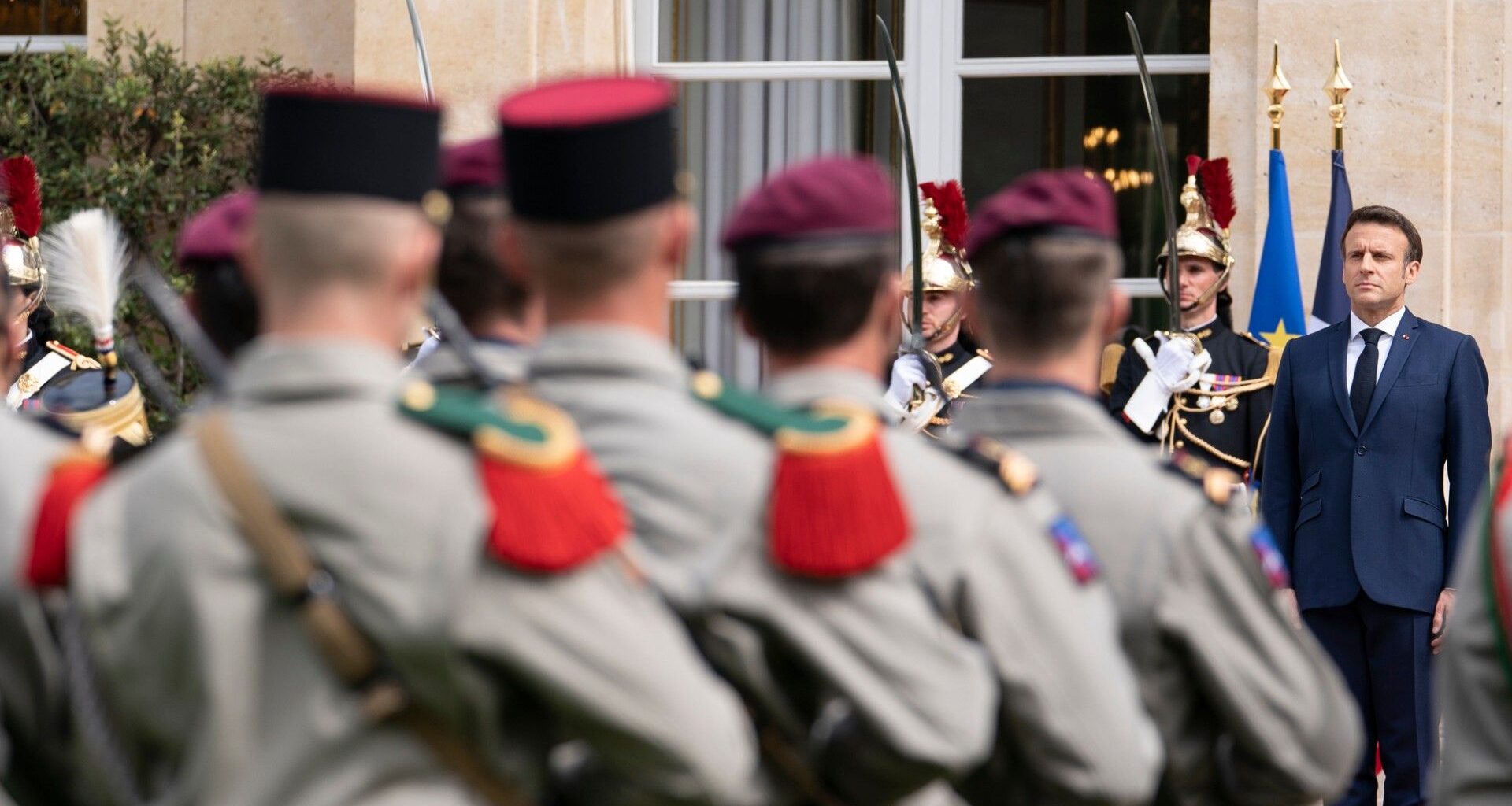
Photo. https://www.elysee.fr/en/
Emmanuel Macron has announced a new ten-month voluntary military national service for young adults (Service national militaire (volontaire); SNM). Fully military, paid, and carried out in operational units on French territory, it is not a return to conscription but an attempt to rebuild civic resilience in a society increasingly detached from defence.
In the past year, willingness among French citizens to defend their country has collapsed. Support for fighting in case of war has fallen from almost half of the population to just above forty percent, and among men under 35 the drop exceeded twenty percentage points. For a country that calls itself the backbone of European defence, this is not a polling fluctuation. It is a fracture between the Republic and its youth that cannot be repaired through procurement programmes or political rhetoric. Macron is not resurrecting the conscription abolished by Jacques Chirac. He is creating a controlled channel where only motivation and utility determine who serves.
The SNM will begin with limited cohorts. Around 3,000 young people will be selected in 2026, moving to 10,000 per year by 2030, and eventually 50,000 by 2035. Participation is open to young citizens aged 18–19, who will enrol after the Journée de mobilisation (the new mobilisation day replacing civic defence day). Candidates will be chosen by the armed forces; there is no automatic entry. Those admitted will receive a uniform, full equipment and a salary close to entry-level soldiers. They will serve under military statute. The structure is simple: a one-month initial formation—discipline, weapons handling, drill, barracks life—followed by nine months embedded inside real units on French soil.
The missions are specific and operational. Volunteers will participate in domestic security and protection tasks, including Opération Sentinelle (France’s internal counter-terrorism and security deployment), population support during crises, base security, and staff duties. They will not deploy abroad, and they will not be used in external operations. The aim is to reinforce the active force where it is physically present and to expose young French citizens to the realities of military service. The state is preparing infrastructure to host them. The launch phase alone is estimated at more than €2 billion in 2026, and the annual running cost is assessed at roughly €1 billion. Macron’s France is not improvising patriotic internships; it is building an institution.
The president describes the reform as the foundation of a hybrid force. The professional army remains the core. The reserve is being expanded to 80,000 personnel by 2030. Behind them will stand annual SNM cohorts: citizens who have lived under discipline, operated within a military hierarchy, and can be reactivated if necessary. This is not nostalgia for the Third Republic’s mass armies. It is a response to a society where responsibility has become optional and duty has been replaced by consumer choice.
Despite the war in Ukraine, France is not preparing to fight Russia. Paris does not believe that a direct military confrontation is realistic, and Macron made this explicit: the SNM is territorial, confined to metropolitan and overseas France. The service is not designed to produce expeditionary battalions. It is designed to produce citizens shaped by the republican ethos. The goal is to ensure that French youth understand service not as ideology or marketing, but as a lived experience. The conflict in Eastern Europe did not create this reform; it made visible how unprepared European societies have become when asked to defend themselves.
Across the continent, the pattern is unmistakable. Finland and Estonia never abandoned conscription. Sweden and Croatia reinstated it. Belgium and Poland are rebuilding voluntary service and reserve pathways. Even countries that publicly reject mandatory service expand integration quietly. Europe is not militarising for war; it is rediscovering the foundational principle of democratic defence: nations that cannot mobilise in peacetime will not mobilise under threat. France has chosen to relearn this lesson before it becomes unavoidable.