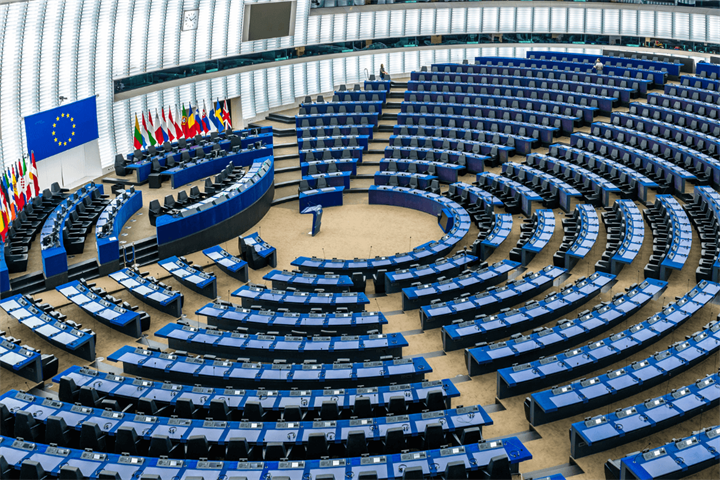
Marrakech – The European Parliament voted Wednesday to support stricter age restrictions on social media platforms, calling for a default minimum age of 16 years across the European Union.
The non-legislative resolution passed by 483 votes in favor, with 92 against and 86 abstentions. The measure aims to protect minors from harmful online content and addictive digital features that lawmakers say threaten young people’s mental health.
“We are finally drawing a line. We are saying clearly to platforms: your services are not designed for children. And the experiment ends here,” said Danish lawmaker Christel Schaldemose, who sponsored the resolution.
The proposal establishes a harmonized EU digital age limit of 16 for accessing social media platforms, video-sharing sites, and AI companions. Children aged 13 to 16 would still be permitted access with parental consent. An outright ban would apply to all minors under 13.
The resolution draws urgent attention to growing concerns about social media’s impact on young users. Research cited in the report indicates that one in four minors displays “problematic” or “dysfunctional” smartphone use resembling addiction patterns. Studies show 97% of young people go online daily, with 78% of teenagers checking devices at least hourly.
Parliament members also called for banning engagement-based recommendation algorithms for minors and eliminating addictive design features. These include infinite scrolling, auto-play videos, excessive push notifications, and reward systems for repeated platform use.
The measure seeks to address what lawmakers describe as manipulative design features inherent to social media business models. The resolution notes that such features undermine children’s well-being, concentration, and sleep patterns.
Several EU countries have already implemented age restrictions. France requires parental consent for under-15s opening social media accounts, though enforcement has faced technical challenges. Germany permits social media use for children aged 13-16 only with parental approval. Italy mandates parental permission for users under 14.
Belgium established a minimum age of 13 for account creation without parental permission in 2018. Norway proposed raising its age of consent from 13 to 15 in October 2024. Denmark’s government recently agreed to implement a 15-year minimum age requirement for certain platforms.
‘Our digital laws are not for sale’
The European Commission has not indicated whether it will pursue formal legislation based on Parliament’s resolution. Any future law would require a full Commission proposal followed by negotiations with EU governments and Parliament.
Commission President Ursula von der Leyen announced plans to establish an expert panel by year-end to advise on protecting children online. She has criticized “algorithms that prey on children’s vulnerabilities with the explicit purpose of creating addictions.”
The resolution draws inspiration from Australia’s world-first social media ban for users under 16, which takes effect on December 10. Violations can trigger fines up to AUD 49.5 million (around $32 million). The EU is studying Australia’s implementation approach.
Parliament also called for personal liability for tech executives like Mark Zuckerberg and Elon Musk in cases of serious non-compliance with EU minor protection rules. The measure would strengthen enforcement of existing digital regulations.
The vote comes amid broader EU debates about tech regulation. Some critics argue the proposal exceeds EU authority over member state competencies. “Decisions about children’s access must be taken as close to families as possible – in the member states, not in Brussels,” said Polish MEP Kosma Złotowski.
French MEP Stéphanie Yon-Courtin defended the initiative against US pressure to soften EU digital rules. “Our digital laws are not for sale. We will not back down on children’s protections because a foreign billionaire or big tech tells us to,” she stated.
The resolution supports developing EU age verification systems while emphasizing that platforms remain responsible for ensuring age-appropriate service design. According to 2025 Eurobarometer data, over 90% of Europeans consider protecting children online an urgent priority.
Most major platforms, including TikTok, Facebook, and Snapchat, currently require users to be at least 13. Child protection groups argue these safeguards remain inadequate, with large numbers of under-13s maintaining accounts across European countries.
Read also: Morocco’s New Social Media Law: HACA to Expand Authority Under Bensaid’s Plan