
Thursday, 27 November 2025, 19:58
| Updated 20:04h.
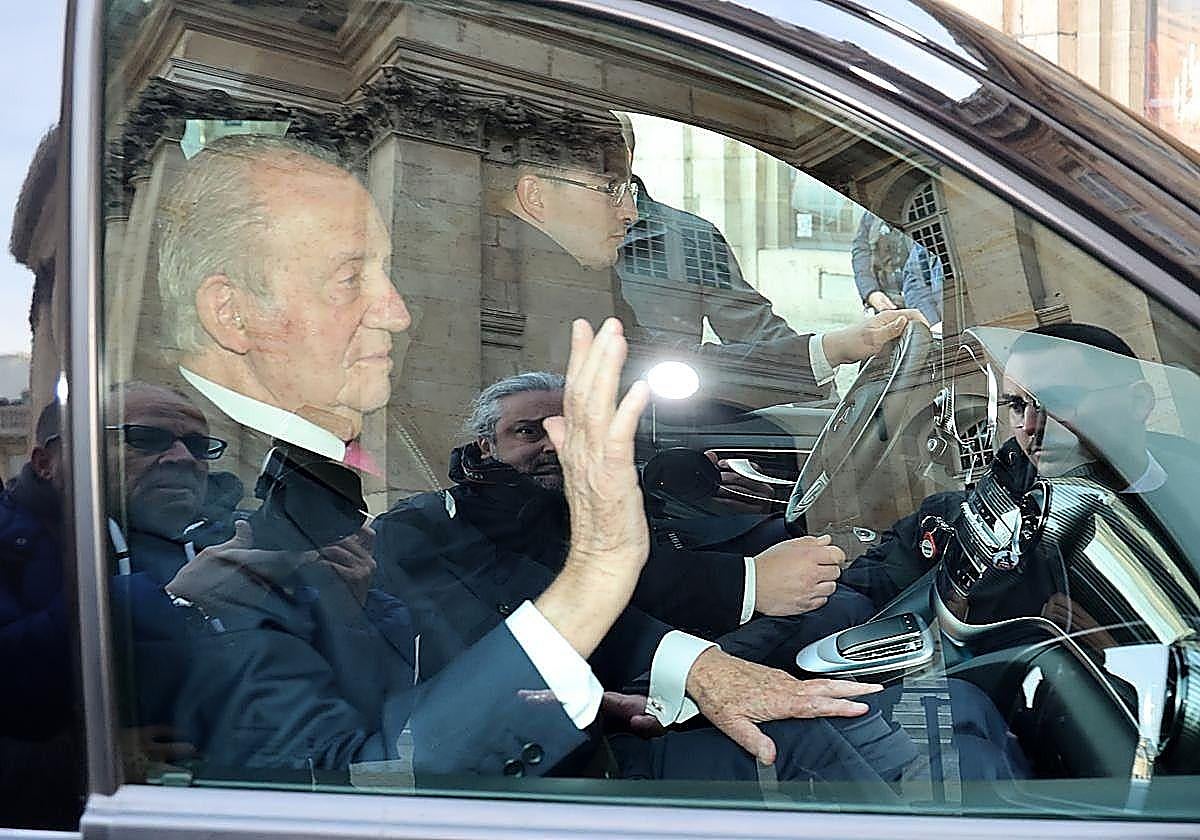
The king emeritus of Spain – Juan Carlos I – has granted public channel France 3 what will, in principle, be his only television interview to promote his memoir Reconciliation, published in French on 5 November. The Spanish edition will be in bookshops on Wednesday, 3 December.
As he does in the book, Juan Carlos I defends his role during Spain’s transition to democracy in the interview, suprisingly without denouncing the infidelities and scandals that marked the last 15 years of his life. Recorded in the UAE, where he moved to live in 2020, the interview was broadcast at 10.50pm on Wednesday on the public channel dedicated to regional news. It is also available online.
The interview does not include any major revelations, nor does the monarch spill significant doses of bile. The content is quite similar to his memoir and the interviewer, well-known journalist Stéphane Bern, who is a specialist on monarchies and royal families, does not ask him about some of the more sensitive issues in that work, such as the king emeritus’ sour relationship with Queen Leticia and his implicit criticism of Pedro Sánchez’s government. Perhaps most interesting are his memories from the end of Francisco Franco’s dictatorship. Juan Carlos I, who is now 87 years old, is in a deteriorated physical state, but he demonstrates his fluent French during the interview.
Franco ‘was aware’ of his intentions
Juan Carlos I says that Franco was aware of his intention to restore democracy in Spain. “He understood very well what the country’s future would be,” the emeritus king tells the cameras of France 3. In the interview, he recounts an anecdote about an interview he gave to a US media outlet before his coronation, in which he spoke about the return of democracy once he became head of state. “I thought (Franco) would be angry with me, but he said: ‘Your Highness, we have to say there (in the US) what we cannot say here (in Spain) and we must say here what we cannot say there,'” Juan Carlos I recounts.
The monarch also talks about Franco’s death on 20 November 1975, the 50th anniversary of which was commemorated last week. “A few days before his death, he asked me to preserve the unity of Spain,” Juan Carlos says, adding that when Chilean dictator Augusto Pinochet travelled to Spain to attend the funeral, he recommended that Juan Carlos I did as Franco had ordered. “But I did the opposite, I finally did what Spaniards wanted,” the king emeritus says.
No remorse for his infidelities
The conversation between Bern and Juan Carlos lasts 25 minutes and deals rather superficially with the infidelities and scandals that led to the king’s abdication in 2014, as well as his decision to move to the UAE in the summer of 2020. “All men make mistakes (…) I’m used to a lot of things being said, everyone can think what they want to think. But all of that has been settled, it’s over,” he says when asked about his affair with German business owner Corinna Larsen and his problems with the tax authorities.
“Do you have any regrets about all this,” Bern asks him. “No,” Juan Carlos replies. “Would you act differently?” the interviewer asks. “Yes, of course,” the king emeritus says. When asked what he is most proud of, he says “having been one of the fathers of the Constitution” of 1978.
The former king does not clarify whether he wishes to return to Spain to spend the last years of his life there. “For the moment, I am very well here (in the Emirates) and I don’t know if in a few years’ time I will return to Spain,” he says, comparing himself to “a lion that adapts to situations”. In the final part of the conversation he expresses his hope that his son (Felipe VI) will reign successfully. “I am very happy with what he is doing (…) He is a good king at a difficult time. The current political moment is very complicated in all countries.”
The interview ends with the emeritus praising France for being “an ally of Spain” and for supporting him at different times. In fact, it concludes with an anecdote about a conversation between Juan Carlos and Philippe Séguin, when the conservative politician was president of the National Assembly (between 1993 and 1997): “I told the president (Séguin) that the music reminded me of something, the moment just before someone’s head was cut off,” the king emeritus says, referencing the drums at an official event that sounded to him like the guillotine.