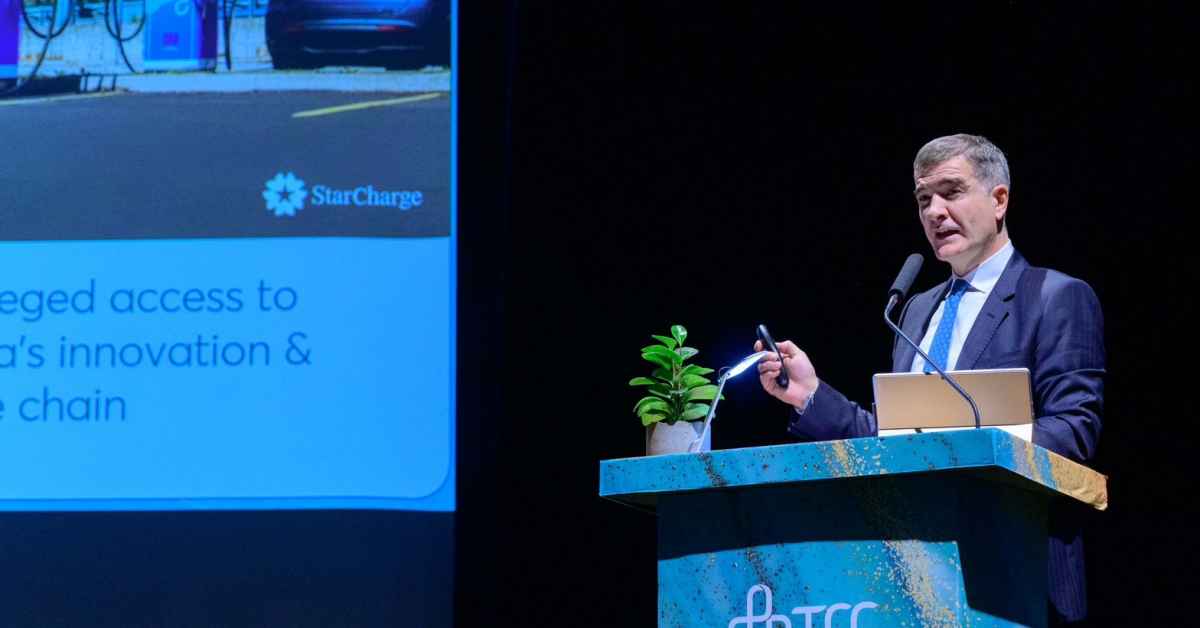
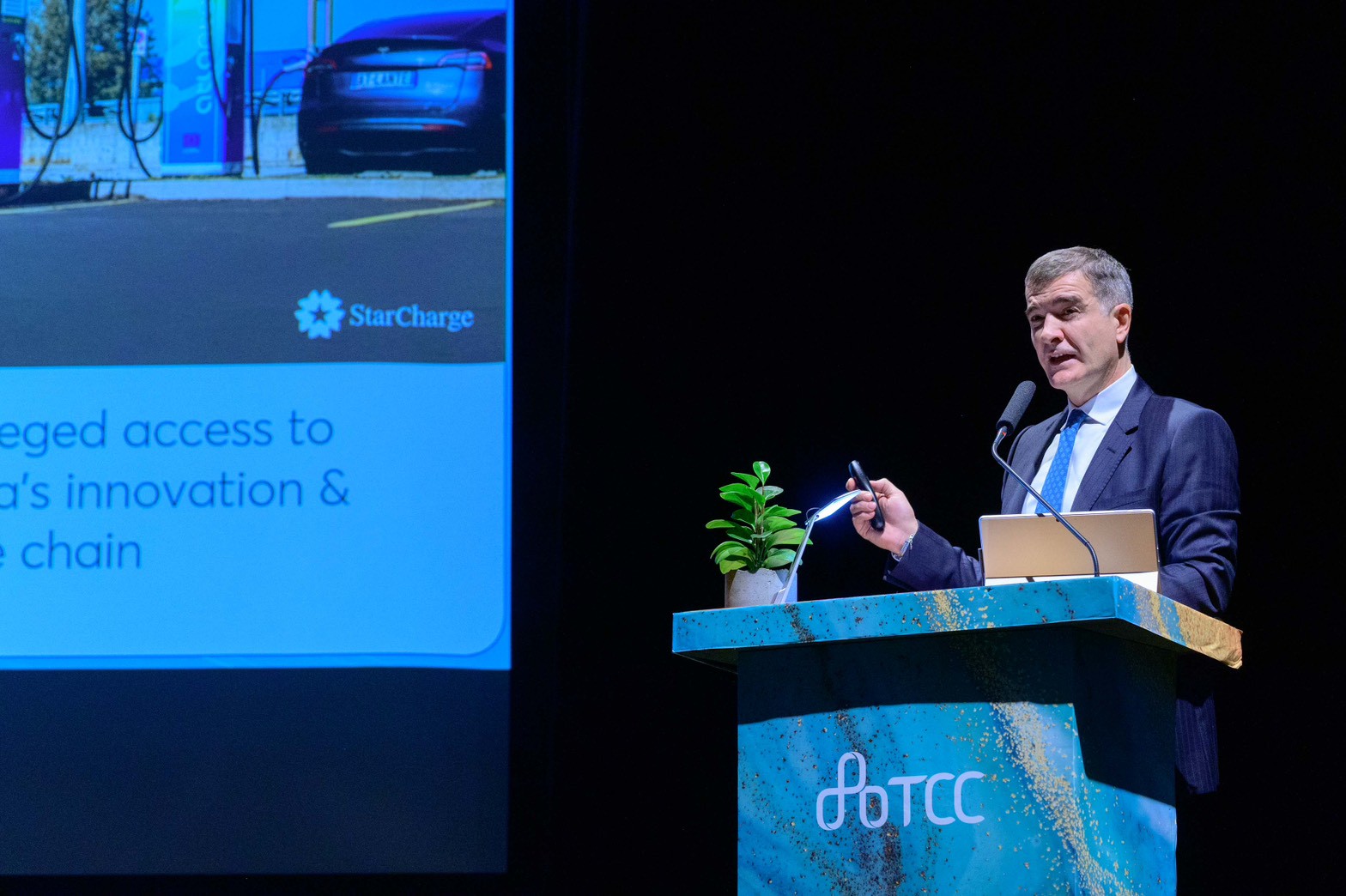
Speaking at TCC Group’s investor meeting on Nov. 27, Atlante CEO Stefano Terranova outlined plans for an accelerated 2026 rollout. (Photo: TCC)
Atlante, one of Europe’s largest EV fast-charging operators, and a subsidiary of Taiwan’s TCC Group Holdings, has unveiled plans for expansion in 2026, including the deployment of more than 200 integrated storage-and-charging systems.
The company already operates over 1,000 charging stations with more than 3,700 charging points across Southern Europe. Speaking at TCC Group’s investor meeting on Nov. 27, Atlante CEO Stefano Terranova said the company is preparing an accelerated rollout next year, supported by its strategic ties with TCC, the custom-built Energy Ark storage system, and strong backing from EU and national governments.
Managing 100% green energy and expanding the continent-wide network
Atlante powers all charging stations with 100% green energy. Although the company operates in markets where renewables already exceed 50% of electricity generation, guaranteeing pure green sourcing still requires dedicated management, Terranova said. The company maintains a specialized green energy team, with at least one expert in each operating country, tasked with navigating cross-border market rules. “In the European market, each country is different, so the solution has to be tailor-made for each country,” he said.
To maintain renewable integrity, Atlante works exclusively with suppliers that produce electricity from 100% renewable sources. In Italy, for example, it sources electricity from Dolomiti Energia, a Dolomites-based energy company whose portfolio consists entirely of hydro and other renewables, Terranova told RECCESSARY.
Even with dedicated suppliers, Atlante still participates in the spot market, which requires careful internal hedging to manage exposure to the region’s extreme price swings. Daily fluctuations can reach up to 180 euros/MWh in markets such as Italy, France, Spain, Portugal, the Netherlands, and Switzerland, said TCC President Roman Cheng (程耀輝). Atlante’s strategy focuses less on managing electricity volumes and more on mitigating volatility, which has become a defining challenge as Europe’s renewable share grows.
Storage is increasingly central to this effort. Atlante currently has 42 storage systems online across four countries, including roughly 20 sites equipped with the new EnergyArk, a storage system designed by TCC specifically for Atlante’s operational needs. Storage allows the company to buy power during low-price periods, such as sunny midday hours with high solar output, and discharge during peak hours, enabling cost optimization despite volatile markets. These storage-integrated stations also feed into Atlante’s Virtual Power Plant (VPP), which participates in capacity markets, frequency regulation, and wholesale arbitrage.
This model underpins Atlante’s role in the ChargeLeague, recently renamed from Spark Alliance, a coalition with Electra, Fastned, and Ionity that operates Europe’s largest fast-charging network with more than 11,000 charging points across 25 countries. Through the ChargeLeague, Atlante contributes to scaling a continent-wide charging ecosystem anchored in renewable power and storage-enabled flexibility.
.jpeg)
Atlante partners with Electra, Fastned, and Ionity in ChargeLeague, Europe’s largest fast-charging network spanning 11,000 charging points in 25 countries. (Chart: ChargeLeague)
Leveraging TCC’s ecosystem and scaling energy storage
Atlante’s relationship with TCC Group offers support that differs from what many European competitors have access to. Terranova said the parent company provides direct access to Asia’s innovation ecosystem, particularly China’s EV charging and battery supply chains. This allows Atlante to benefit from both European public funding and Asian manufacturing capabilities, creating a level of strategic flexibility that rivals backed by automakers or investment funds do not have.
This advantage became clear when Atlante launched in 2021. At the time, there was no commercially available storage product that met its requirements for a compact footprint, minimal installation disruption, high reliability, and strong fire resistance. In response, TCC’s engineering teams developed the Ultra High Performance modular system to overcome Europe’s infrastructure bottlenecks, including slow construction timelines and high labor costs. Terranova noted that the resulting EnergyArk system offers a small footprint and low hassle during installation, which is especially important in premium and space constrained locations.
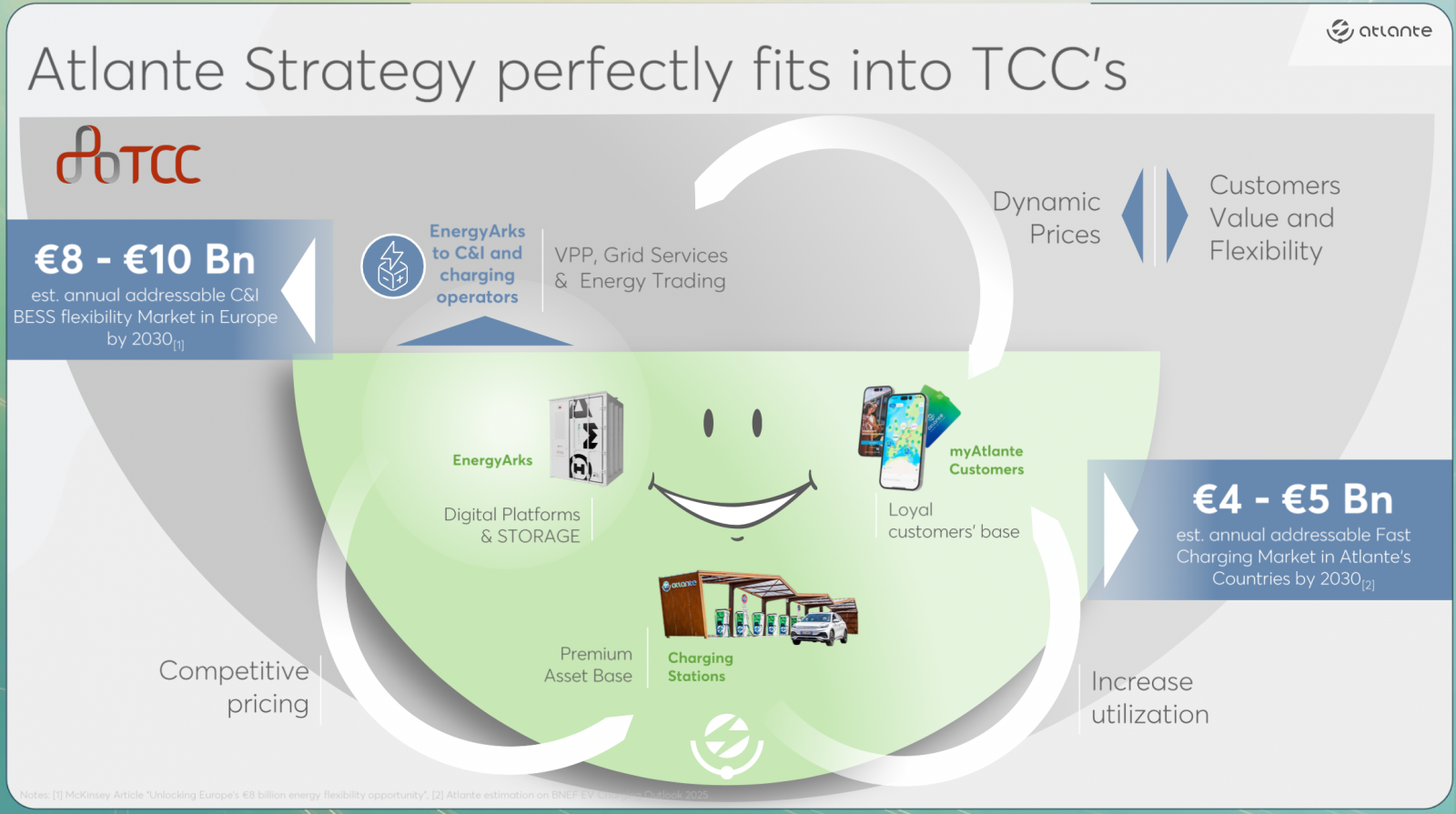
Atlante’s link to TCC gives it a dual advantage: access to European public funding and Asian manufacturing capabilities. (Chart: Atlante)
The EnergyArk is also the world’s first storage cabinet built from low carbon materials, reflecting TCC’s transition from a traditional cement manufacturer to a broader energy and technology group. Atlante is now preparing to scale deployment. According to Cheng, the company has signed contracts for 174 EnergyArk integrated charging systems, forming the foundation for its next phase of expansion in 2026.
Scaling the next phase of Europe’s charging infrastructure
Atlante plans to scale aggressively in 2026, expanding its fast-charging network and deploying more than 200 Energy Ark systems. With more than 2 million connected users and 50,000 customers on its MyAtlante platform, it aims to deepen customer engagement while accelerating growth through the ChargeLeague network.
Heavy-duty electrification is also becoming a core focus. Atlante has five e-truck stations under construction at key border-crossing corridors and eight EnergyArk units already installed to support high-power charging. Three more units are underway, and the company expects to deploy 19 MWh of dedicated e-truck storage capacity by 2026.
Atlante has secured 5 million euros in EU funding for its e-truck program in Italy and recently won the tender for what will become the country’s largest heavy-vehicle charging station. Together with ongoing EU and national support, these investments position Atlante to scale Europe’s next stage of electrification, from passenger mobility to logistics corridors.
As Atlante moves into 2026, it is positioning itself not only as a charging operator but as a key energy player shaping how Europe will power its electric future.
.jpg)