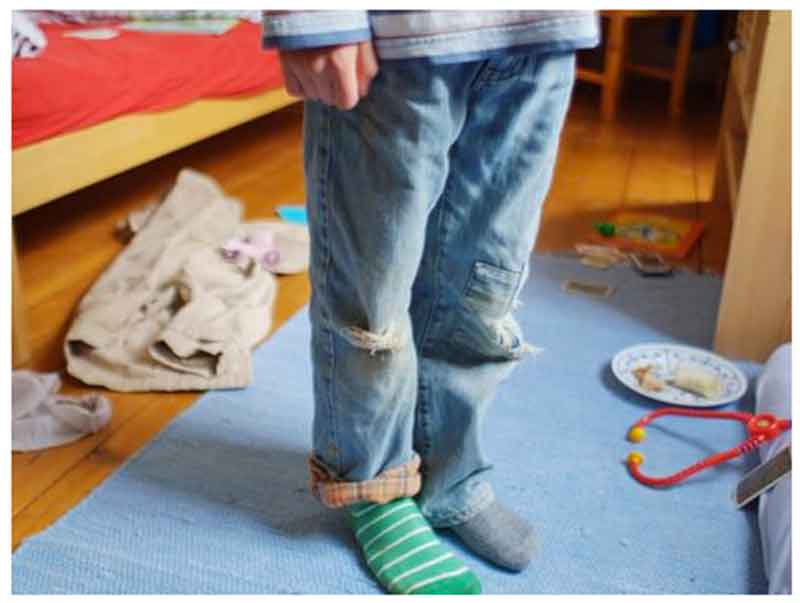
 Screenshot from German public radio: www.deutschlandfunk.de/kinderarmut
Despite the false promises of neoliberal capitalism and its tireless ideological cheerleaders, capitalism has always coexisted with – and at times produced – staggering levels of child poverty. Not even the sacred dogma of “personal responsibility” can hide that fact.
Germany, so often presented as a wealthy nation, exhibits shockingly high levels of child poverty. According to Germany’s own statistical office – to make it all very “official” – every seventh child is already at risk of poverty. That means living right on the edge of the poverty line.
In everyday life, this translates into a broken bed that cannot be replaced, no cinema, no participation in school excursions, and certainly no vacation. Welcome to Germany, 2025.
The raw numbers are devastating: 2.2 million children and young people in Germany are at risk of poverty. These children cannot all have made the “wrong life choices,” they cannot all be lazy, and they certainly cannot all be unwilling to work.
In short: statistics defeat neoliberal ideology. The much-trumpeted notion of “competition” produces not only winners but an entire raft of losers.
Beyond the general dynamics of capitalism, additional risk factors include a social mobility that is hardening into near immobility. Leaving the precariat, the manual working class, or the Lumpenproletariat is becoming nearly impossible.
Worse: the low educational level of parents almost predetermines a child’s future poverty. According to German statistics, 15.2% of all children – or 2.2 million under 18 – are at risk of poverty.
And this is an increase: the previous year’s rate was 14%. These children live with less than 60% of the average “net equivalent income.” In other words, when others have €10, they have €6. When a school trip costs €200, they can pay only €140 – €60.- short.
For a household of two adults and two children, a net income below €2,900 per month ($3,340) means poverty risk. That might look like a lot — but in a high-cost country like Germany, it is not.
Take housing: a random search for a three-bedroom apartment in Frankfurt — for example, in Frankenallee 98 – 102 – shows a Kaltmiete between €820 and €2,800 (excluding heating, gas, electricity). A small 65m² apartment in Frankfurt-Nied costs €1,190. Averaging these figures, one can say such a family might rent a Frankfurt apartment for around €1,500 per month – before utilities.
With an income of €2,900, that leaves €1,400 per month, or €350 per week, or €87.50 per person per week. Not much for life in Germany. Incidentally, a pair of Levi’s 505 jeans on Amazon.de costs €101. Buying one pair of non-luxury jeans means having no money left for food that week.
For single parents with one child, poverty risk begins below €1,800; for a person living alone, below €1,381 per month. The consequences are severe:
19% of children live in households that cannot replace broken furniture;
12% cannot afford a week-long vacation;
5% must forgo leisure activities like sports clubs or cinema; about
3% cannot afford a second pair of good everyday shoes. Between
1–2% of children under 16 cannot invite friends home, celebrate birthdays, or eat fresh vegetables daily.
Germany’s hyper-bureaucratic definition of deprivation involves 17 indicators – and failing three means a child is considered materially and socially disadvantaged.
According to the Statistical Office, more children are at risk than last year. Child poverty in Germany is worsening, not improving. The data is described as “unfavourable” – a polite euphemism for poverty. In some groups, risk levels exceed 40%.
Germany’s rate of 15.5% may sit below the EU average of 19.3%, but that offers no comfort to a child with broken shoes and no breakfast. And compared to last year’s 14%, the increase is significant. Children whose parents have only a secondary school certificate and no vocational qualification face a 41.8% poverty risk. With vocational training or Abitur, it drops to 15.2%. With a master’s-level degree, it falls to 7.2%.
Children of parents with low educational attainment – through no fault of their own – must often do without a second pair of shoes, leisure activities, school trips, adequate living space, or even a one-week annual holiday. Many German workers enjoy six weeks’ leave; poor children stay home.
Child poverty affects every aspect of life. Such children are sick more often, face reduced educational opportunities, and of course endure bullying for not having the latest fashion, a phone, or a flashy school bag for €200.
And when you think it can’t get worse: it does. Over 60,000 children leave school each year without any degree – poverty essentially pre-programmed. They lack support from exhausted parents juggling insecure, underpaid jobs, from overburdened teachers, and from a state more concerned with neoliberal narratives about “welfare dependency” than with real children’s lives.
In short, the outlook for many children in Germany in 2025 is bleak. Many continue to fall behind in chances for a good start in life and any meaningful future prospects. Despite the rhetoric of opportunity, a large chunk of children in Germany have none.
More than one million children lack essential prerequisites for social participation or later professional success. Many do not even have a place to do homework, cannot afford a full meal or even a döner kebab, and rarely join leisure activities with friends.
There are three rather simple truths:
- Capitalism has never cared for all;
- The capitalist systems generate poverty.
- Poverty-free capitalism is impossible.
But instead of confronting the systemic roots, public debate frequently shifts blame onto families. The old trick: blame the victims so capitalism remains invisible. Meanwhile, media capitalism ensures endless talk about economic growth – as if it were infinite and inherently virtuous – while almost no one discusses how this growth is distributed or the structural causes of child poverty.
The resulting stress on children is enormous. Reports show sharp increases in physical and psychological complaints: 40% of young people now report such issues.
Progress on child poverty has stagnated for years. Child poverty hovers around 15% – 14% in 2023. Today, 1.9 million children rely on allowances.
Health problems are rising: in 2022, 40% of 11- to 15-year-olds had headaches, stomach aches, or sleep problems multiple times a week – compared to 24% in 2014.
Worse: many children rate their own mental health and life satisfaction as low. Depending on gender and family income, scores range from 51% to 67%. Financially disadvantaged girls score 51, barely above the threshold indicating depression.
In other words, support from families and schools is insufficient – and internationally, Germany performs poorly. Only 54% of 15-year-old girls report high family support (Switzerland: 69%). Only 26% feel supported by teachers (Norway: 53%).
Overall, one gets the impression that – beyond using children as labour or as consumers – capitalism has little interest in them. Responsibility is conveniently offloaded onto parents, following the neoliberal creed of “individual responsibility” and the classic “blame the victim” strategy.
Germany must act decisively to give children better starting conditions and real prospects. That requires targeted investment in disadvantaged children and strengthened family resources – expanded school support programmes, improved day-care strategies, and a comprehensive plan to reduce child poverty.
Subscribe to Our Newsletter
Get the latest CounterCurrents updates delivered straight to your inbox.
Born on the foothills of Germany’s Castle Frankenstein, Thomas Klikauer is the author of over 1,100 publications. He writes for ZNet, Countercurrents, and Cross Border Talks (CBT: as a columnist). His homepage is: https://klikauer.wordpress.com/.