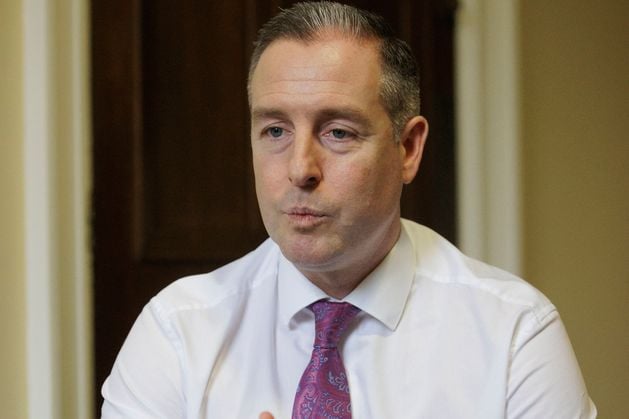
In a letter to principals, Paul Givan admitted his department will look to reform the RE syllabus in the wake of the judgement.
The Supreme Court ruled that RE had not been taught in an “objective, critical and pluralist manner, that collective worship was similarly not conveyed in such a way” in schools and that the Christian-focused RE taught in Northern Ireland was unlawful.
The Minister has now informed schools that while the judgement was “complex”, it remained the case that schools “have a legal requirement to hold collective worship like assemblies each day”.
Last Wednesday’s ruling by the UK Supreme Court had brought a long running case taken by a anonymous father and daughter from Belfast to a close.
In 2022, the High Court in Belfast had ruled that the Christian-based RE taught at primary schools in Northern Ireland was unlawful. However, the Department of Education then won an appeal against that judgement.
But last week the Supreme Court unanimously allowed the father and daughter’s subsequent appeal and dismissed the Department’s cross-appeal.
A spokesperson for The Department of Education had said: “We will carefully consider the complex judgement and its implications and will provide advice to schools in the near future.”
And Mr Givan has now informed schools that the Department has “requested further legal advice to understand the full implications of the judgment”.
Informing schools they are expected to continue following the legislation by “teaching religious education based on the Holy Scriptures,” he added that “the area of collective worship requires further consideration.
“While parents have the right to withdraw their child, the Supreme Court found that current arrangements did not meet legal requirements,” he said.
The court had also ruled that exercising the right to withdraw a child from RE lessons and worship could place an undue burden on an objecting parent.
The judges stressed the case was “not about secularism” in education and insisted that no-one was suggesting that RE should not be provided in schools.
Mr Givan added that judgement “recognised that Christianity is the main religion in Northern Ireland, and the greater part of RE would still focus on knowledge of Christianity”.
He said that schools can expect “further comprehensive and legally sound guidance” soon, but that the department had now “requested further legal advice to understand the full implications of the judgment”.
While unionist politicians, notably from the DUP and TUV, had expressed disappointment at the Supreme Court ruling, Reverend Andrew Forster, the Bishop of Derry and Raphoe and Chair of the Transferor Representatives’ Council (TRC) said his organisation “will take some time to consider the ruling”.
“The judgement brings a long court process to a conclusion and once the ruling is considered,” he added.
“We hope it will provide clarity and direction in respect of both the teaching of religious education and collective worship in schools.”
The leader of Northern Ireland’s humanists, Boyd Sleator said the ruling provided “a great opportunity” for the Department of Education to revisit and re-write the curriculum, while Bishop Donal McKeown, from the Council for Catholic Maintained Schools said: “Northern Ireland has changed a lot since the last core curriculum was put together. This is an opportunity for all of us to be involved in renewing the RE curriculum to enable us to create a healthy, forward-looking society.”
TUV leader Jim Allister had called the verdict ‘deeply disturbing’ and “an affront not only to teachers and parents but to the Christian foundations upon which our education system has long rested,
He said the court ruling was “another insidious elevation of rights of non-Christian parents over those of Christian parents.”
Mr Allister also urged the Education Minister to “protect Christian values in our schools” and he was joined in criticising the judgement by DUP deputy leader Michelle McIlveen, a former Education Minister, who said the ruling was “deeply disappointing,” and “would “concern many parents, governors, teachers and faith communities for whom the ethos is so important”.
David Smyth, Head of Evangelical Alliance NI, though, added that: “This is not suggesting that religious education should not be provided in schools in Northern Ireland. Nor is this the end of Christian collective worship in schools
“Schools will continue to teach about Christianity but may be required to do so in a more objective, critical and pluralistic manner. This is not a moment for fear.”
In the Assembly earlier this week the Minister told MLAs: “We have parents contacting schools demanding that Nativity plays are cancelled. Not just in light of this Supreme Court judgment but years before this has happened… I can give an absolute, categorical answer: Nativity plays can continue to take place within our schools.”

Education Minister Paul Givan at his office in Parliament Buildings at Stormont.
News Catch Up – Friday 28 November
Mr Givan added that school principals had contacted his department seeking advice on the issue, which he has now provided, pending the further exploration of legal implications.