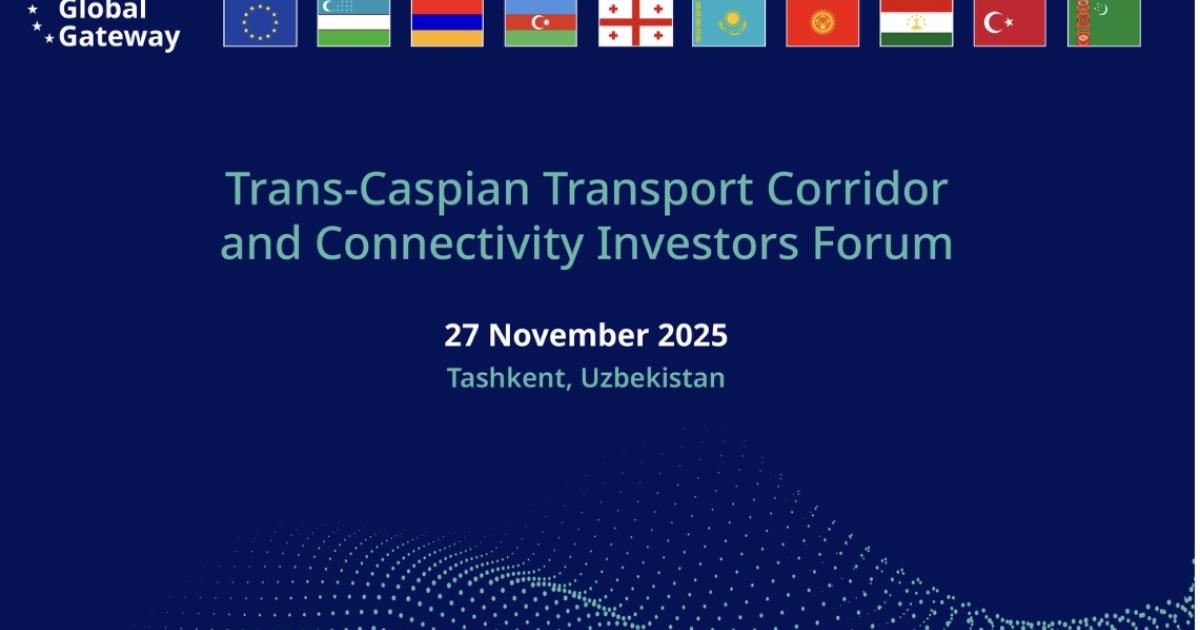
Tashkent, 27 November 2025 – the Trans-Caspian Transport Corridor (TCTC) and Connectivity Investors Forum concluded with a positive signal of joint ambition from the European Union, South Caucasus and Central Asian countries, Türkiye, International Development Banks, the private sector and regional partners. The Forum demonstrated how the Global Gateway strategy is moving from vision to delivery, with new cooperation mechanism and investments discussed to strengthen transport links, improve trade flows, and build a more resilient, sustainable, and interconnected region. In her opening speech, Commissioner Kos underscored the importance of the discussions with regional and international partners in Tashkent as a milestone to advance a comprehensive Connectivity Agenda for Central Asia, the South Caucasus and the Black Sea Region.
Throughout the event, participants reaffirmed the strategic importance of the TCTC as a fast, secure and reliable route connecting Europe and Asia. Discussions focused on cross-regional connectivity and transport links between the EU and Central Asia.Participating countries shared their ongoing investment efforts as well as future plans. These deliberations were deepened in a Transport Ministerial meeting and a high-level panel, including the EU, IFIs and Ministers from Central Aisa and the Southern Caucasus. Participants emphasised the need for coordinated action and prioritisation of key investments to remove logistical bottlenecks, harmonise regulations, and scale up high-impact infrastructure investments. The discussions during the event were a big step forward in view of the implementation of the connectivity agenda and showed, despite all challenges, which opportunities a coordinated action could bring for all partners. Participants, in particular fromIFIs and private sector, underlined the need for advancing digitalisation and align customs and border procedures. Discussions were informed by the EU-funded meta study which presented corridor-wide connectivity recommendations for key investments which will serve as a basis for future consultations with the partner countries and other key stakeholders, like IFIs and the private sector.
The bilateral and regional investment agreements announced in Tashkent in the presence of the European Commissioner for International Partnerships Jozef Síkela and the European Commissioner for Enlargement Marta Kos reflect an important step forward in enhancing multimodal connectivity and supporting the long-term economic and social development of the region. They collectively underline the EU’s long-term commitment to a modern, resilient, and prosperous South Caucasus and Central Asia, built on shared values, sustainable development, and trusted partnerships. In particular, Commissioner Kos announced the Caucasus Transmission Network, a landmark energy infrastructure project with the German development bank KfW.
The event concluded with a press conference. The Minister of Transport of Uzbekistan Ilhom Makhkamov, Commissioner Síkelaand Commissioner Kos delivered press remarks and responded to questions from local and international journalists.
Background
Cross-Regional Security and Connectivity ministerial meeting – October 2025
Global Gateway – European Commission
Trans-Caspian Transport Corridor and Connectivity Investors Forum
Caucasus Transmission network
The EU, together with the German development bank KfW and the European Investment Bank, supports the Caucasus Transmission Network—a key energy infrastructure project that will strengthen Armenia’s energy security and diversification. With a total estimated cost of over EUR 500 million, the project will expand Armenia’s ability to trade electricity, especially from renewable sources, reduce its reliance on external grids and enhance overall grid stability. By reinforcing cross-border links, the initiative will also advance regional energy cooperation and contribute to a more integrated and sustainable energy market in the South Caucasus.