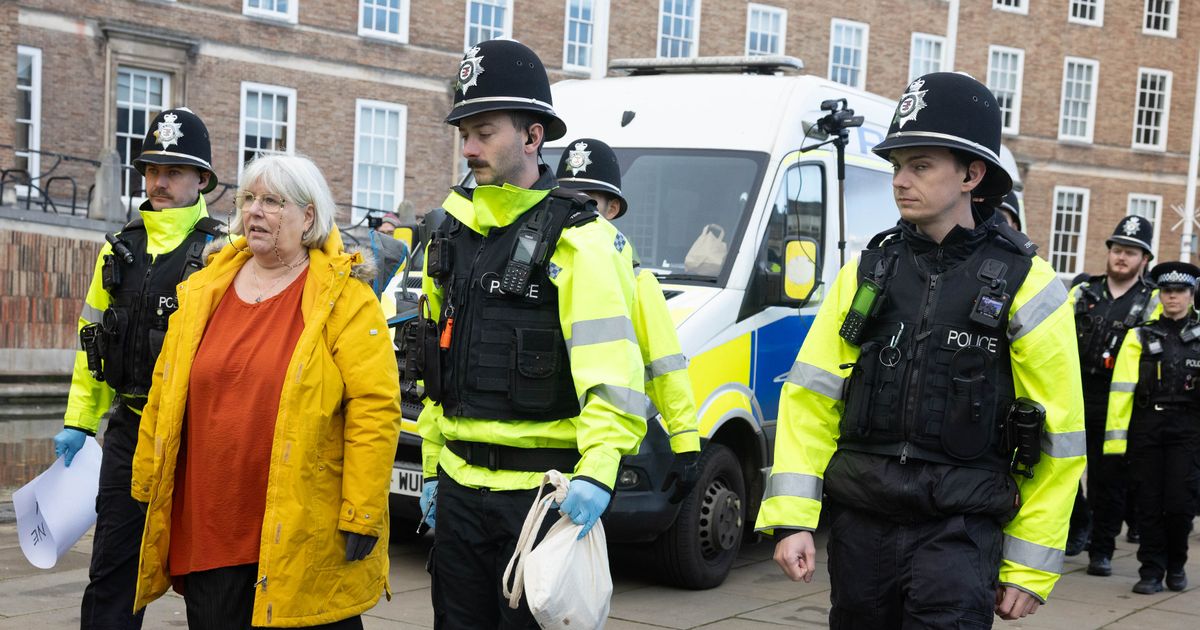
Elderly protesters wrote illegal signs to get themselves arrested
17:42, 29 Nov 2025Updated 17:42, 29 Nov 2025
More than 30 people were arrested by police in Bristol today as part of a co-ordinated nationwide campaign calling for the ban on protest group Palestine Action to be dropped by the Government. A total of 29 people were arrested for holding up signs expressing support for the proscribed group, while two more were detained for separate offences.
The protest and the arrests used a huge amount of police resources – a total of 16 police vans were on standby around the protest site in the city centre throughout the afternoon – and a large number of officers were required to make the arrests.
The protest, organised by Defend Our Juries, began at 1pm. Protesters, most of whom were in their 60s and 70s, lined up along the ornamental water feature in front of City Hall on College Green, sat down and wrote on placards the words: “I oppose genocide I support Palestine Action”.
The group, which has its roots in the long-running direct action protests against Elbit Systems in Filton, Bristol, was proscribed as a banned organisation under the Terrorism Act 2000 by the UK Government back in June after its members broke into an RAF base and tried to disrupt military flights.
The group had said it is actively trying to stop the Israeli military action in Gaza, which it says is genocide, but in the summer, the Home Secretary and Parliament added the group to the list of proscribed organisations alongside the likes of Hezbollah, al Qaeda and far-right neo-Nazis National Action.
On College Green, a large number of police officers swung into action within minutes of the protest beginning. One by one, each protester sitting quietly with their placard was approached and advised that expressing support for Palestine Action was an offence, and they would be arrested.
READ MORE: Live: Huge Palestine Action protest in Bristol city centreREAD MORE: Mass arrests likely at Bristol protest today as campaigners challenge Palestine Action ban
Each person was then arrested and taken to a waiting police van nearby. If the arrested person did not agree to walk to the van, they were picked up by at least four police officers and carried. Each time an arrest was made, a large group of fellow-protesters, who were not sitting with signs, cheered and clapped, and someone rang a bell to indicate another arrest.
Two people were arrested by police outside the sit-down sign protest for public order offences.
The first arrest took place just after 1.15pm, and the 29th and final arrest was made at 4.26pm, over three hours later. Among those arrested was 75-year-old Sir Jonathon Porritt, from Cheltenham, the prominent environmentalist and author, who said nothing as he was led away. Sir Jonathon, a former advisor to the then Prince Charles, now King of England, has been arrested before at a similar protest in London in August this year.
The Bristol protest happened simultaneously with protests in Exeter – although no arrests were made there – and other towns and cities across the UK, including Birmingham, Sheffield, Edinburgh and Cardiff.
Defend Our Juries have mounted a legal challenge to the UK Government’s decision to proscribe Palestine Action, which is ongoing at the Court of Appeal in London last week and next.
The campaign group described the action to provoke mass arrests as the ‘most widespread wave of civil resistance in modern UK history’.
“This historic wave of action has seen people of courage and conscience taking action to resist the government’s clampdown on our fundamental rights to protest and free speech,” said a spokesperson for Defend Our Juries.
“In the face of our government’s steadfast support for Israel as it carried out war crimes, collective punishment and genocide, Palestine Action were the one group who made a material impact by hitting the profits of companies supplying hardware to Israel’s killing machine.
“In court this week the government has had to try and defend the proportionality of the ban. Yet it hasn’t been able to offer any argument that proscription was in the public interest. Repeated statements by government barristers make it clear that it was simply to protect the profits of arms companies.
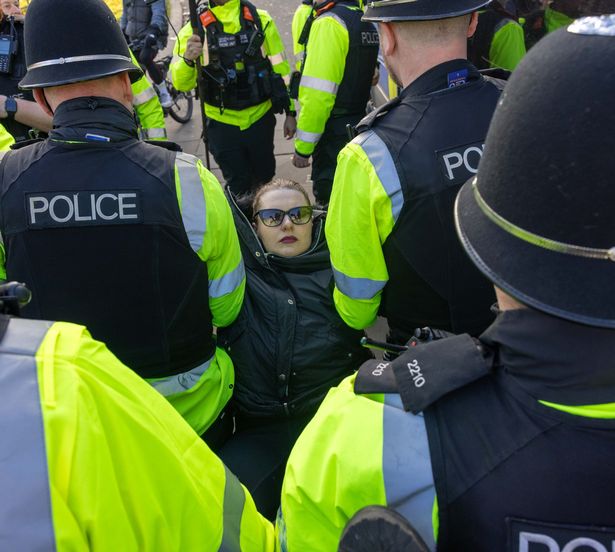 One of those arrested for displaying a sign in support of proscribed group Palestine Action is carried away by police at College Green in Bristol(Image: PAUL GILLIS / Reach Plc)
“The ban was never in the public interest as Palestine Action never posed any threat to the public. Conflating property damage with terrorism, as the Terrorism Act 2000 does, is an insult to everyone who has lost loved ones through acts of genuine terror,” they added.
“The proscription of Palestine Action was an act of authoritarian overreach whose only purpose was to protect Israel, the arms companies supplying its genocide, and the government ministers who have been so shamefully complicit in that genocide,” he added.
READ MORE: Bristol Labour councillor defects to the Green PartyREAD MORE: Kneecap review – Bristol frenzy as Irish trio put on gig like no other
Before the protest, Avon and Somerset police said they had a clear plan in place to deal with the possibility of a ‘mass arrest’. A spokesperson said they would be attending to ‘enable lawful and peaceful protest’.
Those taking part were reminded by police that ‘expressing support for a proscribed group’ is a criminal offence under the Terrorism Act 2000.