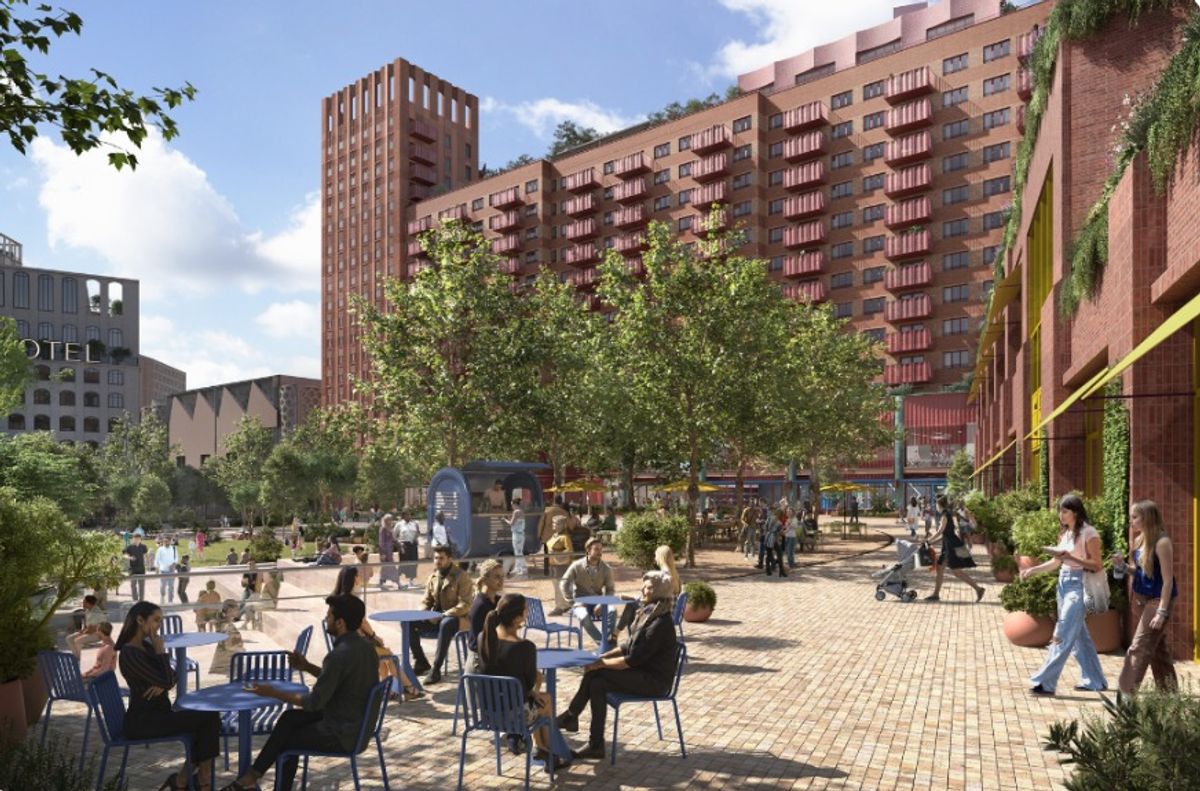
The enormous project is set to transform the former wholesale market site, turning it into a landmark destination in the city centre.
The plans, which were given the green light by council planners last year, include proposals for homes, retail space, civic squares, a market complex, leisure facilities, a park and more.
Earlier this week, the city council confirmed archaeological works have begun at the site of the scheme, marking an “important new phase” for the £1.9bn regeneration project.
 A visualisation of the Birmingham Smithfield regeneration scheme. Taken from Birmingham Council website.
It says an investigation, led by Cotswold Archaeology on behalf of the council and development partner Lendlease, will provide an insight into Birmingham’s medieval past.
The area being explored sits just north of the city’s former moated manor, once home to the Lords of Birmingham.
“Any findings will be carefully documented and preserved in line with national guidance,” the council said.
 CGI of Manor Square in Smithfield, Birmingham. Taken from planning application\\\’s design and access statement.
The investigation is set to be carried out until mid-December 2025 before redevelopment begins early next year, it added.
Selina Mason, director of masterplanning for Birmingham Smithfield Lendlease, said momentum was “really building” at the project.
“This excavation marks another important step forward,” she said.
“The medieval manor and market is at the heart of Birmingham’s most historic area, it helped shape the city we know today and honouring that heritage is central to Birmingham’s regeneration.”
Coun Sharon Thompson, deputy Leader at Birmingham Council, described Smithfield as “one of the most significant regeneration projects” in the city’s history.
“We are committed to ensuring that its future is built on a deep respect for its past,” she said.
“These archaeological works give us a unique opportunity to uncover and celebrate the city’s medieval heritage before redevelopment work begins to deliver new homes, jobs, and vibrant spaces for generations to come.”
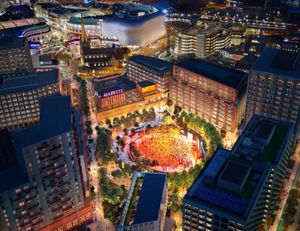 CGI of the Smithfield development, with Manor Square in the centre. Taken from a design statement included within the planning application‘Wider pressures’
There’s been a huge amount of optimism surrounding the project and the positive impact it could have on the city.
But financial challenges have seen a number of proposals squeezed, an outline business case revealed earlier this year.
The Art Shed cultural building and the Round House music venue for example is now set to be incorporated into a single building rather than two separate structures.
The council said it needed to reduce the funding requirement, as requested by government-appointed commissioners, who were sent in to oversee the authority’s recovery after it declared itself effectively bankrupt in 2023.
“To address the budget shortfall the council set a principle not to commit to any new prudential borrowing and to consider any new investment in regeneration projects on a case-by-case basis,” the outline business case said.
“In September 2024, the commissioners did not support the £209m EZ [Enterprise Zone] funding ask for the Smithfield proposal and requested that the EZ gap funding ask be eliminated or reduced to the minimum.”
The requested funding linked to the Enterprise Zone, which invests in projects and initiatives that drive economic growth, is now £172.8m according to a report over the summer.
The council said the changes could not have been foreseen at the time of procuring development partner Lendlease and highlighted “wider, viability pressures” arising from the higher levels of inflation recorded during 2022-24.
The outline business case continued: “To assess if Lendlease’s proposal is still the most economically advantageous when compared to the final tenders of other bidders cannot be accurately and fairly benchmarked.”
It said other bidders would have also needed to change their proposals to respond to the “challenges” which Lendlease had faced.
“As such, with all things being equal, the council still considers Lendlease’s proposal as being the most economically advantageous bid,” it continued.
The city council has faced financial turmoil due to Birmingham-specific factors such as an equal pay fiasco and the disastrous implementation of an IT system, as well as other issues such as the rising demand for services and funding cuts.