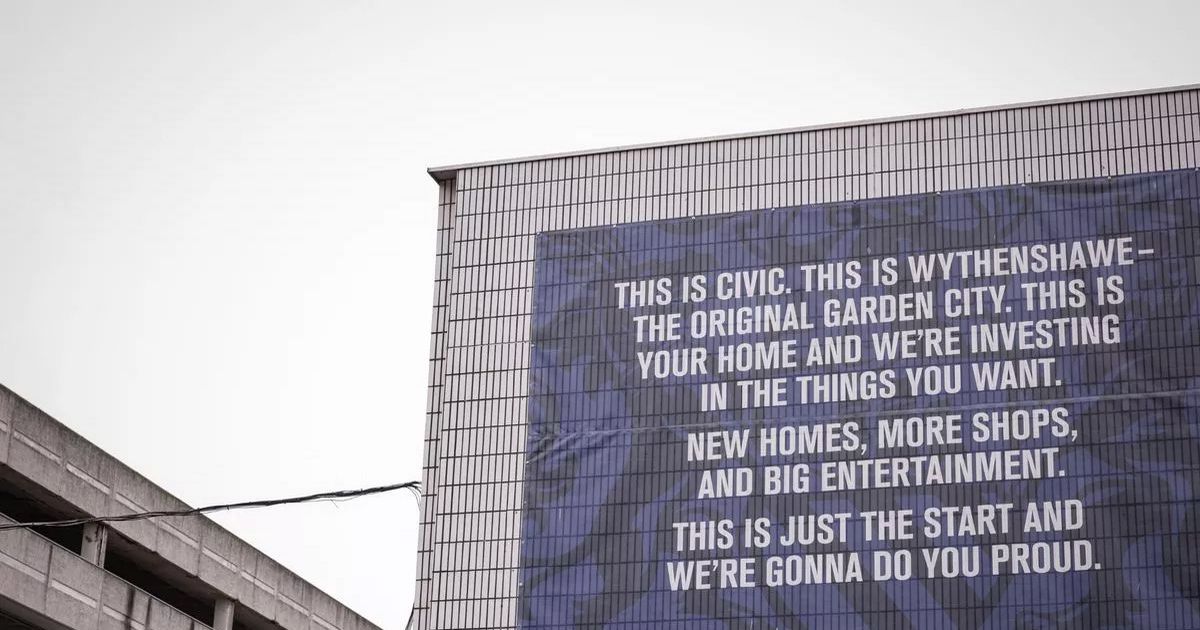
Campaigners say Wythenshawe’s £500m revamp has ‘a real sense of gentrification’, but Manchester council points out that it’s building 422 all-affordable homes to kick the project off. Ethan Davies reports on the battle for the garden city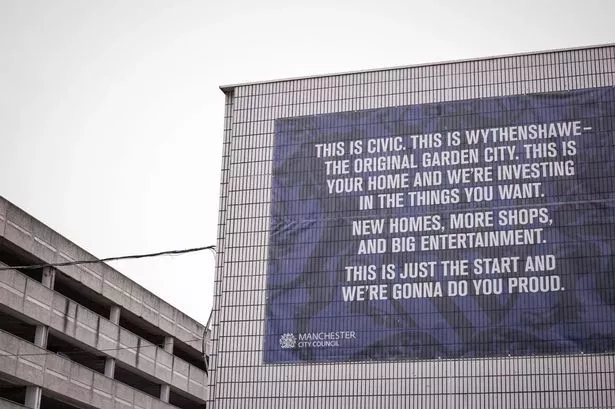 (Image: Manchester Evening News)
Forty words have loomed over Wythenshawe’s civic centre for more than a year.
They’re on a council banner promoting its impending redevelopment. In three short sentences, copywriters highlight it’s the ‘original garden city’, upsell the regeneration, and make a promise to Wythenshawe’s 100,000 residents: “This is just the start and we’re gonna do you proud.”
It’s a big promise for a town that needs a big lift.
Most of Wythenshawe town centre is in the worst 20pc for deprivation in England. The area covering the civic is in the bottom 2pc.
But Wythenshawe’s also got a lot in its favour. It’s close to the Airport, a huge employer. It’s well-connected by bus and tram, and only a short hop to the motorway. Its park would be envied by countless Greater Manchester suburbs. And its garden city layout means there are a lot of family houses with greenery.
That’s why Manchester council is investing big here. Half-a-billion pounds will flow into the town centre — promising thousands of new homes, culture hub, food hall, and revamped public square — to ‘create opportunities’ for residents to ‘share in Manchester’s economic success’, Bev Craig said announcing the project last year.
 (Image: Muse)“It’s a bit eastern European… we will bring the garden city back”
The dream’s about to become reality: Formal planning applications for 422 new homes, all for social rent, will be submitted ‘imminently’. Progress is expected to be quick: Within 18 months, the food hall and culture hub will be open.
The broad idea is to get people into the town centre and make it a vibrant place once more, Joe Stockton explained to the Local Democracy Reporting Service on a recent tour.
“There will be a lot more activity to make it a completely different environment,” Mr Stockton, a manager at Muse, the company Manchester council has partnered for the redevelopment. The food hall and culture hub cafe will have ground-floor seating to ‘spill out’ into a new square.
“Costa is always busy,” he added. “There’s very few options to sit down and enjoy it. There’ll be a new public square.”
But scattering tables and chairs across the civic won’t be enough to bring the masses in, both Mr Stockton and executive councillor for development Gavin White, accept.
 (Image: @Manchester Libraries and archives)
The civic opened in 1963, when concrete was architects’ material of choice. Its liberal use in the 60s was hit-and-miss: It gave Manchester a new landmark in Piccadilly’s City Tower, designed to emulate a circuit board. It also gave Mancs the Church Street multi-storey, a monstrosity the council now plans to pull down.
Concrete, combined with typical Mancunian cloud, gives Wythenshawe a persistent drabness even bright shop signs can’t shake. It feels like a place where you come to run errands efficiently, not ‘linger’ for long periods catching up with loved ones.
“It’s a bit eastern Europe,” Coun White admitted. “The civic has lost that ‘garden city’ element.”
“That was to combat anti-social behaviour in the 90s,” he added, glancing at the imposing black gates, locked nightly until recently.
 (Image: Manchester Evening News)
That’s why the project aims to ‘bring the garden city back’, Coun White added. Trees are in, those gates are out, and new paving will go down.
It’ll be flanked by 422 flats and townhouses, all available for social rent, set to be built where offices Brotherton House, Alpha House, and C2 The Birtles are now.
The civic’s regeneration sounds great on paper, but there are worries under the surface.
“People living here for generations will lose out”
“The big fear is that Wythenshawe will be an offshoot of the Airport,” Kate Maggs, chief executive of Woodhouse Park charity Better Things, explained. She’s a member of the Wythenshawe Central Network (WCN), campaigning for more affordable housing and new disabled supported housing.
She added: “All these houses will go up mainly for people working at the Airport and people living here for generations will be the ones to lose out. There’s a real sense of gentrification.
“What we are asking for is 40pc of affordable housing, the council has committed to 30pc.”
Another WCN campaign is to give residents more of a say in the regeneration, Rev Dr Kate Gray said: “I think there’s a sense they do not feel listened to about that. That’s a concern of mine.
“It’s not that people are consulted so they are done to, but they join in the existing processes set up by the organisations.”
However, Rev Dr Gray added Muse ‘are not being tokenistic’, but need to do more: “It’s moving at pace. It’s a risk to devolve power and co-designing work. That’s part of it.
“But since we have the expertise and are well placed, we can respond to that with the structures we already have in Wythenshawe.”
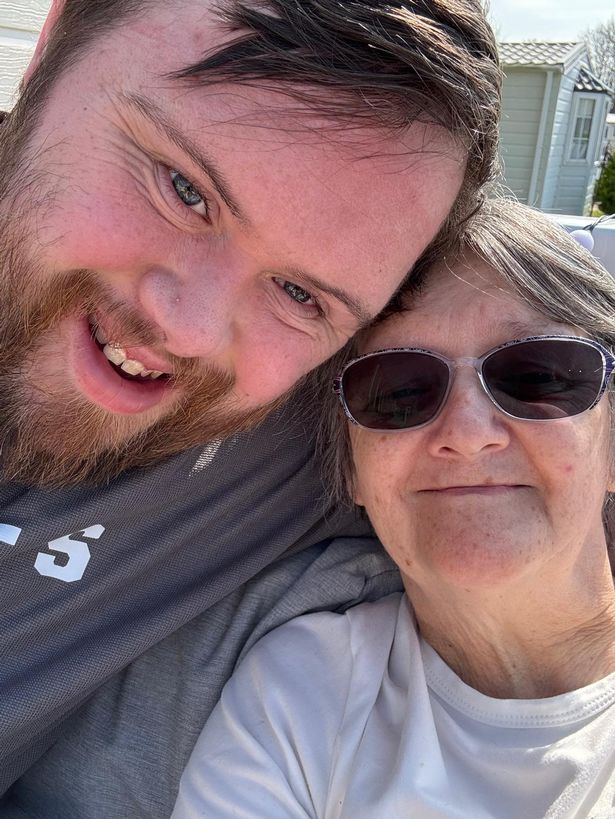
One WCN suggestion is planners incorporate specially-designed housing for people with autism and learning disabilities who need some support, but not residential care. It’s something Sue Thomas-O’Flaherty — mum to Declan, her 28-year-old son with Down’s Syndrome — wants.
 (Image: Sue Thomas-O’Flaherty)
“Something similar to Village 135 we feel would work for adults with learning disabilities or autism that do not need intense support,” the 60-year-old said. “Manchester council say they want to provide housing for all people.
“They say they want to create a truly equal and inclusive city. In order to do that, they need to listen to people who want to stay in Manchester.
“You could have someone growing up in Wythenshawe going to north Manchester or further because of a lack of provision. They would be taken away from their family and things they access in their community and their friends.”
The LDRS understands Manchester council is discussing how local housing associations could support disabled people who need extra care on-site in Wythenshawe. A spokesperson added that, because the first 422 homes will all be available for social rent from Wythenshawe Community Housing Group, at least 20pc of the regeneration’s estimated final total of roughly 2,000 homes are already affordable — and more will come.
A spokesperson for Muse added: “Already the feedback we’ve had has helped shape the plans. People said they wanted to see affordable homes and that’s exactly what we are delivering in the first phase. But it doesn’t stop here. This is a 10–15-year regeneration masterplan and the consultation will be ongoing throughout.”
 The battle for the garden city
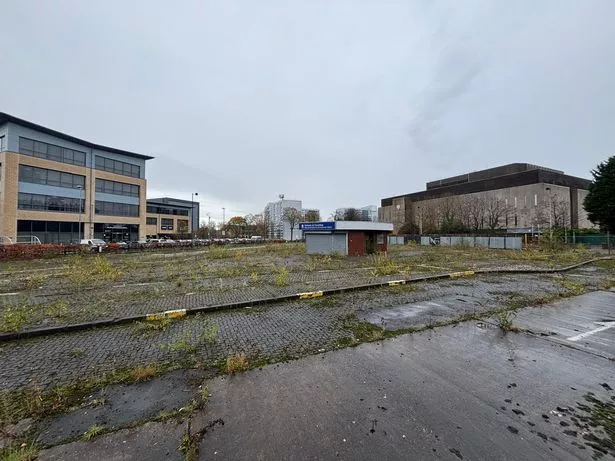
Just behind the civic is Wythenshawe’s old bus station which closed a decade ago. Overgrown and filled with debris, it looks like a post-apocalyptic go-kart track.
It also serves as a reminder there is a lot of land waiting to be used — either as offices to help Manchester’s economy, homes to ease the 19,000-strong social housing waiting list, or greenery to give people space to breathe.
All sides of the Wythenshawe debate agree the land needs to be used. What it’s used for remains a battle in the garden city.