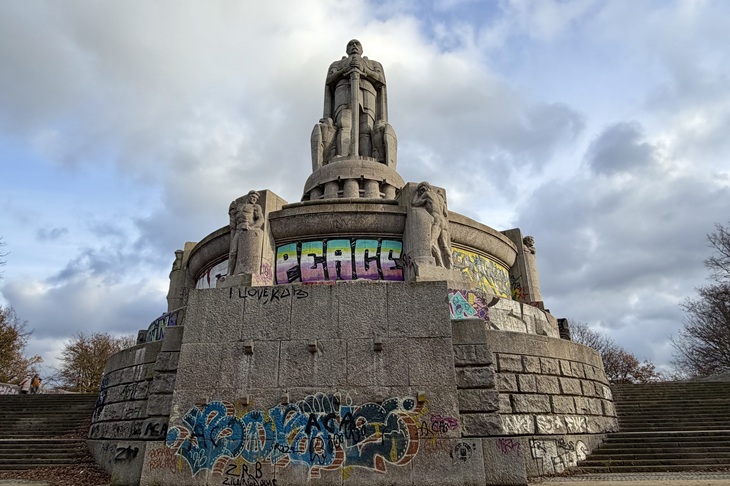
From Hamburg. The only way to cleanse post-colonial guilt is for every person, including immigrants, to give an extensive portion of theirs and their forebears’ assets to their empire’s former colonies. Or do like everybody else throughout history and just get over it. In Hamburg, instead of honouring the heritage-listed colossus of Bismarck, the Iron Chancellor who unified Germany under Prussian rule as its first Chancellor in 1871, the activists have turned the monument into a post-apocalyptic horror show.
The Bismarck Monument stands high above the port and looks down the River Elbe towards the sea. Symbolically, the statue portrays Bismarck as the protector of the city and the German Empire’s maritime ‘gateway to the world’.
The monument was completed in 1906 with some funding provided by Hamburg’s merchants. It was opened by Kaiser Wilhelm II and remains the largest Bismarck monument in the world.
In 2024, a €13 million restoration project, funded by the City of Hamburg and the federal government, was completed to address structural issues caused largely by additional concrete added during the second world war to create an air raid bunker.
Barely a year later, the statue looks disgraceful.
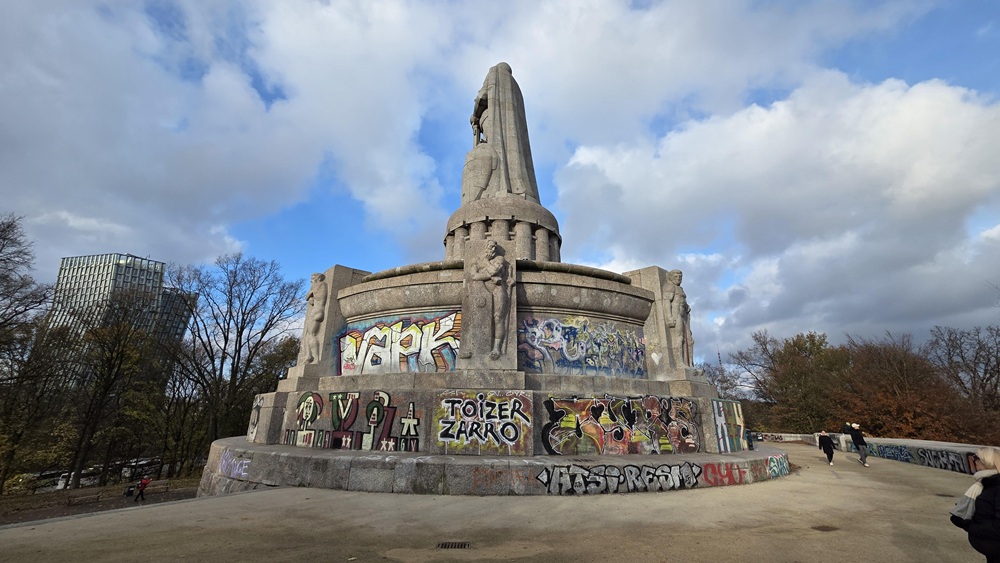
Horrid graffiti consisting of zero artistic talent is all over the monument. Signs nearby tell a sad story:
‘Proposals to the State Parliament acknowledged the difficult legacy of Bismarck, who is remembered not only as the Prussian founder of the German Empire and strategic foreign policy maker, but also, controversially, as an anti-democratic figure and a persecutor of minorities. By contrast, the colonial dimension of this legacy was not mentioned – an indication of post-colonial gaps that persist in German historical consciousness.’
On seeing the monument, I felt physically ill. What made matters worse was learning more about recent developments for the monument’s future.

In 2021, the City of Hamburg launched Rethinking Bismarck:
‘…an open competition calling for ideas to aesthetically and pedagogically transform the Bismarck Monument, without modifying the actual monument itself, which is protected as a listed heritage site. However, a jury of diverse and independent panel members concluded that no single artistic intervention could do justice to the task. Its recommendation was to prioritise critical reflection and public discussion about the monument for the time being.’
What a load of tosh. The monument and its surrounds are a disgrace. That’s my critical reflection.
It was as if the adults had left the room and let the children run amok. It was the worst of low-class graffiti, no doubt applied by children who couldn’t possibly grasp the complex history of the world let alone aesthetics or pedagogy. The signs bearing the words above were also covered in graffiti, none of which meant anything other than the tag of the cheap and nasty ‘artist’.
This is not my first time in Germany and it’s not the first time I have seen crappy graffiti on otherwise brilliantly crafted statues.
The monument depicts Bismarck as a medieval Roland figure in armour with a sword meant to symbolise civic freedom. It is a ‘Teutonic–medieval colossus in Wilhelmine neo-Baroque clothing – designed not to be beautiful, but to be awe-inspiring, slightly frightening, and eternal’.
Instead, a lack of leadership and pandering to idiots who have no clue of history has resulted in a colossal eyesore. Instead of being awe-inspiring, the monument now symbolises the decay of democracy that destroyed ancient Athens.
It is interesting that Bismarck kept the socialists at bay during his reign. While he implemented universal male suffrage, he was appointed by the Kaiser and was not elected. Critiques of Bismarck as an authoritarian, conservative elitist are mostly accurate, but he was also a man of his time.
If the monument in its present form represents what post-colonial democracy looks like, I’ll take Bismarck any day.
Dr Michael de Percy @FlaneurPolitiq is the Spectator Australia’s Canberra Press Gallery Correspondent. If you would like to support his writing, or read more of Michael, please visit his website.