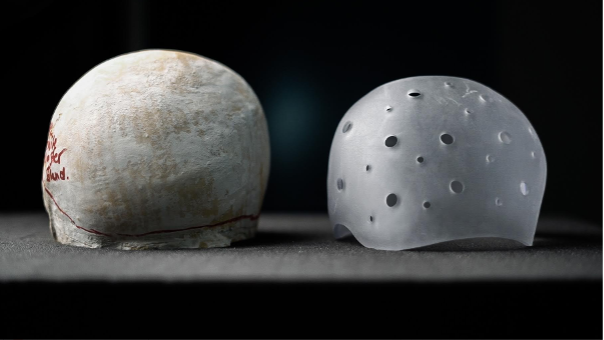
According to the NHS, around one in five babies will experience a condition known commonly as flat head syndrome (plagiocephaly or brachycephaly).
Typically, flat head syndrome is not a significant cause for concern. Head shape usually does not affect brain development and will likely improve itself over time as the skull develops and the baby starts to move their head, roll, sit up, and crawl.
In more severe cases, the forehead might bulge on the opposite side from the flattening, making the head look uneven and potentially causing issues to the neck, jaw or face. If left untreated, such a difference in shape could be noticeable into adulthood.
Prevention, then, is considered key.
Earlier this year, North Bristol NHS Trust revealed that it had turned to 3D printing to design and manufacture customised helmets that help to reshape the skull as the baby grows via the Bristol Helmet Service at the Bristol 3D Medical Centre.
Amy Davey [AD], a Reconstructive Scientist and Lead Clinician for Bristol 3D Medical Centre, has since sat down with TCT to explain why the organisation sought to adopt additive manufacturing and what impact the technology has had on flat head syndrome treatment.
TCT: The Bristol Helmet Service is believed to be the only NHS hospital service in the UK that provides 3D printed helmets for flat head syndrome. So, what was it that convinced the service to explore 3D printing technology? What did the service perceive as the potential benefits of adopting the technology?
AD: Bristol Helmet Service is part of the Reconstructive Prosthetics department at North Bristol NHS Trust. The service provides patient-specific medical devices that use a mix of traditional and modern techniques. 3D technology has enabled the team to streamline processes and improve patient experience to create these devices. There are a multitude of potential benefits to using 3D technology within healthcare, and Bristol 3D Medical Centre is at the start of utilising and researching this for Bristol and the wider region. We are able to support our hospitals and region by providing a service that was only previously available by expensive outsourcing or individual department equipment purchases.
TCT: 3D printing technology is not always cheap to purchase and run. Can you provide insight into how the service built a business case for integrating the technology into its patient care and treatment offering?
AD: The majority of equipment for Bristol 3D Medical Centre was purchased through generous donors to Southmead Hospital Charity. The Reconstructive Prosthetics team has been using an entry-level 3D printer for many years prior to the centre and has used this to show its potential benefits if utilised on a wider scale for the entire hospital and region.
This post is for subscribers only
Already have an account? Sign in