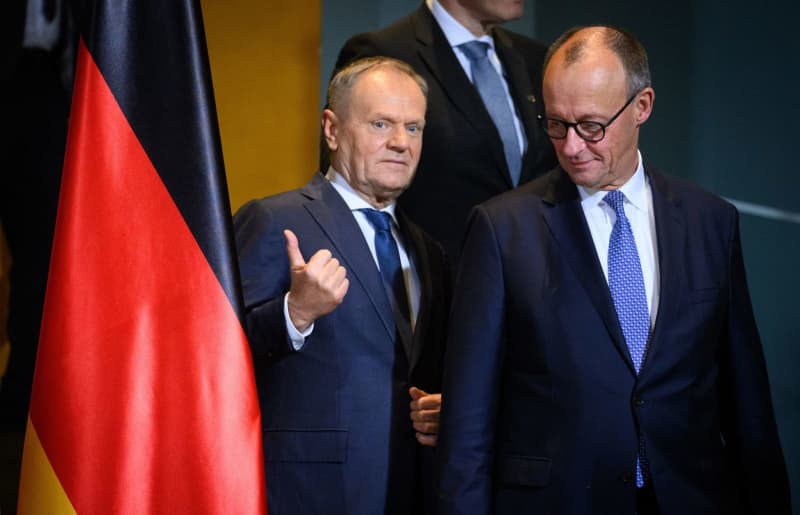
Polish Prime Minister Donald Tusk has called on the German government to provide support as quickly as possible to the surviving victims of the German occupation of Poland during the World War II.
“Hurry up if you really want to make this gesture,” Tusk suggested after a meeting with Chancellor Friedrich Merz in Berlin on Monday during the 17th German-Polish government consultations.
Tusk pointed out that the number of surviving victims of German Nazi occupation of his country is steadily declining.
When former chancellor Olaf Scholz promised this support in July 2024, there were still 60,000 surviving victims, according to the Foundation for German-Polish Reconciliation, but now there are only 50,000.
“If we do not receive a clear and quick explanation soon, I will consider making the decision next year that Poland will meet these needs from its own resources,” Tusk asserted. He did not want to say more on the matter for the time being.
Merz did not go into specifics on the subject. “I ask for your understanding that we cannot disclose any figures at this point. But please rest assured that the federal government, which I lead, is very aware of its historical responsibility towards our neighbour Poland and that we will continue to hold talks with each other,” was all he said.
At the joint press conference with Tusk, Merz repeatedly acknowledged Germany’s responsibility for the suffering and destruction caused by Nazi Germany in Poland.
“The past never ends,” Merz said, but also reiterated: “From Germany’s point of view, the question of reparations has been conclusively answered, both legally and politically, for many years.”
Tusk countered that Germany’s position of adhering to a formal diplomatic act from the 1950s was well known. However, he said that the Polish communist leadership’s decision to waive reparations in 1953 was “not a decision made in the interests of the Polish people, because the Polish people had no say at the time.”
In Poland, therefore, “everyone without exception” believes that the country has not received compensation for the losses and crimes committed during World War II, Tusk asserted.
Dealing with the consequences of the German occupation of Poland during the war is a recurring theme in relations between the two countries.
Poland continues to demand trillions in reparations for the damage caused at that time. The most recent request came in September when Polish President Karol Nawrocki was in Berlin on his inaugural visit.
Both Merz and German President Frank-Walter Steinmeier have rejected these demands.
Germany considers the reparations issue settled by the 1990 Two plus Four Treaty that facilitated German unification.
Unlike Poland’s right-wing conservative president, Prime Minister Tusk’s centre-left government is no longer aggressively pursuing the issue of reparations – but it does expect the German government to at least make this gesture of support for the victims who are still alive.
However, both sides want to push ahead with the project to establish a permanent memorial to Polish war victims in Berlin. Concrete tendering procedures are to be launched for this purpose.
The current round of consultations on Monday actually focused on deepening relations in the areas of defence, economy and infrastructure. Tusk described the results of the meeting as “an historic change.”
He particularly praised “comprehensive Polish-German cooperation with regard to the defence of Europe’s eastern border.” To this end, an agreement with specific projects is to be signed next year to mark the 35th anniversary of the German-Polish Neighbourhood Treaty.
Merz called Germany and Poland “indispensable neighbours and partners.”
The modernization of infrastructure includes the railway line between Angermünde in Brandenburg and the Polish border town of Szczecin, as well as the road connection at the border near Frankfurt an der Oder