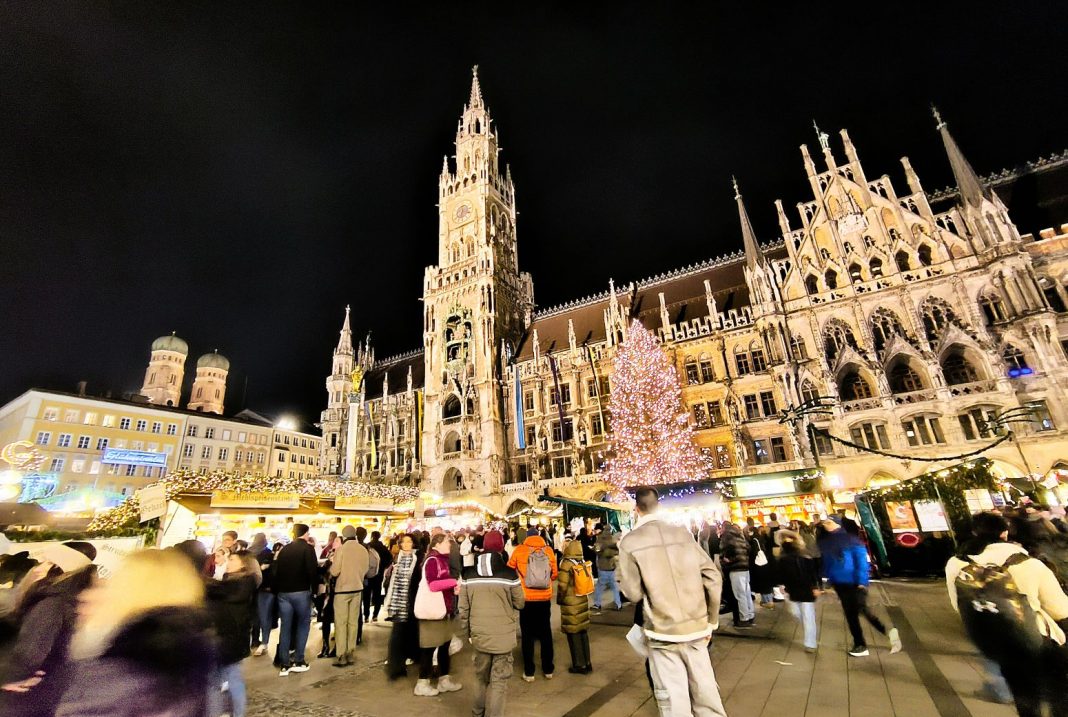
The Advent season with its Christmas markets represents for Germany an important moment to celebrate centuries-old traditions.
Around 170 million people gather year after year at Christmas markets across Germany to get into the holiday spirit with family and friends, to reconnect, and to enjoy the enchanting pre-Christmas atmosphere.
The tradition of Christmas markets has its roots in the church’s Advent season: back then, farmers and traders sold their goods outside churches to supply worshipers with essential provisions for winter and the upcoming Christmas celebration after services. Entertainers, performers, and street artists soon joined in, delighting visitors with tricks and attractions.
Notable examples include Dresden’s Striezelmarkt, founded in 1434 and considered Germany’s oldest Christmas market, and Nuremberg’s Christkindlesmarkt, whose beginnings date back to 1530.
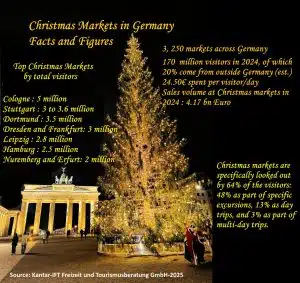
Today, Germany’s Christmas markets are a cherished social highlight of the year and drawing visitors from near and far. Germany roughly has 3,250 Christmas markets held nationwide.
Christmas markets : a showcase of the Amusement-Trade Industry
The very word “Christmas market” includes the term “market,” reflecting the economic trade that has always taken place around the holiday season. These markets invite people to stroll in a festive setting, offer the chance to buy gifts for the most wonderful time of the year, and adapt to the evolving needs of visitors.
Unlike traditional retail, Christmas markets only open during the four weeks preceding Christmas. In Germany, the tradition is to close the markets on December 24, on Christmas Eve.
Christmas markets have become a fixture in virtually every municipality of note, now serving not only as a beloved seasonal tradition but also as a major image driver and economic engine for tourism.
The most famous markets can attract between 2 and 5 million visitors. From rankings published by Germany’s biggest auto club, ADAC, to travel magazines and hotel websites nationwide, listings of the “most beautiful Christmas markets” are now everywhere—a trend that underscores their immense marketing value. Christmas markets in Germany are supported by the German Amusement Trade Association (Deutscher Schaustellerbund e.V or DSB).
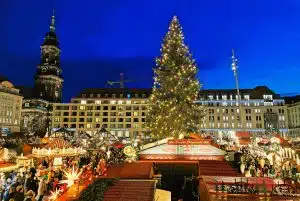 Dresden Striezelmarkt is Germany’s oldest Christmas market (Photo: LC/Cleverdis)
A Tourism Booster
A study conducted by University of Bremen found that 80% of visitors to Bremen cited the Christmas market as the reason for their visit during the pre-holiday season. Early weekend and holiday openings—even before the official church Advent period—particularly help out-of-town visitors plan trips that include an overnight stay.
The success of Germany’s Christmas markets lies in their centuries-old traditions. Christmas markets are also one of Germany’s biggest cultural exports. Chicago has hosted the “Christkindlmarket,” inspired by Nuremberg, since 1996. In Birmingham, the Frankfurt Christmas Market opens its annual U.K. branch. Markets influenced by German Christmas traditions can also be found in countries including France, Italy, Poland, and even Japan.
Back to Germany, the craze for Christmas markets are showed in data comparing year 2024 to year 2017. The 170-million-market visits in 2024 represent a 10-million-person or 6% increase, reflecting continued visitor enthusiasm even amid inflation and geopolitical uncertainty.
Average per-visitor daily spending has climbed sharply, now reaching €24.50—up €6.50 or 36%—including €7.90 on food, €6.40 on beverages, €6.50 on gifts and crafts, €2.00 on rides, and €1.70 on other activities. Total revenue generated directly on market grounds now stands at about €4.17 billion, up €1.29 billion or 45%.
Markets also generate nearly €4.88 billion in secondary revenue in local economies, an average of €28.70 per visitor per day spent beyond the market perimeter, including €5.90 at restaurants and cafés, €8.90 in retail, €5.30 on overnight stays, and €8.60 on transit, parking, taxis, or entertainment such as movies.
 (Photo: Christmas tree in front of the Brandenburg Gate in Berlin-LC/Cleverdis)
Facing the security issue
In recent years, the centuries-old tradition Christmas markets have been confronted to a new central requirement: security.
The severity of attacks in previous years has repeatedly triggered existential debates around whether markets should—or even can—continue. Following attacks in 2016 in Berlin and in 2024 in Magdeburg, protective infrastructure—vehicle blockers, surveillance cameras, expanded security staffing, and mandatory police screening—are now non-negotiable fixtures of public safety in coordination with the Federal Criminal Police Office, Bundeskriminalamt.
Yet while security has played a role in rising overhead, the DSB maintains that no mass wave of Christmas market cancellations occurred despite misinformation spread by some social media.
Federal leadership also acknowledged the moment. On November 26, 2025, German Chancellor Friedrich Merz expressed its sadness that even small towns now require complex security frameworks to continue operating Christmas markets.
He called for cross-city safety standards to secure the tradition’s future with greater consistency and less administrative burden. However, one conclusion prevails: Christmas markets in Germany remain culturally indispensable and economically influential while providing a time for enjoyment to all.
Related News Stories: Cruising with Susan Calman back for festive episode aboard APT ship Agent Archives – Page 646 of 2618 – TravelMole Strasbourg ready to endorse again its title of Capital of Christmas Visit Orlando – TravelMole Birmingham Airport flights resume after crash landing Thanksgiving feast on Florida’s Historic Coast Holiday traditions in Asheville, NC Jet2.com – TravelMole Jamaica sets pre-Christmas target for full tourism restart Australia baggage handler strike could impact Christmas flights