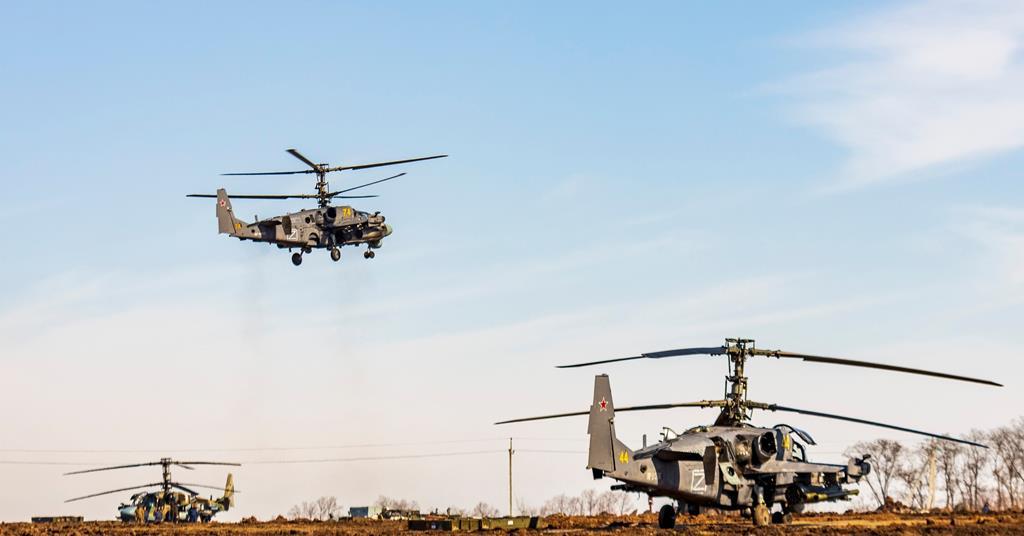
One of the most iconic images of the highly documented Russia-Ukraine War came from the conflict’s opening hours.
Lines of Russian attack helicopters flying low over the grey winter forests and fields of northern Ukraine, discharging countermeasure flares as they absorb incoming fire. Arrow-straight plumes of smoke trailing both incoming Ukrainian anti-air missiles and rockets shot from the Russian rotorcraft.
Behind the Mil Mi-24 and Kamov Ka-52 attack helicopters come waves of Mil Mi-8 troop-carriers headed toward one of Moscow’s earliest objectives of the war: Antonov airport in the city of Hostomel.
Moscow’s plan was to quickly seize the airfield, owned by the Antonov aircraft corporation, and use it to land fixed-wing transports laden with combat troops, providing an airhead from which to seize the capital Kyiv less than 19 miles (30km) to the southeast.
The helicopter-borne air assault portion of the mission was carried out by the Russian army’s elite VDV paratroopers. A small force of several hundred troops ferried and supported by a few dozen aircraft was meant to land at the Antonov airport. That small assault force would be reinforced by a larger contingent set to land in Ilyushin Il-76 transports and by mechanised troops advancing overland from Russia.
Very little of the plan came fruition.
The Russian assault force was engaged by Ukrainian air defences around Hostomel, taking fire from anti-aircraft guns and shoulder-fired guided missiles.
Losses of multiple Russian helicopter types have since been documented during or after the Hostomel assault, including Ka-52s, Mi-24s and Mi-8s. Total rotorcraft losses from the operation have been estimated between three and 10 on the Russian side.
While a portion of Russia’s assault force did land and briefly hold the Antonov airport, a Ukrainian counter attack allowed Kyiv’s forces to thoroughly crater the 11,480ft (3,500m) runway and prevent the crucial Russian reinforcements from landing.
Although Russian armoured forces eventually reached Hostomel by ground, the delay fended off Moscow’s attempt at a lightning decapitation strike on the Ukrainian capital.
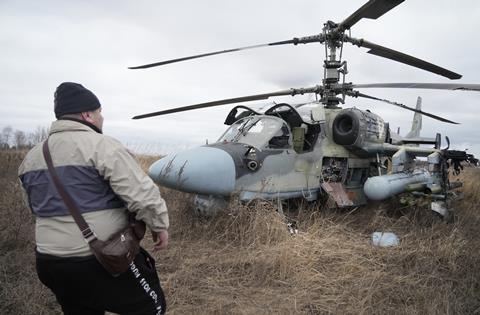
The high-profile failure of a crucial helicopter strike mission in the war’s opening hours became an enduring scene of the war, which at the close of its fourth year is now frozen in a bloody stalemate.
Russia’s helicopter woes were not limited to Hostomel, however.
Data provided by the Ukrainian defence ministry suggests Russia has lost 347 rotorcraft during the war. The Russian Losses in Ukraine project says the vast majority of those losses – 82%, or 288 helicopters – came in the first 12 months of fighting.
“There’s the absolute reality of Russian aircraft being shot down,” says Jeffrey Schloesser, a retired two-star general with the US Army and now senior vice-president of strategic pursuits at rotorcraft manufacturer Bell.
Widely available battlefield footage of Russian aircraft being engaged and wrecked has led armchair generals to declare the end of the helicopter as an effective battlefield tool.
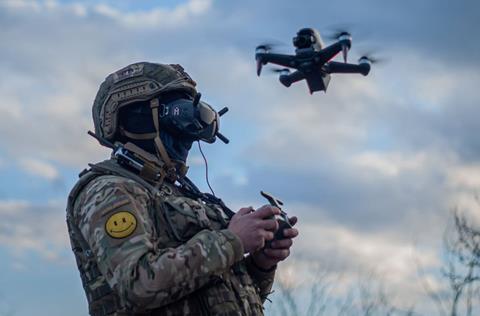
That conclusion has been further reinforced by emergence of drone warfare in the more recent years of the Russia-Ukraine conflict, now defined by skies saturated with lethally armed quadcopters precisely guided by remote operators.
However, Schloesser believes this conclusion is overly simplistic and fails to account for obvious failings in Russian planning and tactical execution.
“You see their aircraft flying in formation, in the middle of the day, at an altitude that is a perfect box for both surface-to-air missiles as well as small arms fire,” he tells FlightGlobal.
“The Russians, using really outdated tactics and techniques and procedures during the initial parts of the war, suffered huge amounts of rotary wing casualties and I think that became the perception throughout much of the world,” Schloesser adds.
While the Bell executive certainly has incentives to downplay suggestions of the helicopter’s irrelevance, Schloesser draws on frontline experience that spans combat tours in Iraq, Afghanistan and the NATO-led intervention in Kosovo.
As a uniformed officer, he commanded a battalion of the US Army’s elite 160th Special Operations Aviation Regiment that provides rotary-wing aviation support to commando forces across the US military. Schloesser later commanded the army’s 101st Airborne Division, which specialises in helicopter air assault operations much like the ill-fated airfield seizure attempted by the Russian VDV in Hostomel.
Rather than indicting the entire concept of rotary wing air support and troop movement, the retired major general says Russia’s struggle to effectively employ its helicopter force should be regarded as an internal failing of Moscow’s generals and war plan.
“The Ukrainians destroyed much of that Russian capability right off the bat because of the errors they made,” Schloesser says. “They tried to do an air assault without suppressing enemy air defences.”
An equivalent US operation in contested airspace would have involved a massive deployment of fighters, bombers, ground-attack aircraft and electronic warfare platforms to open a temporarily safe corridor for the assault force – something the Russians only loosely attempted, seemingly based on the expectation of minimal resistance.
The main assault on Hostomel also occurred in daylight, with the helicopters flying directly toward their target. By contrast, the US Army prefers to fly at night and use indirect avenues of approaches to avoid defenders or mask their destination, Schloesser notes.
Defeat at Hostomel, and the failure of several less-publicised helicopter operations over the subsequent weeks of combat, has substantially blunted Russian enthusiasm for rotary-wing aviation, in Schloesser’s opinion.
“I have seen very limited intent to use air assault in this conflict ever since the first two months or so,” he says. “They lost a large amount of aircraft and the troops that were specially trained… In many cases, the defeat of those forces occurred very quickly on, and in many cases they were utterly destroyed.”
The true cause of Russia’s bloody rotary wing fiasco was failure to adapt tactics to the reality on the ground, rather than an inherent inadequacy of the medium, he insists. “They did not learn while they were trying to execute.”
Instead of evolving, the Russians appear to have sidelined much of their remaining helicopter fleet, with losses mostly levelling off since mid-2023, according to the Russian Losses in Ukraine project.
On the Ukrainian side, Schloesser says there have been one or two notable instances of successfully employing helicopters, such as the evacuation of army forces from the besieged port city of Mariupol in 2022.
And in October, a small team of Ukrainian special forces were deployed via a Sikorsky UH-60 Black Hawk to the city of Pokrovsk, which the army was in the process of withdrawing from. That news was reported by Reuters.
However, Kyiv’s options for helicopter-borne operations have largely been limited by its small inventory of outdated Soviet-origin rotorcraft.
Fleet data from aviation analytics firm Cirium counts the Ukrainian army as having 61 Mi-8 utility and 39 Mi-24 attack helicopters.
Even after wartime losses, the Russian fleet still includes more than 770 aircraft from the Mi-8 family, more than 320 Mi-24/35 attack helicopters and 135 of the distinctive Ka-52 coaxial ground-attack rotorcraft.
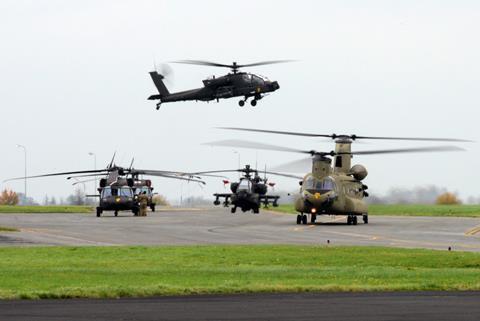
By way of compassion, the US Army’s world-leading helicopter inventory boasts nearly 2,300 UH-60 troop-carrying assault rotorcraft, along with more than 830 Boeing AH-64 attack types and over 500 Boeing CH-47F heavy-lift transports. The service has also contracted with Bell to design and deliver the next-generation MV-75 tiltrotor, with an eye toward providing significantly more speed and range – qualities US Army leaders say they need to make air assaults viable in an era of long-range precision weaponry.
But the Russia-Ukraine war has forced tweaks to the Pentagon’s long-term helicopter strategy.
Most notably, the US Army in 2024 cancelled the Future Armed Reconnaissance Aircraft scout platform over concerns about survivability – just as Bell and Sikorsky were set to launch flight testing on two prototype designs.
The army is now developing a new class of uncrewed vehicles it calls “launched effects”, which the service plans to integrate with existing rotorcraft like UH-60s and AH-64s.
Air-launched effects will act as scouts, operating ahead of manned rotorcraft to identify threats and strike targets, keeping helicopters and crews away from the most-hazardous areas.
Still, despite dangers confronting rotary-wing aviation, the US Army does not appear to be backing away from its use of helicopters.
“Apache, Black Hawk and Chinook platforms remain indispensable to the force,” the service said in 19 November feature highlighting its work to incorporate more quadcopter drones and other small UAVs into army aviation.
“[The army] is not discarding helicopters, it is augmenting them,” the report notes, adding that small drones will supplement existing rotary-wing missions such as medical evacuation, logistics support and deep-penetration strikes, rather than taking them over entirely.
“The difference now lies in employment,” the report says.
According to Schloesser, that is the right approach.
Rather than consign helicopter forces to the ash heap of history, he argues rotary-wing forces will return to their historic place as a battlefield enabler deployed strategically in closely coordinated operations alongside fixed-wing jets, electronic warfare assets, ground-based air defences and other combat forces.
That concept, known as “manoeuvre warfare”, has been a doctrinal pillar of combat operations in Western armies for decades.
The very earliest example of the idea emerged in 1918 at the end of World War I, when Australian General John Monash combined tanks, infantry, artillery and early military aircraft to seize the French town of Le Hamel in a meticulously choreographed operation.
Bell’s Schloesser says helicopters can still survive and be effective in modern combat when used in this fashion – specifically with the goal of quickly moving troops or disrupting enemy forces in ways enabling larger ground offensives.
“I never operated them separately,” Schloesser notes of his time commanding the 101st Airborne Division, which includes thousands of infantry and artillery soldiers in addition to its sizeable contingent of helicopters. “I always combine the efforts on the battlefield for maximum effect, and that’s what’s going to be required to change the calculus.”
Part of that change will be shifting toward using what Schloesser calls “disaggregated forces”.
Rather than relying on large staging areas to support dozens or hundreds of helicopters, armies will need to spread aircraft across many smaller refuelling and rearming sites, further removed from front lines.
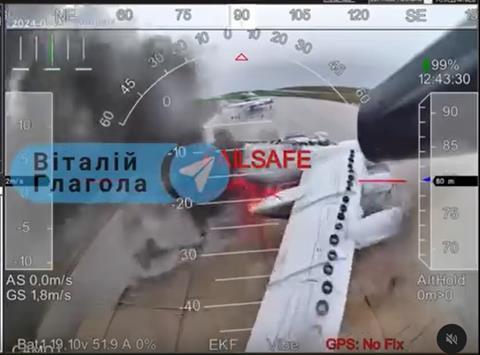
The proven ability of both Russia and Ukraine to strike specific targets over hundreds of kilometres away with relatively simple munitions indicates this will prove challenging, requiring layered air defences and counter-UAS protections. Ukraine’s successful strike against three strategic bomber bases deep inside Russia in May revealed the vulnerability of parked aircraft, even those far from the battlefield.
Multiple Tupolev Tu-22M3, Tu-95 and Tu-160 bombers, and at least one Ilyushin Il-76-based A-50 airborne early warning and control platform, were damaged or destroyed in the unconventional attack.
Schloesser says Russia’s ongoing performance in Ukraine suggests either risk aversion or a lack of expertise necessary to develop and execute complex, multi-layered operations to which helicopters can safely and effectively contribute.
“There just doesn’t seem to be an ability at the higher levels to fight in this type of combined arms manoeuvre warfare,” he says. “I just don’t see that.”
One possible explanation is the heavy losses suffered by Russia’s helicopter forces in the first year of the war – which may have killed many personnel experienced in developing such operations.
While Moscow appears to have settled into an attrition-based strategy of long-range bombardment and infantry attacks, Kyiv is now looking to expand its rotary-wing capabilities.
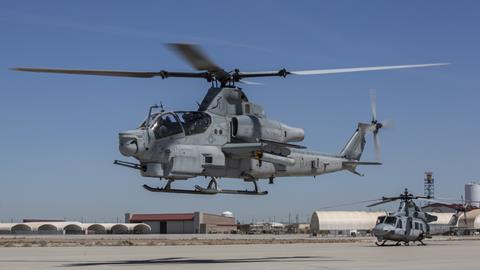
In October, the Ukrainian government signed a letter of intent with Bell to pursue acquisition of an unspecified number UH-1Y utility and AH-1Z attack helicopters.
While details around financing and US government approval still need to be addressed, Schloesser says the Bell rotorcraft offer significant potential benefits to Ukraine.
The aircraft have 85% commonality, offering simplified sustainment across a wide portfolio of rotary-wing missions. The two H-1 aircraft are primarily operated by the US Marine Corps (USMC), which practises an expeditionary fighting style Schloesser says fits well with the wartime demands and abilities of the Ukrainian army.
Schloesser says the UH-1Y and AH-1Z feature sophisticated countermeasures that would help them survive modern threats, though he declines to elaborate, citing security classification.
From an operational perspective, the USMC has already demonstrated the ability to of the AH-1Z to perform air-to-air and counter-UAS missions in test environments.
A cost-effective means for both those functions is in high demand by the Ukrainians, as Russia overpowers conventional air defences with massed wave bombardments of low-cost, one-way drones.
Perhaps most importantly, Bell’s H-1 production line in Amarillo, Texas has availability. After the final new delivery for the USMC in 2022, and more recently completing orders for Bahrain and the Czech Republic, Bell is working through a 12-aircraft order from Nigeria for the AH-1Z – the company’s last confirmed H-1 customer.
That gives Ukraine a rare opportunity to relatively quickly secure new-build aircraft, wait times for which typically run several years out.
With peace talks between Ukraine, Russia and the USA currently underway, it may be that new H-1s fail to reach Ukraine in time to impact the war.
However, Schloesser, who was part of the Bell team negotiating with Kyiv on the potential H-1 deal, says a new helicopter fleet can still bring significant benefits to Ukraine.
“They have a vision of the future where their country is able to rebuild its defence capabilities and its defence industries,” he notes. “In our discussions with them, one of the things that they’ve constantly talked about is how can this play in a way that allows the Ukrainians a role in the future of the aircraft as well.”
Kyiv has made commitments for large numbers of military aircraft in recent weeks, including Dassault Rafale F4 fighters from France and Swedish-made Saab Gripen E/F fighters.
While a means to pay for the new jets and helicopters remains elusive, all indicators are that Kyiv is preparing for the current war to end with some form of uneasy truce – one requiring a strong Ukrainian military to deter subsequent Russian adventurism.
Whether that force includes significant numbers of modern rotorcraft remains to be seen. However, recent sales indicate helicopters will likely remain fixtures of modern militaries for decades.
For instance, in addition to plans to field Bell’s MV-75, the US Army is upgrading its existing UH-60s, AH-64s and CH-47Fs. Meanwhile, allies in Europe, the Middle East and the Indo-Pacific region are moving ahead with significant fleet expansion plans. Most recently, Poland signed a multi-billion dollar order for 96 Boeing Apache attack helicopters.
China is also fielding new rotorcraft, including its domestically produced Z-21 attack helicopter and Z-20T troop-carrying assault type.
For more analysis, listen to the 1 December episode of the FlightGlobal Focus podcast, which features additional comments from Bell’s Schloesser and commentary from FlightGlobal’s defence editorial team.