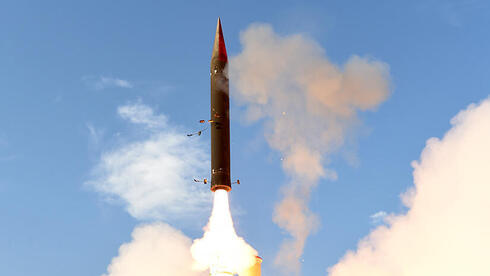
Two years after Israel signed the largest arms deal in its history — a 3.5 billion-euro contract with Germany — an Israeli delegation arrived in Germany this week to hand over the first operational components of the Arrow 3 missile defense system. German security forces are expected to deploy the system operationally for the first time on Wednesday following a formal ceremony.
The system will be stationed at the Holzdorf Air Base, about 40 kilometers south of Berlin. The base is set to become the German military’s largest installation in the east and will serve as a frontline defense point against potential aerial threats from Russia. Germany is the first country outside Israel to purchase and operate the Arrow 3.
The transfer carries symbolic weight. The past year saw diplomatic tensions between Israel and Germany over the war in Gaza, and Berlin imposed restrictions on certain defense exports to Israel. Critics also spoke out against the missile deal. Still, a senior German officer said Germany’s decision reflected the lessons it drew from Israel’s recent conflicts.
“Israel’s wars over the past two years, the range of threats it faced and the extraordinary success of its air defense systems made clear Germany must deploy these capabilities, especially amid Russian aggression,” the officer said. “This move changes Germany’s security posture.”
Germany’s procurement of the Arrow 3 is part of a rapid military buildup triggered by Russia’s 2022 invasion of Ukraine. Earlier this year, German lawmakers amended the constitution to allow higher national borrowing, largely to fund defense expansion.
Two additional Arrow 3 components purchased by Germany are scheduled to become operational by 2030 and will be deployed at bases in the north and south of the country.
“The ceremony marking the delivery of the first operational Arrow system to Germany is symbolic and significant in many ways,” said Boaz Levy, CEO of Israel Aerospace Industries. “Germany now joins the United States and Israel as the only countries able to defend their citizens from ballistic missiles. This is a global shift.”
Levy noted that the agreement was signed ten days before the Oct. 7 Hamas attack and that Israel delivered the system on time despite the demands of wartime.
“We promised an operational system within two years and met the deadline while Israel was at war,” he said. “It was a tremendous technological and professional challenge.”
Asked whether the German export restrictions affected the project, Levy said cooperation continued. “Germany remained an ally. Disagreements are allowed. The schedule we kept is a sign of partnership. German officials saw in Israel the systems’ phenomenal performance and we hope this will lead to stronger ties.”
Levy added that the project holds deep personal meaning for him. “I began as an aeronautical engineer on the Arrow project and led the development of Arrow 3. It is meaningful to see it protect Israeli civilians, but today I am even prouder that it will protect people abroad. I am the son of a Holocaust survivor, so helping defend German citizens carries powerful emotion. But I do not compare today’s Germany to the Germany of the past.”
Levy said demand for such systems is expected to grow. “This would have happened regardless, because we offer a solution for the modern battlefield. Russia’s invasion of Ukraine only accelerated the need. I have no doubt this is just the first step and that as Germany gains experience operating the system it will need additional batteries,” he said.