A simple request for speeding-fine data escalated into a full FOI dispute – and a ruling that the public can’t know a decade of enforcement history on one of the M60’s most notorious stretches. John Scheerhout reports.
06:03, 02 Dec 2025Updated 10:59, 03 Dec 2025
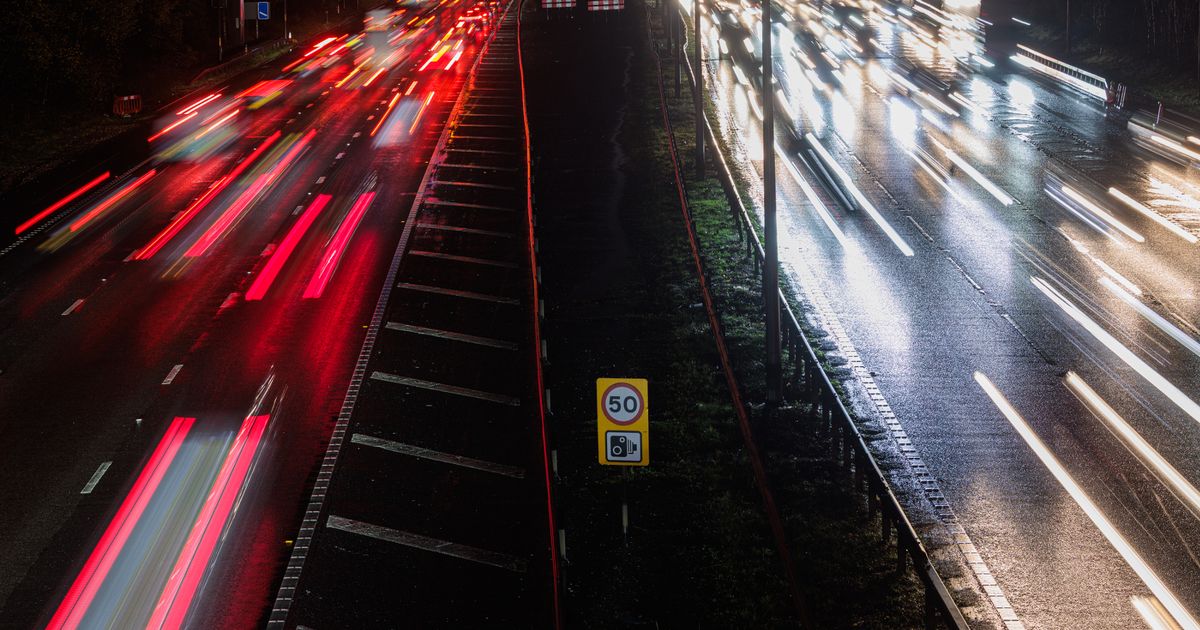
 Traffic on the M60, heading towards Stockport through the 50mph zone at Bredbury.(Image: Kenny Brown | Manchester Evening News)
Greater Manchester Police has refused to provide details on the number of speeding fines dished out on a stretch of the M60 despite a two-year battle for information.
In January last year the Manchester Evening News asked the force to provide the number of fines handed out for speeding offences captured by average speed cameras on the clockwise carriageway of the M60 between junctions 24 and 25 near Bredbury, Stockport, over the previous ten years. There is a 50mph-limit on this stretch of the motorway.
The force, which conceded ‘not all speed cameras are operational at all times’, refused to provide the information following a freedom of information request by the M.E.N., initially refusing to confirm or deny it even held the information.
We lodged a complaint with the information watchdog, the Information Commissioner’s Office (ICO) which rejected GMP’s position and ordered the force to provide a fresh response.
GMP provided a revised response which acknowledged it did hold the information but the force argued it shouldn’t be made public as this could jeopardise the detection of crime and the prosecution of offenders, and also risk public safety.
 Traffic on the M60, heading towards Stockport through the 50mph zone at Bredbury.(Image: Kenny Brown | Manchester Evening News)
The M.E.N. argued ‘it was a matter of legitimate public interest’ to release the data as it could ‘reveal lengthy periods of inactivity potentially for years at a time’, pointing out that for at least three locations GMP has previously provided speeding fine information following freedom of information requests.
The force has previously revealed speeding fine data for the M62 near Heywood, on the A5103 Princess Parkway in Manchester, the M62 again, and in Hale.
But following our second complaint to the ICO the watchdog concluded there was a ‘strong public interest in protecting those at risk of harm’ and backed GMP. It ruled the force was right to keep the information from the public.
In its final decision notice the ICO concluded releasing the information ‘could provide a tactical advantage to offenders, which could negatively impact upon road safety and undermine the policing purpose, and be likely to prejudice any current or future investigation or deterrent and therefore the potential detection and prevention of crime’.
The ICO also concluded ‘that the risk of endangerment to health and safety in this case is not based on mere assumption or belief and that the risk is logical and substantially more than remote’. The watchdog went on that ‘if disclosed to the public at large there is a real possibility of the harm envisaged occurring’.
The decision notice went on: “There would be nothing to prevent the information from falling into the hands of someone who would attempt to misuse the information for their own purposes – and that could have very real, harmful consequences.”
The ICO also assessed whether the public interest in releasing the information outweighed withholding it on the grounds of public safety.
The watchdog said: “The complainant has argued that it is in the public interest to know the extent of speeding enforcement on this stretch of motorway, or lack of it if that should be the case. If it were to be the case that there were lengthy periods of inactivity, this would or should not suggest to the public that this will remain the case going forward.
“The cameras can always be ‘switched on’, as it were. GMP argue disclosure could be ‘used to the advantage of criminals’. This is obviously speculative and it’s worth remembering speed cameras are capturing speeding drivers committing traffic offences, whether deliberately or inadvertently, rather than criminals per se.
“They go on to conclude that if disclosure would reveal lengthy periods of inactivity potentially for years at a time, they believe it would be a matter of legitimate public interest. Someone speeding on the stretch of motorway for a period of time would be able to work out for themselves that the cameras are not working, perhaps encouraging them to drive at even greater speeds and potentially increasing the risk of collisions.
“Simply keeping motorists in the dark about whether cameras are switched on or not, would not achieve the aim of reducing the number of collisions. It may be viewed as an effort to avoid important road safety work. The minimum period of inactivity exposed would be a year. The public may view this as too long and could lead to increases in collisions.”
However, the watchdog concluded there was a ‘strong public interest in protecting those at risk of harm’ and was ‘persuaded that the balance of the public interest should favour maintaining the exemption’.
The M.E.N. had requested the number of speeding fines captured by the average speed cameras between junctions 24 and 25 in each of the ten years since and including 2014.
When GMP originally refused the request, the M.E.N. sought an ‘internal review’ with the force, setting out our case. We wrote: “If, as I suspect, disclosure would reveal lengthy periods of inactivity potentially for years at a time, then I believe this would be a matter of legitimate public interest. Anyone who speeds over that stretch of motorway for a period of time would be able to work out for themselves that the cameras are not working, perhaps encouraging them to drive at even greater speeds and potentially increasing the risk of collisions.
 (Image: Kenny Brown | Manchester Evening News)
“In these circumstances, simply keeping motorists in the dark about whether cameras are switched on or not, would not achieve the aim of reducing the number of collisions. It could, however, achieve one potential aim: to spare embarrassment. The public may view it as an effort to avoid important road safety work. If my request does reveal periods of inactivity, the minimum period of inactivity exposed would be a year. I suspect the public may view this as simply too long as it could lead to an increase in collisions.”
The Bredbury junction, which features a tight right-hand bend, had been considered an accident blackspot following a series of accidents and fatalities which prompted then Stockport coroner John Pollard to write to the Highways Agency about safety concerns in 2007, resulting in changes at the junction.
The cameras are owned by National Highways although GMP is responsible for enforcement.
A spokesman for GMP declined to comment, although it is understood bosses have noted that the ICO upheld its position and stress road safety ‘is of the utmost importance’. It is understood that GMP maintains that disclosing details of how enforcement is carried out ‘compromises’ its work and increases risk to the public
National Highways has confirmed it provides speed detection equipment to police forces although the data from them is gathered by individual forces. It is up to each police force when to enforce any speed limit although the cameras are capable of operating round the clock.