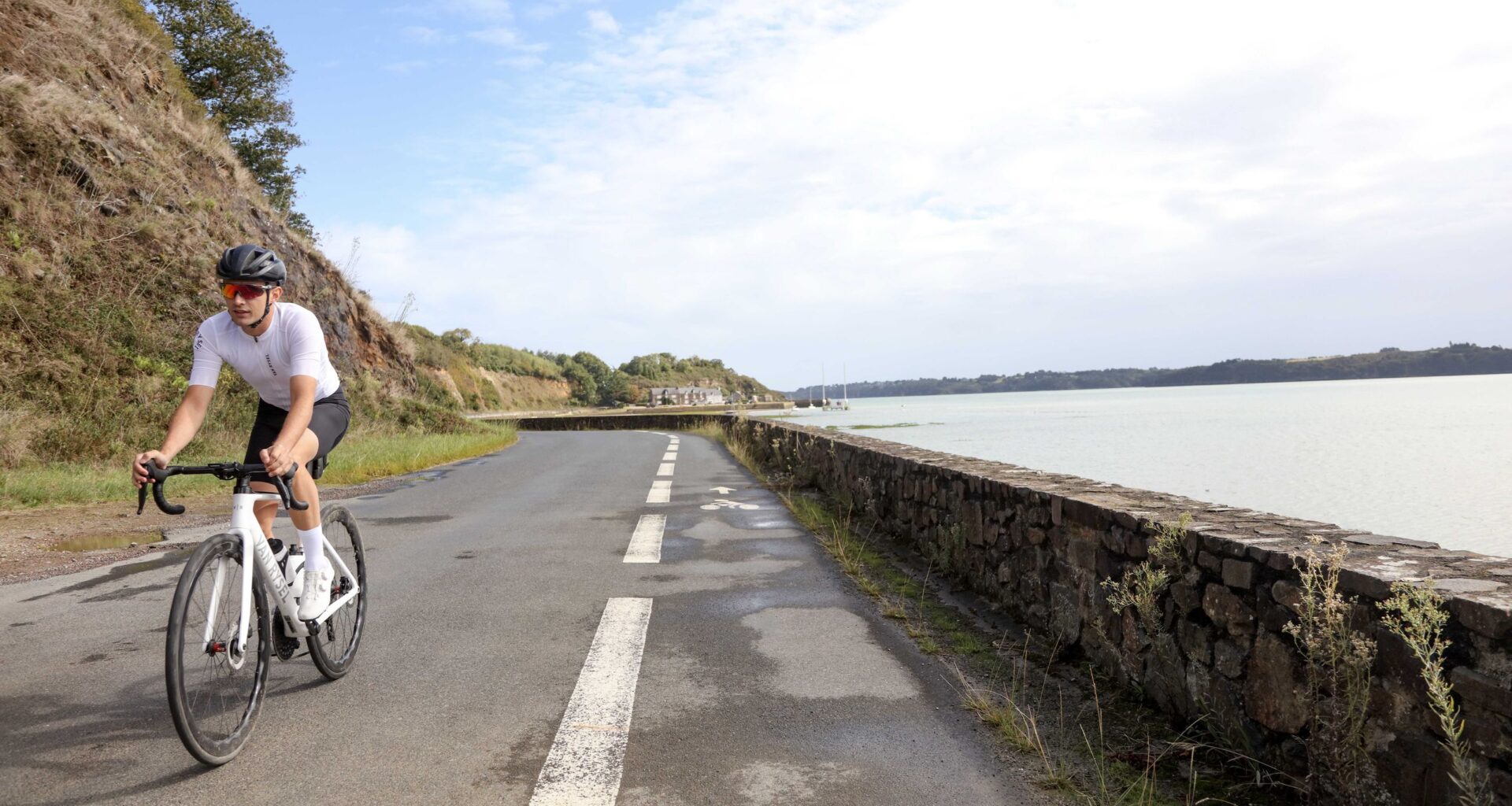
To me, Brittany and cycling are inextricably linked. It started when I was a skinny kid in the 1970s, taking family trips and trying to hold my dad’s wheel on the roads around Brest, Quimper, Carnac, Tréguier. Then camping trips as a penniless student – I watched the 1989 Lemond/Fignon showdown in a bar in Dol de Bretagne. Later, as an only slightly less penniless adult, I’d follow the Tour de France whenever it headed into this great heartland of cycling.
My wife Carole and I were there for the Tour this summer, bikes on the back of the van – but somehow managed to go home without having turned a single pedal stroke. Slackers.
To make amends, we headed back for a couple of days in late August, determined this time to explore parts of Brittany we hadn’t visited before, and to find out not only why it’s so cycling-friendly but why it’s been such a fertile breeding ground for generations of top riders.
You may like
There may have been only four Breton winners of the Tour – Lucien Petit-Breton, Jean Robic, Louison Bobet and Bernard Hinault – but between them they have 11 titles out of a possible 104 – more than 10%, and nearly a third of all French wins. The region has no obvious Tour contender right now (although Brest’s Maëva Squiban is a bright hope on the women’s side) but Brittany still punches well above its weight – last year, Bretons made up a fifth of the French pro peloton. It was time to explore the reasons why – starting in the countryside.

(Image credit: Kevin Raymond)
Once settled by Celts who’d fled Britain following Anglo-Saxon invasions, Brittany is a land of striking contrasts. Rugged, rocky coastline frames a fertile interior of rolling farmland. Gentle and welcoming in summer, it turns wild and unforgiving in winter. To get a proper feel for the place, you need to see both sides of its personality.
We start by the sea, exploring the coast between Saint-Malo and Saint-Brieuc. The former, an old, walled city, seems barely changed since the days when corsaires sailed out to terrorise passing ships. In fact, Saint-Malo was almost completely destroyed during the second world war, but afterwards was rebuilt as authentically as possible. Heading west across the river Rance at the hydro-electric barrage, through Dinard and Ploubalay, there’s a nice mix of country roads and little bays and inlets. You could explore here for days.
Dimly remembering a rocky outcrop with stunning views, I’m keen to take a look at Cap Fréhel. It seems half of France has the same idea, though, so we turn away from the snarled-up scenic north coast, cross the little peninsula and drop down to a lovely little road meandering along the bay to Port à la Duc. Thankfully, we get this beautiful spot to ourselves. From here we turn inland towards our overnight stop at Quintin, and start climbing.
“As we climb through the town, there are vestiges of the recent Tour everywhere; the town hall remains wrapped in polka dots and all the shop windows and public spaces are still decorated”
Kevin Raymond
Brittany doesn’t have any proper mountains but it does have lots of tough, punchy climbs that favour tough, punchy riders, and they don’t get much tougher – or more literally punchy – than Bernard Hinault, whose home town is next on our itinerary. ‘The Badger’ won the Tour five times and the small town of Yffiniac is understandably proud of him. There’s a stone bust of him in the mayor’s office, and a few weeks before our visit they’d even named a roundabout after him to celebrate the 40th anniversary of the last of his yellow jersey victories.
We’re not in Yffiniac to honour Hinault’s palmarès, though; we’re here to pick up VeloRoute 408, which runs for around 200km from Saint-Brieuc on the north coast of the peninsula down to Lorient in the south. We’re not doing the whole thing, but the section from Yffiniac to the lake at Allineuc is only about 40km and runs through some beautiful countryside. We get to the lake just as a thunderstorm rolls in, so we duck into the local crêperie for galettes and cider and wait it out. At this point it becomes clear I’ve not done enough homework.
The next stretch of VR408 is a Voie Verte, a canal towpath. Flat, well surfaced – easy, right? Wrong. The canal at La Rigole d’Hilvern dried up decades ago and only the towpath remains. It’s basically a 60km farm, much of it rutted and muddy. We quickly rule it a no-go for our road bikes, and retrace our route to pick up the car and head to our next destination, which couldn’t be more different from a muddy farm track.
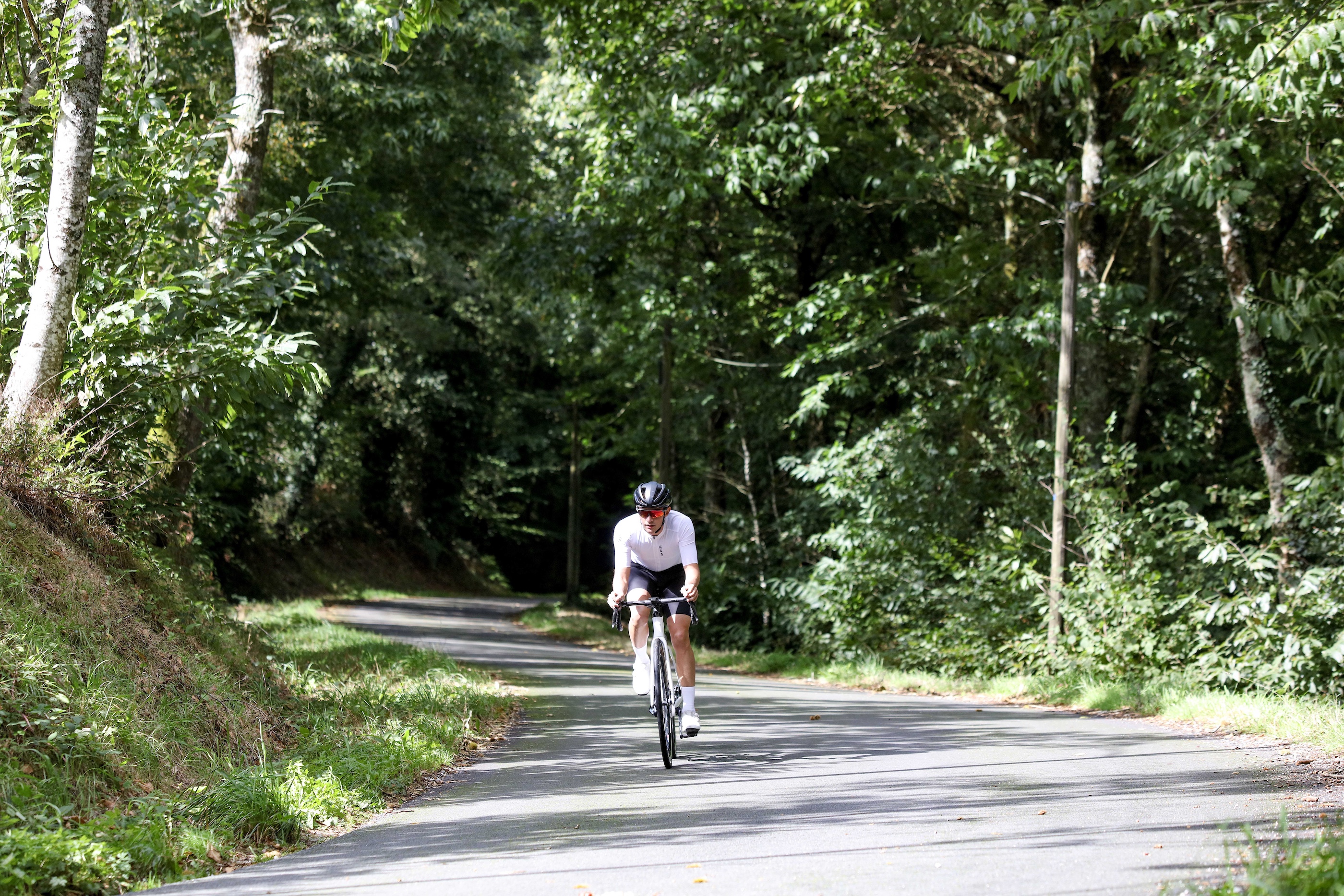
The roads around Brittany are quiet, and often surrounded by greenery
(Image credit: Kevin Raymond)
You’ll know the Mûr de Bretagne climb as a staple of the Tour de France, and on race day it’s a riot of noise and colour. But subtract the clamour and what’s left is a graffitied stretch of tarmac up a hill in the middle of nowhere.
As we climb through the town, there are vestiges of the recent Tour everywhere; the town hall remains wrapped in polka dots and all the shop windows and public spaces are still decorated. Out of the town, we take a brief downhill, across the N164, and then it’s just a straight run to the top.
After a steady initial drag, it ramps up sharply, the middle section averaging around 10%, with spikes over 15% before it flattens out over the top, and you come to a halt gasping in a windswept gravel layby. There’s not even a nice view. Mont Ventoux it ain’t – but the authorities have recently installed a big sign congratulating you for conquering the climb of… no, it’s not the Mûr de Bretagne after all – that’s the name of the nearest town. It’s the Côte du Menez Hiez, ‘menez’ meaning hill or mountain in Breton.
We’re running out of time but we squeeze in a visit to the beautiful walled village of Moncontour, where we find cobbles, tiny back lanes, charming houses and a really good brass band playing outside the church. Leaving our campsite the next morning we get an unexpected bonus. Under the trees in the park next door is an asphalt oval, lumpy and leaf-strewn but recognisably a velodrome.
It was built in 1909 and during its post-war heyday, from 1948 to 1984, it hosted an annual event as part of the post-Tour circuit of criteriums and exhibition events where the big names of the peloton faced off in a series of largely choreographed races in a village fête atmosphere.
Each new road on this short trip has revealed another layer of the region’s rugged character and rich history
Kevin Raymond
We decide that it would be rude to leave now without doing a few laps in homage to those great days.
Cycling in Brittany is a reminder that the sport is about far more than racing or ticking off famous climbs. It’s about the landscapes that shaped the riders I once watched on grainy TVs; the small towns that still celebrate their heroes decades on; the hidden lanes where I first struggled to hold my dad’s wheel; the quiet bays where the road runs out; and the climbs so much steeper than they looked on the screen.
Each new road on this short trip has revealed another layer of the region’s rugged character and rich history. No wonder it has produced so many champions. And the best part is that there’s always more to discover. We’ve barely nibbled at the edges this time, but I know Brittany will keep calling me back just as it has been ever since those first family trips all those years ago.
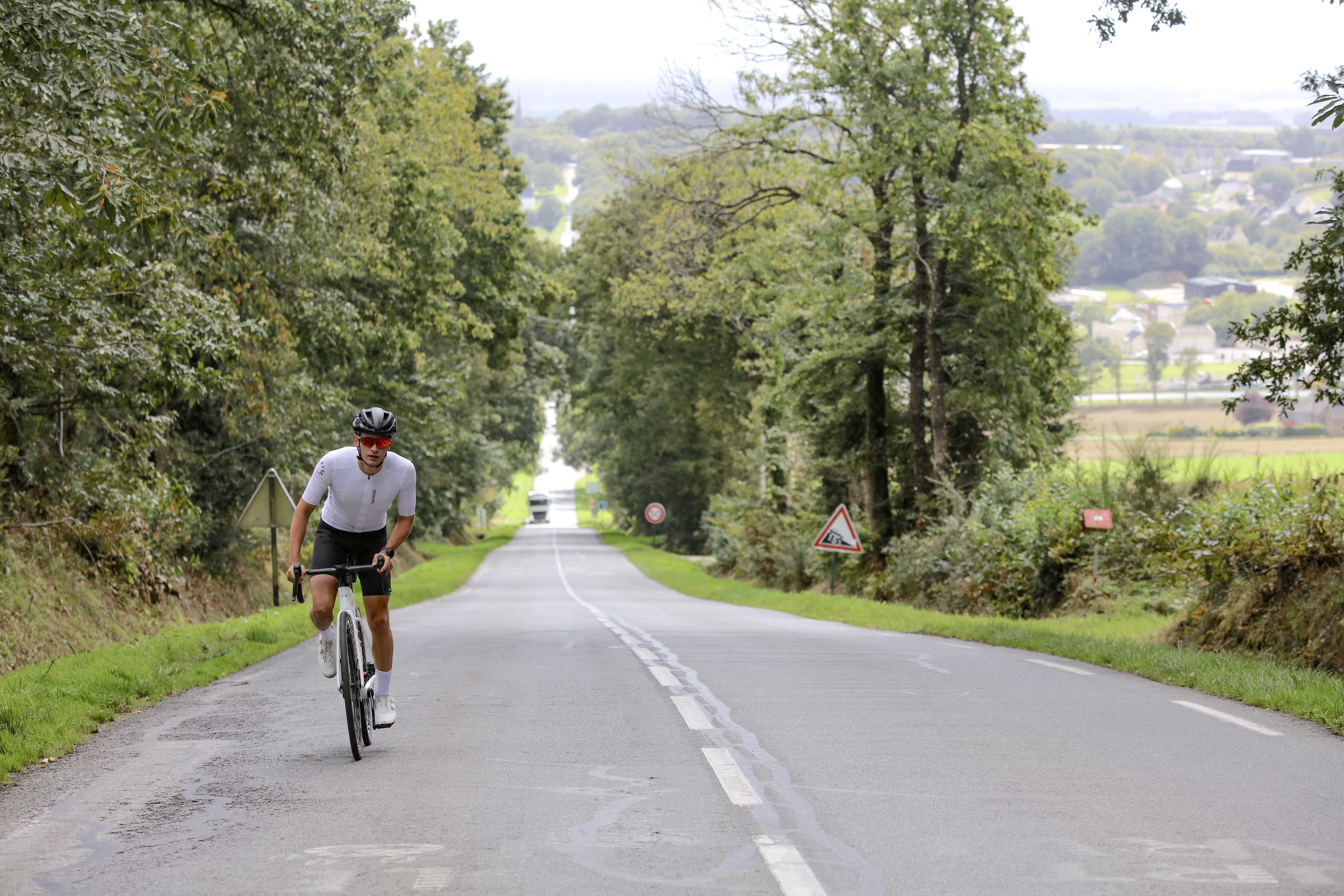
(Image credit: Kevin Raymond)
Essential information for riding in Brittany
How to get there
The easiest way is via Brittany Ferries from Plymouth, Poole or Portsmouth into Roscoff, Cherbourg, Saint-Malo and Caen respectively. Another option is to fly into Rennes (Easyjet flies from Manchester and Gatwick from as little as £25 each way) and hire a bike. Abicyclette Voyages in Rennes rents out all types of bike (from €160 per week).
Where to stay
We stayed at the very modest Camping Municipal in Quintin. One night for two people, a tent and a car came to a mighty €7. Don’t leave without spinning a few laps on the ancient open-air velodrome next door.
When to go
July and August are very busy – Brittany’s hugely popular with French tourists, but it’s a real draw for Dutch and Germans as well. Autumn is quieter, with less pressure on hotels and campsites, but don’t leave it too late as many campsites will be closed by the end of September.
Eating and drinking
If you’re a seafood fan, you’ll be in heaven anywhere on Brittany’s coastline. We enjoyed a world-class plateau de fruits de mer for lunch in Cancale, just east of Saint-Malo. If you prefer terre to mer, the lamb from the Prés Salés (salt marshes) is hard to beat, though pricey.
On a more modest budget, you’ll find galettes (buckwheat pancakes) filled with cheese, ham, mushrooms for less than €10. Top it off with a slice of Far Breton (a sort of custard flan with prunes) or Kouign-Amann (pronounced ‘queen uh-mon’), a rich, buttery pastry.
Cycling routes and events
Brittany is well served with cycling routes, from quiet, well-signposted rural roads (VeloRoutes) to a network of canal towpaths and old railway lines (Voies Vertes or Green Ways). The website brittanytourism.com is a good place to start, and links to the main France Velo Tourisme site for maps, elevations and more.
Brittany loves its bike racing, and highlights include the epic Tro-Bro Léon in May (called the Hell of the West for its hellish farm tracks and cobbles – and the winner gets a piglet. Yes, really). The more conventional GP de Plouay and Bretagne Classic take place in late August. For more, visit: cyclisme.bzh
Thanks to
Our thanks to George Bazley, who races with Montoir Atlantique Cyclisme, for joining us in Brittany to model for photos.
Cycling in Brittany – local knowledge
We caught up with Cyclo Club Chateaubourg, spectating near Vitré on stage eight of this year’s Tour. The club’s vice president Olivier Cavaloc says club cycling in the region is on the up.
“It’s a pretty healthy scene. When I started 30 years ago, we had 30 licence-holders, and now we have 105. We organise four or five rides a week. Today’s ride out to watch the Tour will be about 110km. Local favourites? David Gaudu, Warren Barguil, Kévin Vauquelin.” [Other club members heckle: “He’s not local, he’s from Normandy!”] “It’s real cycling country here. It’s not like the Alps, where you can’t ride in the winter. You can ride all year round. You have to be tough, but the rain’s not that cold.”
Breton local Marie-Françoise Lendrein and her husband were parked by the road for the Tour’s Mûr de Bretagne stage. “It’s lovely – a great atmosphere,” said Lendrein. “We’re from Finistère. Normally we follow every stage of the Tour but we’re getting older and it’s getting harder to find somewhere to park the van by the side of the road, so this year we’re just doing the Brittany stages.
This year, by accident, we were next to Adrien Petit – he’s retiring soon and he’s not riding the Tour but he was out to cheer on his Intermarché-Wanty team-mates. We’ve known him for years. A lovely man.”