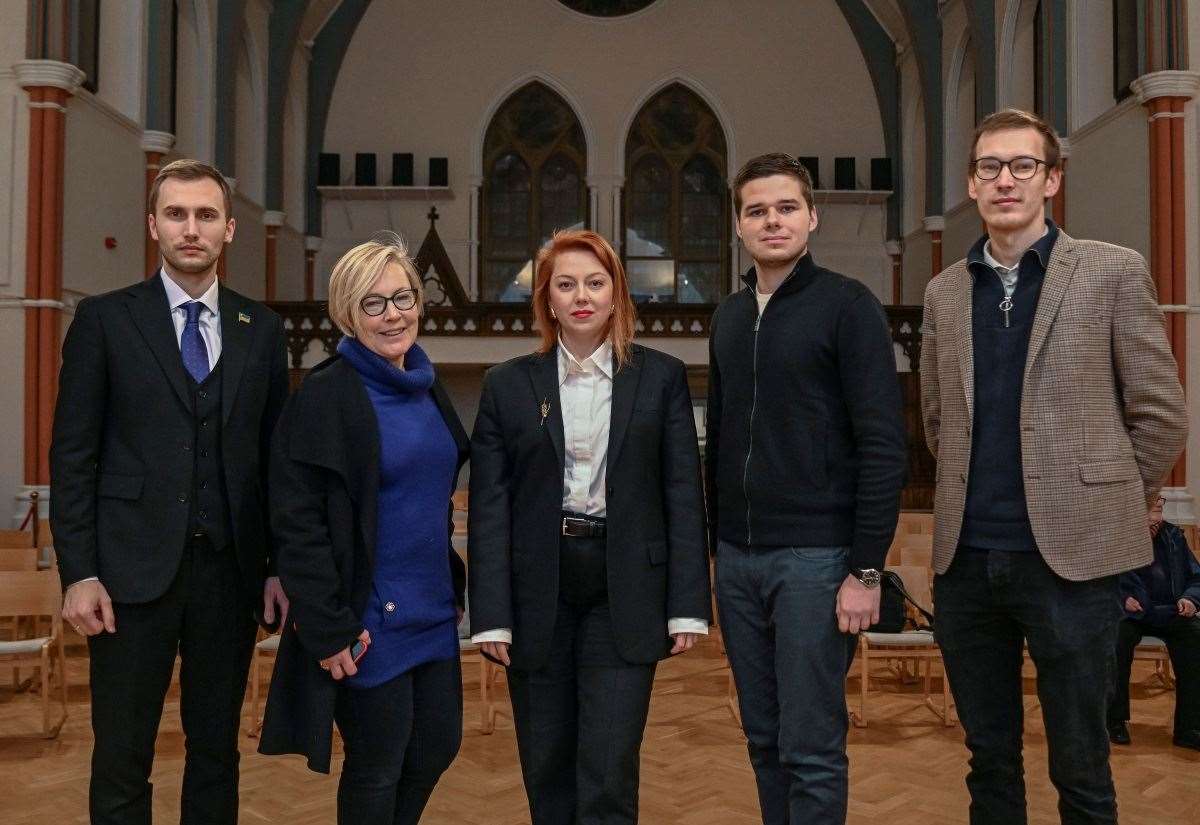
Cambridge welcomed the Cambridge alumna deputy minister of communities and territories development of Ukraine, Alyona Shkrum, to the city for an in-conversation evening at Downing Place United Reform Church.
Moderated by Gillian Tett, the Provost of King’s College, the visit last week was part of a wider mission to raise reconstruction funds to rebuild Ukraine’s infrastructure, including housing, energy farming and industrial sectors.
 From left at Downing Place UR Church are Artem Husak, director of Ukraine’s Department of European Integration and International Cooperation; Gillian Tett, Provost of King’s College; Alyona Shkrum, First Deputy Minister of Communities and Territories Development of Ukraine; Erik Kucherenko, policy and legal adviser to a member of the Parliament of Ukraine, and Andrii Smytsniuk, associate professor in Ukrainian at the University of Cambridge and chairman of Cambridge4Ukraine. Picture: Keith Heppell
“We need help on innovative reconstruction strategies,” said Ms Shkrum, speaking to the Cambridge Independent ahead of the Cambridge Ukrainian Studies event organised by Andrii Smytsniuk.
Confessing to feeling “very nostalgic”, she said: “I matriculated in 2012 and came back for friends’ graduations ten years ago but since it became a horrible crazy world with covid and then the invasion, so it feels like another life, but I’m happy to know that there are a lot of Ukrainians here [in Cambridge], and there are lots of very important things happening here.”
After obtaining her law degree she entered Ukraine’s national parliament for ten years before becoming deputy minister in 2014. Her job now is to coordinate Ukraine’s reconstruction efforts. While Ukraine is seeking – and receiving – assistance from the financial sector in the UK, Europe and Japan, the Ukraine government is looking to further sanctions on Russia “to punish Russia for starting this war because if this doesn’t happen then Iran, North Korea and other countries will see that aggression pays off”.
Kier Starmer, UK prime minister, with Ukraine president Volodymyr Zelenskyy. Picture: PA
The message is partly financial, and includes negotiating access to frozen Russian assets, estimated by the UK government to be £28.7billion in the UK alone as of October 2025.
But as well as an appeal for resources, the deputy minister’s visit is a reminder of the wider outcomes from the war – aggression, though most clearly manifested by the unprovoked invasion of Ukraine by Russia in February 2022, is also taking place elsewhere. Russia is exploiting political, military and economic weaknesses in ways that already threaten UK interests.
These transgressions, and the ongoing hybrid warfare they represent, were further unpicked during the session with Gillian Tett.
“As a journalist and an economist in various geeky parts of the world everyone likes to ignore, I’ve been obsessed with undersea cables and the shadow fleet,” Dr Tait said. “Our internet won’t work without these cables. The internet could go down very easily if these attacks continue.”
“Yes, there are 1,500 tankers illegally carrying Russian oil,” Ms Shkrum replied. “India and China are the biggest buyers – they work around international law.”
Gillian Tett , Provost of King’s College and member of the editorial board for the Financial Times, right, with the First Deputy Minister of Communities and Territories Development of Ukraine, Alyona Shkrum at Downing Place United Reform Church
In September, MPs and Peers on the Joint Committee on the National Security Strategy warned that the UK’s undersea internet cable network represents a strategic vulnerability in the event of hostilities. The report criticised the inadequacy of security preparations and argued for “more muscular deterrence” measures. Meanwhile the Royal Navy has intercepted two Russian ships in UK waters in the last two weeks, and RAF flights have been disrupted by lasers beamed from Russian ships.
Ukraine has a lot to offer in the new hybrid warfare challenges of the new landscape: its skills on the battlefield have resulted in a very advanced use of drones and also a very robust energy sector which includes building houses with minimal energy requirements and loss.
Pro-Ukraine march in Cambridge. Picture: Krisha Cabrera
The situation, noted Dr Tett, “is going to create a lot of systems, models and products which are going to be useful for the rest of the world, not least in terms of green energy”.
Dr Tett went on to suggest that the UK can only take advantage of these opportunities when the true picture becomes apparent – “the level of complacency in the UK and other places is absolutely shocking”. She noted wryly that 90 per cent of trains in Ukraine run on time – “I wish that were true for the Cambridge to London service!”.
“I’m optimistic,” Ms Shkrum said in conclusion, before returning to London for a series of meetings. “Great Britain has been incredibly helpful, and continues to support Ukraine, with other countries. But we need to be very, very careful.”