NEWS ANALYSIS: The initiative seeks to harmonize abortion access across the continent by circumventing national sovereignties, pushing toward the most permissive standards.
Strasbourg, France — A campaign around the European citizens’ initiative “My Voice My Choice” has put the issue of European Union interference in national abortion policies back on the continental agenda.
The initiative, debated at the European Parliament on Dec. 2, after gathering 1.2 million signatures last year, seeks to pressure EU institutions to fund access to abortion for women who cannot obtain it in their own countries — a significant shift in a political system where health policy has traditionally remained a national prerogative.
A European Citizens’ Initiative (ECI) allows citizens to request that the European Commission propose legislation if they gather at least one million verified signatures across at least seven EU member states. An ECI does not automatically create law but requires the commission to examine the proposal.
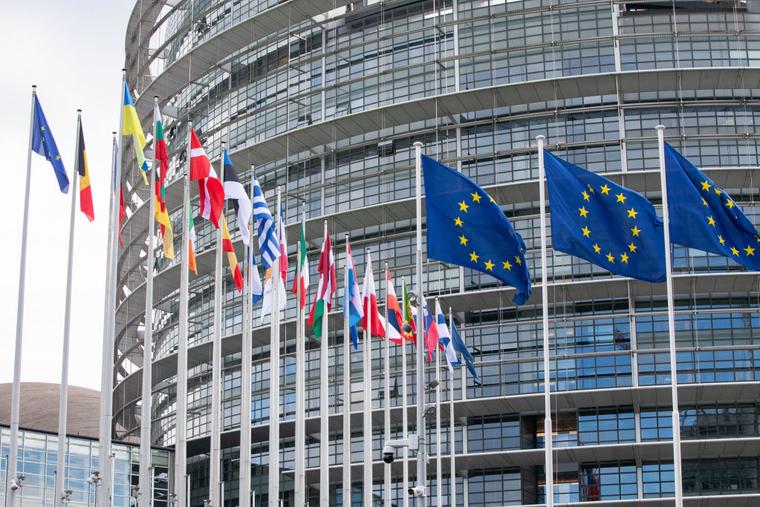
This debate already reached a visible flashpoint on Nov. 26, when demonstrators rallied outside the European Parliament in Strasbourg as lawmakers and legal experts gathered for a conference critically examining the initiative. The event, titled “My Voice My Choice: A Legal, Moral and Financial Fraud,” presented an uncompromising analysis of this campaign, which is part of a broader debate on abortion, transparency and power struggles within the EU. It was organized by Spanish MEPs Margarita de la Pisa and Jorge Buxadé, with the participation of Hungarian MEP András László and experts from the European Centre for Law and Justice (ECLJ), a Strasbourg-based NGO defending human rights and the dignity of life.
The Endless Echo of Roe v. Wade
In recent years, the European debate over abortion has accelerated dramatically. The overturning of Roe v. Wade in the United States in 2022 sent political shockwaves across Europe, prompting several governments to harden their own positions on the issue. France amended its own Constitution to enshrine abortion as a fundamental right, and leading EU officials have since argued that the procedure should be regarded as a fundamental right protected at the European level. Within this climate, “My Voice My Choice” seeks to create a form of harmonization by enabling EU funding for abortion across the continent.
While the Strasbourg conference acknowledged that the ECI resonates with certain fears experienced by women facing unsupported pregnancies, the speakers challenged the way the campaign was built, financed and promoted — and the ultimate goal behind the initiative.
That main warning was that “My Voice My Choice” presents itself as a grassroots petition while relying on a sophisticated constellation of well‑funded NGOs tightly linked to U.S. foundations and EU institutions. Grégor Puppinck, director of ECLJ, underscored the contrast between the initiative and the 2013 European Citizens’ Initiative “One of Us”, whose goal was to end EU funding of activities involving human embryos and gathered more than 1.7 million signatures through volunteers’ actions.
By contrast, he argued, “My Voice My Choice” draws its strength from professional structures whose budgets outstrip those of most national pro‑life groups. “One must ask,” he noted, “how it is that organizations promoting abortion are so rich — richer each year — and so deeply connected to government structures.”
A recent analysis presented during the event sheds light on this disparity. Out of the 254 organizations supporting the ECI “My Voice My Choice,” the 51 that published transparent accounts show a clear pattern: 19 receive EU funding, 20 receive financing from George Soros’ Open Society Foundations, and several maintain operational ties to the International Planned Parenthood Federation. IPPF’s European network alone has received more than 3.2 million euros in EU funds in recent years. Such figures, speakers argued, complicate the initiative’s claim to represent a spontaneous outpouring of public will.
Hungarian MEP András László, for his part, illustrated how these dynamics play out at the national level. Recalling Hungary’s experience during and after the 2015 European migration crisis, he described how a network of foreign‑funded NGOs suddenly gained visibility and influence in domestic political debates — often presenting themselves as representative civic actors despite relying overwhelmingly on funding from abroad. “Strong NGOs popped out of nowhere,” he said, noting that many later turned out to be indirectly financed through EU programs.
Growing ‘Soft Discrimination’
Against this backdrop of funding networks and political influence, legal expert Nicolas Bauer shifted the focus to how these dynamics translate into institutional practice within the EU. Bauer described a growing “soft discrimination” inside EU funding programs that has progressively marginalized Christian, family‑oriented and culturally conservative NGOs.
He recounted how his own networks submitted projects on child protection and youth mental health — initiatives unrelated to ideological debates — yet saw them rejected on the grounds that they conflicted with undefined “EU values.” Meanwhile, organizations promoting abortion rights routinely secured funding. For Bauer, this results in an EU environment in which “neutrality exists on paper, but not in practice,” and in which life‑defending voices find themselves structurally sidelined.
Several speakers stressed that the current political and cultural climate surrounding abortion is concretely impacting personal lives — a reality made visible in the testimonies of two women who testified to having undergone abortions in an environment shaped by limited support and prevailing abortion-minded mentalities; both women said they deeply regretted their abortions afterwards.
The deeper danger of “My Voice My Choice,” according to those critics, lies in its symbolic power at a time when European institutions are increasingly inclined to redefine abortion as a cornerstone of European identity. The uproar provoked by the recent veto of Prince Albert II of Monaco against liberalizing abortion law — a near‑unique stance in contemporary Europe — highlighted how few jurisdictions now diverge from the continent’s otherwise broadly permissive landscape.
The Strasbourg discussion made clear that this European Citizens’ Initiative, if it were to become law, could cement a vision of Europe that leaves little room for those who defend unborn life.