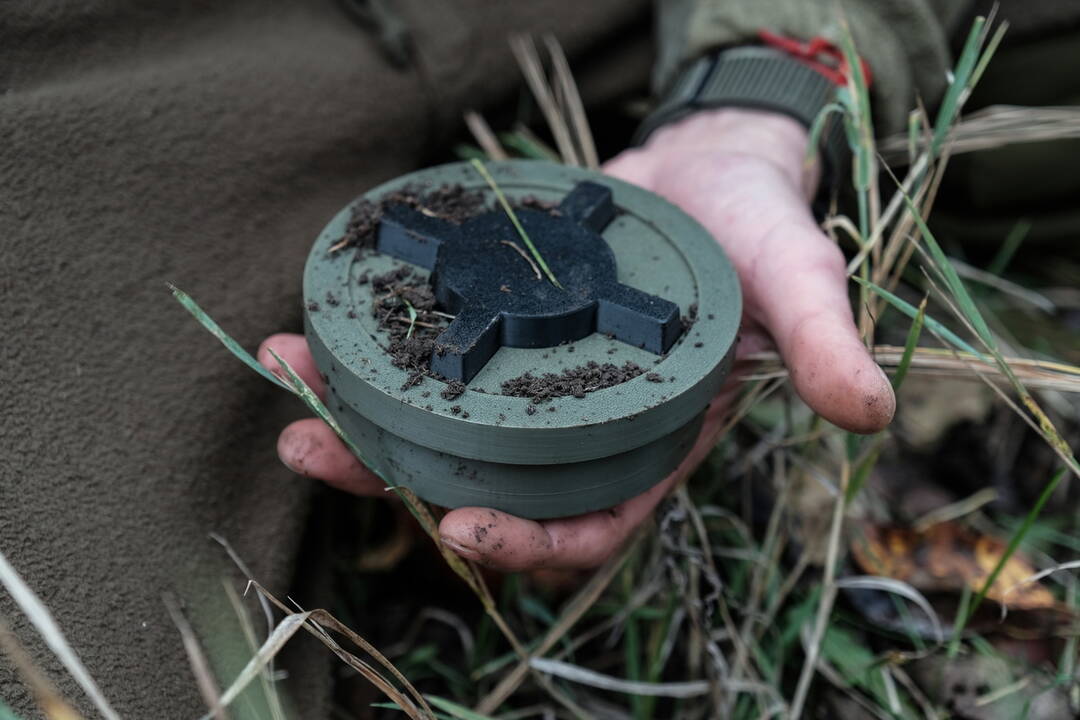
Ukraine’s decision to park its obligations under an international treaty banning anti-personnel landmines as it battles Russia’s invasion has triggered pushback from its European allies and NGOs, which warn that it deals a blow to international law.
Inside the Palais des Nations’ cavernous Assembly Hall, Ukraine’s seat was conspicuously absent on Tuesday as states convened under the Ottawa Convention banning anti-personnel landmines. But an unprecedented decision it made this summer triggered heated reactions. A wave of states, including several of Ukraine’s closest western allies, publicly challenged Kyiv suspending its obligations under the treaty, warning that it threatened to reverse decades of progress against the explosive weapons that continue to harm civilians long after a conflict has ended.
European countries, including Belgium, Austria, Switzerland and the United Kingdom, as well as South Africa and Mexico on behalf of a group of Latin American countries, took to the floor to urge Kyiv to re-engage with the treaty.
While acknowledging the extreme pressures Ukraine faces as it defends itself against Russia’s full-scale invasion, they stressed that the Ottawa Convention does not legally permit suspension, notably in times of conflict.
Mounting pressure
The 1997 convention, which prohibits 166 states from producing, stockpiling or using anti-personnel landmines, has been under mounting pressure after five other countries bordering Russia – Latvia, Lithuania, Estonia, Finland and Poland – this summer began a six-month withdrawal process in the face of what they say are growing military threats from Moscow.
In July, Ukraine formally notified the United Nations it had followed suit and temporarily halted its obligations under the treaty, days after signing a decree, citing extraordinary pressures amid its ongoing war with Russia. Defending the decision this summer, President Zelensky said the explosive devices were an “irreplaceable tool in defending the country”. Russia, which is not party to the treaty, has used anti-personnel mines extensively in Ukraine, according to soldiers, analysts and rights groups. Ukraine has also used the weapons, although the extent is unclear.
Incomparable human cost
In Geneva, where states are meeting under the Ottawa Convention, Kyiv’s decision triggered unusually frank diplomatic pushback. This comes as US officials travelled to Moscow to meet with Russian president Vladimir Putin to discuss Washington’s peace plan, returning without any visible tangible results. Meanwhile, Nato foreign ministers gathered in Brussels to discuss Ukraine amid ratcheting tensions.
“Ukraine continues to face impossible choices in its existential fight against Russia, for Ukraine sovereignty and for Ukraine’s territorial integrity,” said David Riley, the UK’s disarmament ambassador, sitting next to Ukraine’s empty seat. “The UK, though, is clear that the APMBC (Anti-Personnel Mine Ban Convention) itself does not allow for suspension of operations of the convention.”
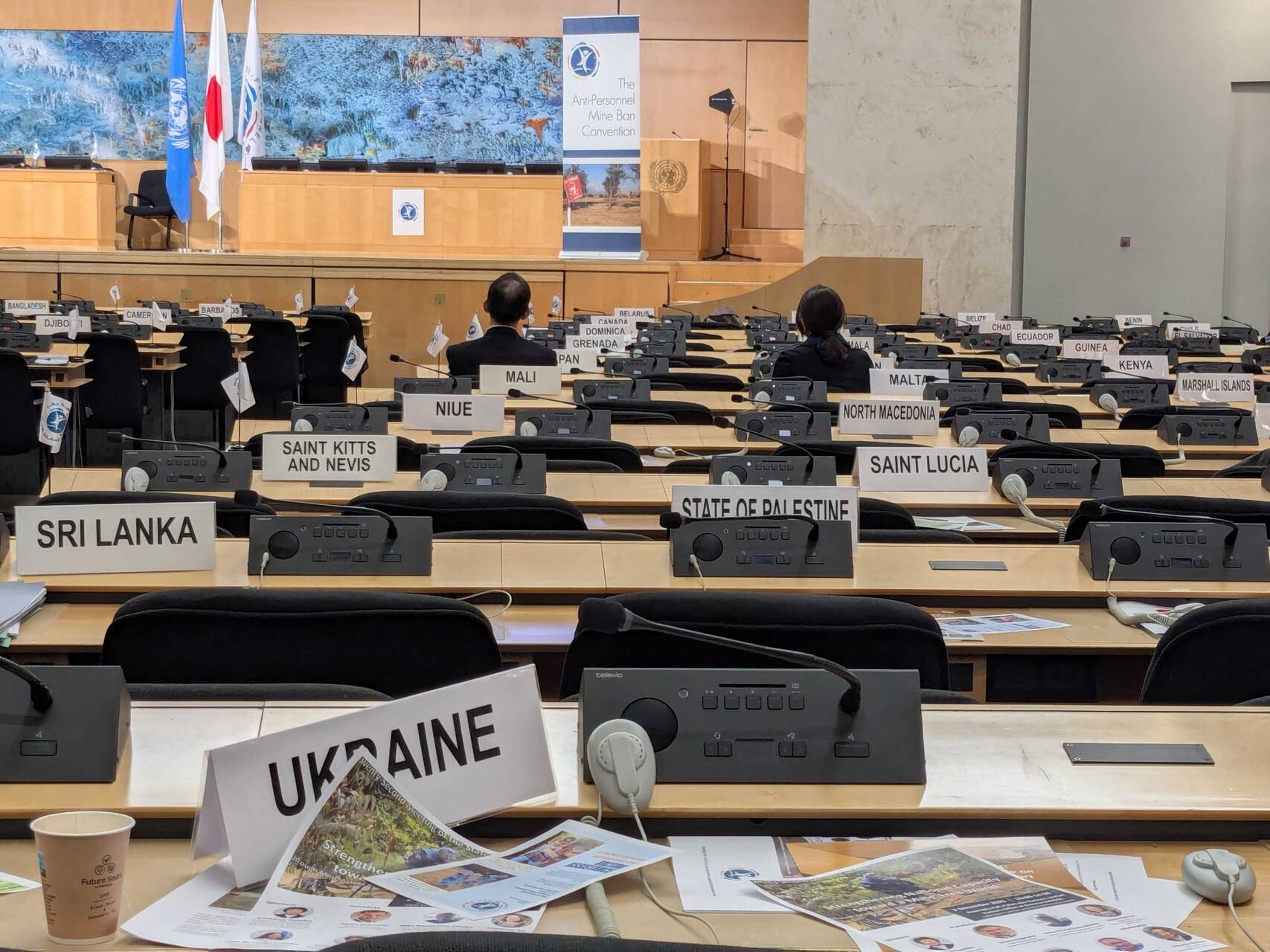
Ukraine’s delegation did not attend the 22nd meeting of states parties to the Anti-Personnel Mine Ban Convention, which took place from 1-5 December 2025 at the UN European headquarters in Geneva (Geneva Solutions/Kasmira Jefford)
Belgium, a long-time champion of the treaty, delivered one of the most explicit statements, rejecting any notion that anti-personnel mines can be justified by military necessity. “Even in our right to self-defence, we are governed by certain rules. If not, we could witness the proliferation of weapons of mass destruction,” its delegation said, adding that the use of mines cannot be reconciled with international humanitarian law. “The military utility of these crude weapons will never outweigh the humanitarian cost. This calculus was made three decades ago and remains as relevant today.”
Belgium is one of several states, including Austria, Norway, Switzerland, Ireland, France and New Zealand, to have sent either a formal objection or a statement highlighting the suspension’s incompatibility with the treaty, to the UN secretary general since October.
‘Dangerous race to the bottom’
While not legally binding, human rights groups are hopeful that the more statements issued by states parties against Ukraine’s suspension will result in a firm rebuke reflected in the final report issued by the convention’s president, Japan’s disarmament ambassador Tomiko Ichikawa, at the end of the week.
“States should be explicit and agree collectively to language stating that it is unlawful to suspend one’s obligations,” Gerry Simpson, associate director in Human Rights Watch’s conflict and arms division, told Geneva Solutions on the sidelines of the meeting. He warned that not doing so would set a dangerous precedent for international law. “What’s to stop any other country doing the same thing – cherry picking which parts of a treaty it follows?”
Speaking earlier that morning, all five Baltic countries withdrawing from the treaty defended their decision amid a deteriorating security environment. Latvia cited explicit threats issued by Russian officials, as well as regular airspace violations, hybrid attacks targeting underwater infrastructure, persistent GPS interference and acts of sabotage. “These hostile activities form a pattern of behaviour, demonstrating that further aggression by Russia against other states cannot be entirely ruled out,” its ambassador Ivars Pundurs said.
NGOs and rights organisations, however, argue that it is precisely in times of conflict that humanitarian disarmament treaties need to be upheld. Last year, 6,279 people worldwide were injured or killed by anti-personnel mines and ammunition remnants – the highest level since 2020, according to a report released Monday by the International Campaign to Ban Landmines, a coalition of NGOs. The majority of deaths and casualties (90 per cent) are civilians, while nearly half are children.
Addressing the conference on Monday, Gilles Charbonnier, vice president of the International Committee of the Red Cross, said steps taken by states to withdraw or suspend the convention “risks eroding life-saving protections and decades of global efforts towards a mine-free world”.
“Preparing for war by abandoning treaties that protect humanity in armed conflict is the wrong choice. Such treaties are precisely meant to make a difference and protect people in wartime.”
In a video message to the conference on Monday, UN secretary general Antonio Guterres warned: “Any weakening of the Ottawa Convention could spark a dangerous race to the bottom.”
Speaking to journalists in Geneva on Tuesday, Izumi Nakamitsu, the under secretary general and high representative for disarmament, said her office had engaged extensively with the five withdrawing states: “We don’t live in an ideal sort of dreamland…we do definitely acknowledge the new security landscape, especially in this continent. That does not mean that states have to rely on a particular indiscriminate weapon system.”
She added that the priority now was to ensure no other states take steps to withdraw from the treaty.