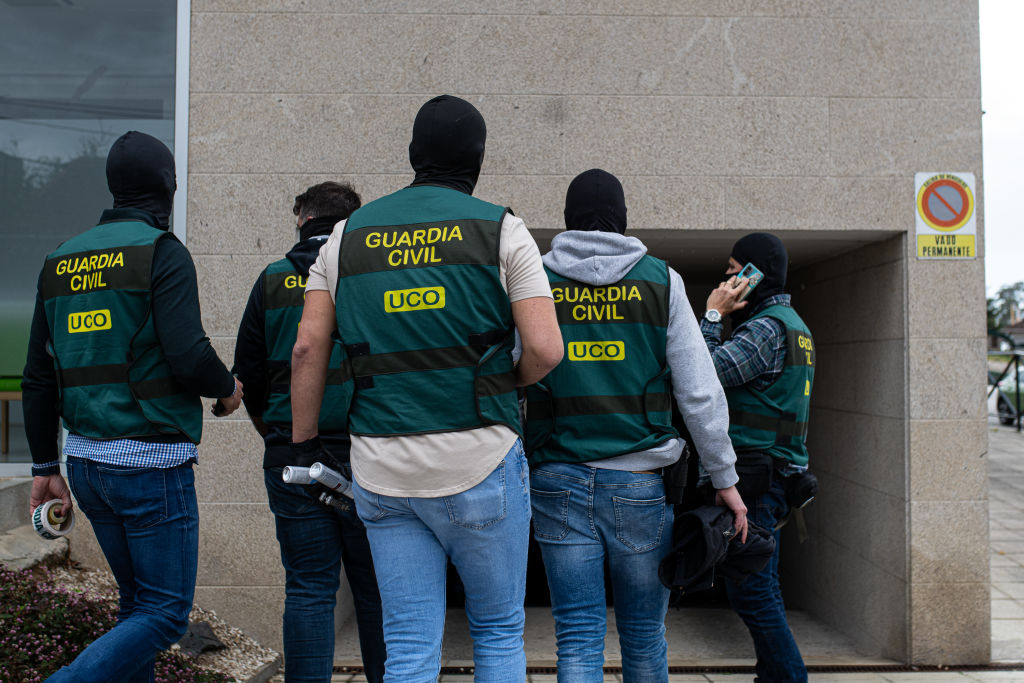
MADRID – Once a little-known elite unit, the Spanish Civil Guard’s Central Operational Unit (UCO) has become an unexpected protagonist in Spain’s latest political crises, as its corruption probes increasingly touch the inner circle of Prime Minister Pedro Sánchez.
This week, controversy erupted after it emerged that the Interior Ministry had promoted Colonel Rafael Yuste, UCO’s widely respected chief, effectively removing him from several high-profile investigations – including the so-called “Koldo case,” a kickback-for-contracts scandal that has engulfed Sánchez’s Socialist Party (PSOE).
Local reports quickly suggested the move was a speedy promotion designed to place someone “more susceptible to pressure” at the helm. Civil Guard sources insist the promotion followed “normal procedures and timelines,” but the episode underscores how intensely scrutinised every shift inside UCO has become in the country.
What is UCO?
UCO operates within the Civil Guard’s Judicial Police Command and works exclusively under judicial orders. The Civil Guard – a militarised force of 87,000 agents – is one of Spain’s two national police bodies alongside the National Police.
Created in 1987 to combat organised crime, UCO has since evolved into one of Spain’s most prestigious investigative units, specialising in corruption, organised crime, drug and human trafficking, and cybercrime.
To prevent leaks, assignments are tightly restricted: even senior commanders are not informed of ongoing developments from specific cases entrusted to one of UCO’s roughly 600 investigators. Finished reports go directly to judges and prosecutors.
However, the unit is suddenly receiving more attention than usual, having been thrust into the political spotlight due to its investigations into Sánchez’s wife and brother – both facing separate court proceedings – and a National Court probe into the PSOE’s financing. Combined with the explosive “Koldo case,” UCO’s work has become central to several scandals shaking Spanish politics.
Under the spotlight
UCO’s reports, when leaked, routinely send shockwaves through Madrid, with ministers, MPs, and major business figures appearing in their pages.
“The media attention is excessive. There is no precedent for this,” said Domingo Medina, secretary of the Spanish Association of Civil Guards (AECG).
Historically, UCO led probes such as the Gürtel case, the corruption scandal that toppled Mariano Rajoy’s Popular Party (PP) government in 2018. But some agents now warn of mounting attempts to interfere with their work.
Never before have media outlets, political parties or organisations “put so much energy on discrediting the unit,” an agent told Euractiv. The logic follows that “if I manage to create a climate of discredit for the police unit, by extension I discredit its investigations,” they added.
“Any attempt to influence or dismantle its work is a direct attack on the heart of the rule of law,” said Daniel Fernández, spokesperson for the Independent Civil Guard Association (IGC).
Recent cases, including the prosecution of Socialist official Leire Díez – accused of orchestrating a smear campaign against UCO agents and prosecutors investigating the prime minister’s entourage – have further fueled the media spotlight on the force.
Still, UCO investigators insist they remain focused despite political turbulence. “The attempts to discredit the unit are not a concern,” Medina said. “The unit is prepared.”
What they want most, Fernández concluded, is simply “to work without media pressure or being used as a political weapon.”
(cs, cm)