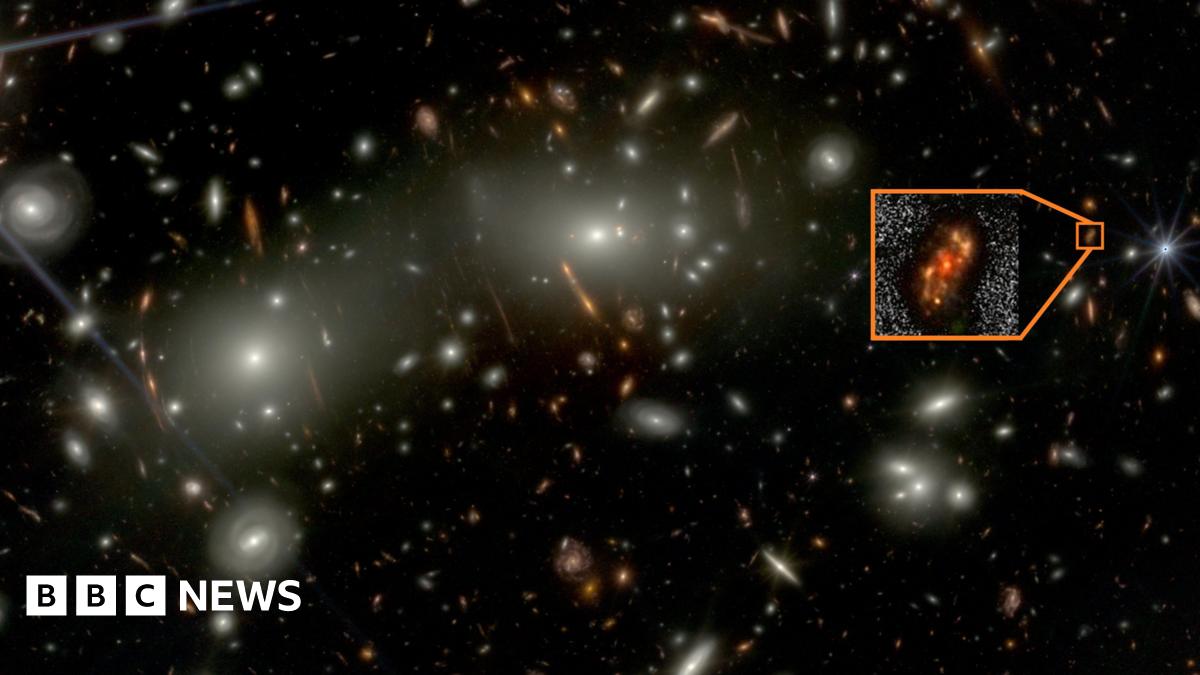
According to Nasa, there are an estimated hundred billion galaxies and many began forming within millions of years of the Big Bang.
Astronomers have long believed that the Universe at the time – a period known as cosmic dawn – was very chaotic and the galaxies were small and low in mass.
“But this galaxy is a different beast,” says Prof Wadadekar. “It’s massive, it’s one-third of the Milky Way in size, and has 10 billion stars. The galaxy is forming new stars at a rate that’s roughly 20-30 times faster than our Milky Way’s current star formation rate.”
Since James Webb began operations, astronomers have been finding newer, more distant galaxies.
In images shared by Nasa in initial years, many looked like red blobs or a faint smudge.
But in recent years, Webb has been discovering more sophisticated structures, including spiral galaxies – and the new galaxy’s discovery adds to that pile of growing evidence that early Universe was much more creative.
“Finding such a well-formed spiral galaxy so far back in time is a rare exception, but such exceptions challenge our understanding of the universe’s early past and how galaxies formed and evolved,” Ms Jain says.
“This galaxy shows that Universe was much more mature early on and that sophisticated structures were being built in our universe much earlier than we thought possible,” she adds.
The information about the new galaxy, however, is from 12 billion years ago – the galaxy lies at a distance from where its light has travelled for that many years to reach us.
“We can see into the past because the light has reached us. A galaxy’s lifetime is so big that we can’t see it from start to finish, so we do statistical studies,” says Ms Jain.
So is there a status update? What’s happened to it? Is it still there – and in what shape and form?
“When people ask me about where it is at present, I tell them wait for 12 billion years to see where it is now,” says Prof Wadadekar.
For the moment though, the researchers say they would apply to do follow-up observations with James Webb or the Alma observatory in Chile to understand how the newly discovered galaxy managed to create its spiral arms. Because the keys to our present and future, they say, lie in the past.