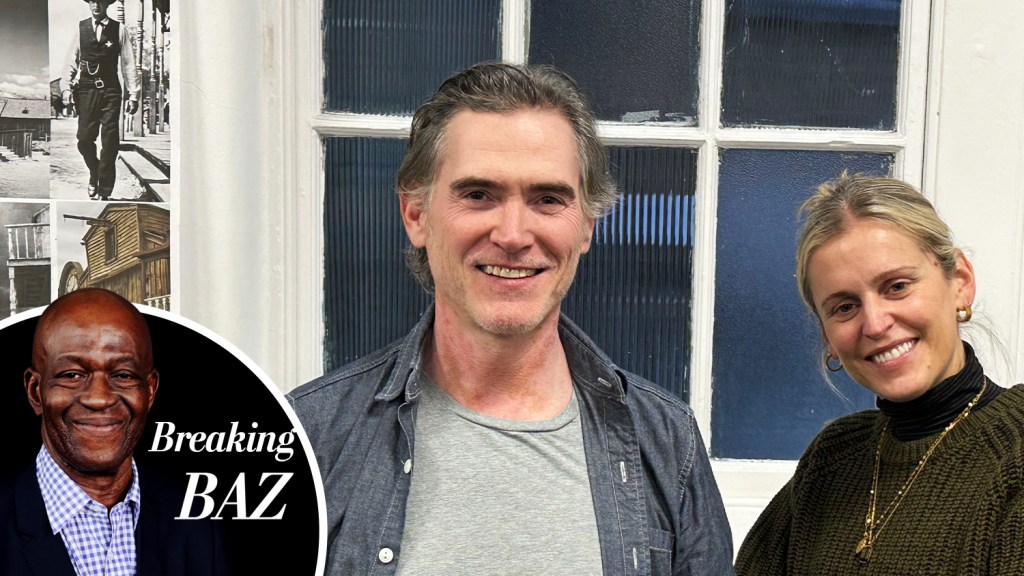
EXCLUSIVE: The clock is ticking as Billy Crudup (The Morning Show) and Denise Gough (Andor) run a scene from Oscar-winning writer Eric Roth’s stage adaptation of High Noon, director Fred Zinnemann’s classic movie Western released at the height of McCarthyism and the Red Scare.
Mood boards adorn the walls of the rehearsal hall in Clerkenwell, London, with images of Gary Cooper and Grace Kelly — who played the key roles of just-retired Marshal Will Kane and his newlywed bride Amy Fowler in the 1952 film scripted by Carl Foreman — plus faded portraits of real-life 1870s frontier folk and blueprints of Tim Hatley’s design’s for the play’s fictional New Mexico Territory town of Hadleyville, where bad men are headed on the noon train out for vengeance and Kane is their target.
There’s a makeshift clapboard buggy in the center of the room as Thea Sharrock, the play’s director, and a phalanx of creatives consider various design options for the thrilling theatrical event that begins performances at the Harold Pinter Theatre on December 17.
Industry titans Paula Wagner (Mission Impossible, Marshall) and Tom Werner (The Cosby Show, Roseanne) are producing, and they’ve stopped by for a visit.

‘High Noon’ mood board
Baz Bamigboye/Deadline
Wagner pauses to tell us that High Noon is being performed in real time. Like, whoosh! “Ninety minutes, no intermission, edge of your seat,” the onetime Tom Cruise agent says succinctly.
The film, she points out, “was an allegory for the ’50s. Now it’s an allegory for the world.”
Crudup and Gough are creatures who have prowled many stages. Crudup made his Broadway debut in Tom Stoppard’s Arcadia in 1995, and 16 years later he returned to perform in a revival. I also caught him in Jack O’Brien’s magnificent 2006 Lincoln Center Theater production of Stoppard’s epic The Coast of Utopia which won Crudup a Tony Award for Best Featured Actor.
Gough won an Olivier and a collection of other silverware for Best Actress for her leading role in People, Places and Things, Duncan Macmillan’s play directed by Jeremy Herrin that originated at the National Theatre and later transferred into the West End and then to St. Ann’s Warehouse in Brooklyn. She also won a Best Supporting Actress Olivier for the National’s sublime revival of Tony Kushner’s Angels in America, which moved to Broadway where Gough was nominated for a Best Featured Actress Tony.
However, it’s fair to say that both are better known in the wider world for their screen work. Crudup starred with Kate Hudson in Cameron Crowe’s Almost Famous, one of my favorite movies, and he’s currently to be seen delivering an angry monologue to George Clooney in Noah Baumbach’s Netflix film Jay Kelly.
And the thespian has won acclaim — and two Supporting Actor Emmy Awards — for playing the unscrupulous, high-wired TV and film executive Cory Ellison in The Morning Show, although we both agree that he behaves with uncommon magnanimity in Season 4’s final episode.
“He had to do the right thing, finally …” he retorts.
I greet Gough and start to say, “So you play…,” a sentence she merrily completes by joking, “Grace Kelly, obviously.”
Are we supposed to think about the movie in this iteration, I ask?
“I would say, yes,” Crudup responds. ”Insofar as the iconography” is concerned, he adds.
Crudup notes that Roth’s adaptation of High Noon isn’t a Western about a Marshal. Rather he says, “It’s about people trying to get along in a civilized way in an absolutely lawless community,” like now, I suggest.
“Exactly,” Gough agrees.
Billy Crudup and Denise Gough at rehearsal for ‘High Noon’
Baz Bamigboye/Deadline
“Or before there were laws, or at every stage where somebody has disrupted the system of order that keeps us all civilized,” Crudup argues.
“And so how do you start to police an uncivilized community? Where do you start by saying what the truth is? Where do you start by saying what’s right and wrong? So those themes that the movie explores so well, I think, harkening back to those as well, it’s useful for us.”
Gough nods and adds that she believes High Noon is “about what a community does when faced with standing behind somebody with a moral conscience. So we’re seeing somebody trying to keep this community together and the community itself is fracturing off. And so what do you do when you’re called upon to be on the side of something true and just? And I do think that with the world the way that it is now, it’s very relevant to that.”
It seems to me that honor and justice aren’t words that come to mind much nowadays judging by what emanates from the corridors of power in the White House and Westminster, I point out.
“Well, but just not in the context we’re familiar with,” Crudup reasons. “They’re calling what we would call unjust things, just.
”They’re calling things that we would call lies, facts. So they’re using a lot of the same verbiage, but they’re referring to things that feel like bullsh*t,” he adds with a Cory Ellison level roar of indignation.
Theater is not just a big part of Crudup’s life; it’s a necessity. To him, theater is “being with my friends, talking about doing plays …To me, it’s like attending any kind of community forum, whether it’s church, whether it’s city council meetings, whatever, provokes a response in you about your civic obligation. Unless you live in the woods somewhere by yourself, you have some civic obligation. And it could just be paying taxes, but it could also be ingenuity. Something that you bring specifically to a group of people through your communication. And to me, it happens in the theater,” he says.
For Gough, the stage taught her about the world. “I left school really young, like 15. I had no education,” reveals the Wexford, County Clare native. “So my education came through plays. So Seán O’Casey taught me all about the history of my country and activated that part of me. But all the great American writers, I learned so much going to the theater, but not just going to the theater, reading the pieces of work,” she says, citing contemporary British playwright Ryan Calais-Cameron’s play Retrograde, about how a young Sidney Poitier grappled with race and McCarthyism early on in his career. The Kiln Theatre production transferred into London’s West End for a limited run earlier this year.
Gough was gripped, as was I, by Calais-Cameron’s “reimagining of Sidney Poitier in a room being asked to sign to betray all his colleagues and he doesn’t sign,” she says, recalling the drama’s impact.
“And so you learn about periods of history through going to the theater. And then at times when the world is in turmoil as we are now completely, to go and see something that hearkens to that I think is really powerful…,” she adds.
(L-R) Gary Cooper, Lon Chaney Jr, Grace Kelly and Eve McVeagh in ‘High Noon’
Everett Collection
Both Crudup and Gough speak with warmth and appreciation for the “grace,” “spirit” and “authority” of Roth’s adaptation of this seminal Western movie, his first work for the stage.
“This is a man who has had this enormous career,” Gough states as she ticks off his films — Forrest Gump, The Horse Whisperer, The Insider, Ali, Black Hawk Down, Munich, Dune: Part One, to name but a few of the titles he’s penned. “But what I loved about working with Eric so far is that his sort of, ‘this is not my world’ and letting us help to create the play so that it can be the best play.”
The beauty of the piece, it seems to me, is that it’s in no way just the film plonked on the stage of the Harold Pinter Theatre.
“It would be impossible to do the movie,” says Crudup, leaping out of his chair to make his point.
“You think about those cuts in the movie as the clock is ticking … How do you do that? I mean, put a lazy Susan out there and just have it rotate around really quick? So you have to reimagine the entire enterprise and leave it to Thea to bring in Tim Hatley and say, ‘Okay, we’ve got some ideas.’”
Gough makes the case that the part of Amy “wasn’t really anything in the film because back then those parts weren’t thought and considered in the same way. I mean, she [Grace Kelly] was wonderful and it was wonderful to watch, but doing the play we’ve been allowed to create this woman that is actually a much more fleshed out character.”
Or to borrow a Jane Fonda comment [in relation to Coming Home], the character of Amy is a “sun and moon in her own right.”
It’s been a privilege to see Gough’s career soar following her breakthrough in People, Places and Things. She’d been working towards that level of recognition, she says, for 15 years. One of her first interviews back then was with this writer, and she remembers telling me how she hadn’t had an acting job for 15 months and had been working as a cleaner.
“I’m still really good at cleaning,” she declares.
Tick-tock, my time is up with them and I swiftly scoot over to Sharrock before anyone can tackle me.
After directing a string of stage shows including After the Dance, The Bodyguard, The Sunshine Boys, Equus [Daniel Radcliffe’s stage debut] and Clarence Darrow with Kevin Spacey at the Old Vic, Sharrock turned to directing for the screen (Me Before You and Wicked Little Letters are but two of her pictures) before the Oxford University graduate has returned to her theatrical roots.
Sharrock cuts to the chase. “It’s a brand new play, there’s no two ways about it,” and even though there’s much reverence for the High Noon movie, she’s emphatic in stating that “we are on the journey of making it as theatrical as not only as it needs to be, but as it warrants.”
There’s also a fierce fealty to Roth’s script, which Sharrock expounds on. “What’s amazing is how it lends itself to theater and to being a theatrical piece because it is so humane in what it’s tackling. Morality, states of conscience, and it’s a love story. It’s kind of Greek and epic in its depth … Then you roll into that Eric, who is the most beautifully poetic wordsmith, and it’s his first play.”
Thea Sharrack watches ‘High Noon’ rehearsal
Baz Bamigboye/Deadline
The director marvels at Roth’s ability “to be poetic with his use of language — he just goes straight to the heart. So if you layer that into a kind of Greek classic structure of a story, which is really straightforward, you have something deeply theatrical that is ready to absolutely speak to a live audience.”
Sharrock is another who believes that High Noon “will resonate very profoundly,” as it did in its day.
I quickly ask Sharrock how they’ve built up the Amy Fowler role for Gough?
Sharrock praises what she terms ”the gift of Denise,” noting that the actress “lends her [Amy Fowler] immediately such a weight and a level of human understanding” and that the chemistry between Gough and Crudup “is completely natural and so respectful.”
I mention the heartbreaking production of Terence Rattigan’s After the Dance that she directed at the National Theatre in 2010 featuring unforgettable performances from Benedict Cumberbatch and Nancy Carroll; it’s become one of my handful of theatrical touchstones. Sharrock feels that High Noon might have a touch of After the Dance about it in terms of “the human soul.”
I exit the rehearsal hall and make my way to a makeshift green room next door to hang out with Wagner and Werner.
They tell me that it all started with Roth. “He’s wanted to do this for a long time,” Wagner explains.
Eric Roth at rehearsal for ‘High Noon’
Justine Matthew
“But Eric has never written a play,” Werner adds. “And so for him, this was really a labor of love that has turned into an exciting experience for Eric … He says to me, it’s the most spectacular experience of his life and he’s trusted us to get this to a point that it is at.”
Werner, reflecting similar comments from the show’s leads, says that “we’re living in a time right now where there’s really a lack of courage. And what’s exciting about it is that live theater is so important right now because the movie business, it’s a challenging business right now. And in theater you can experience something, and with great theater, it becomes an important part of your life.”
Wagner jumps in to note that more than ever the live experience has become “critical because it fulfills needs that are not readily available socially, culturally, even for young people, theater is more vital than ever because it brings people together. Communication, socialization, experience, shared experience,” says Wagner, who produced The Heiress on Broadway with Jessica Chastain and Pretty Woman: The Musical in New York City, London and elsewhere.
Smiling broadly, Wagner pointedly observes that “theater is the one place where you’re not going to be able to replace actors with AI on stage. You’re not going to be able to do that. Somebody will say, ‘Yes you can,’ but you won’t. And I think that the film business, which we’re part of, is finding its new identity…Film hasn’t gone away, it’s evolving into what it’s going to become. It’s not going away. It’s vital. It will happen. But the structures that made the film business are changing. There’s a consolidation and verticalization of everything.”
These are wise words from two titans of the entertainment business and we agree that we could discuss what ails the industry ad infinitum, but alas, they have more pressing matters, like: They have a show to put on, and the move into the Harold Pinter for tech run-throughs is just days away.
We chew the fat a tad about how High Noon was an allegory of the ’50s, but its scope resonates much further in the world today.
Tom Werner and Paula Wagner in London
Baz Bamigboye/Deadline
But Werner says that he doesn’t want to get too earnest about it “because it has to be entertaining.”
He adds, “But the fact is that we live in a world right now where people are not standing up for the right thing.”
Wagner cautions that the play isn’t medicine. “It’s entertainment,“ she insists, and that we can be entertained by things that make us think.
“Now, we’re not having horses and shoot ’em ups and riding across the stage … but it is a Western, it is set in the West, which is very symbolic to the world, the spirit of the Western, the settling of the West. Law and order in the West, all of these issues that came out of the West. So it’s not like medicine, it’s entertainment…, “ Wagner reasons.
The ensemble also includes Billy Howle (The Serpent, The Perfect Couple), Rosa Salazar (Play Dirty), Simon Chandler (The Crown, The Diplomat), James Doherty (The Gold, Say Nothing), Misha Handley (The Stranger), Joshua Hill (The Game, Pride), Jonah Russell (Kill List, Lady Chatterley’s Lover), Rebecca Lee (Miss Austen, Beyond Paradise) and Tim Steed (Breeders, The Crown).
Full ‘High Noon’ cast at first day of rehearsal
Justine Matthew
Set and costume design is by Tony and Olivier winner Tim Hatley (Life of Pi, Back to the Future The Musical), lighting design by Tony and Olivier winner Neil Austin (Harry Potter and the Cursed Child, Paddington The Musical, Born with Teeth), music by Chris Egan and sound design by Nick Lidster. The choreographer and movement director is Lizzi Gee, the fight director is Kate Waters, and the casting director is Jina Jay.