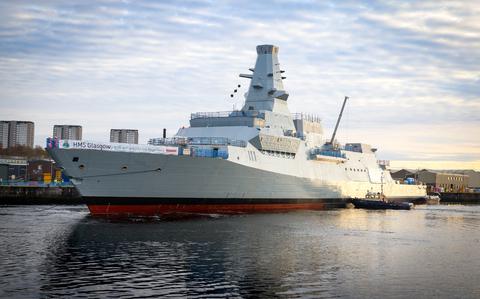
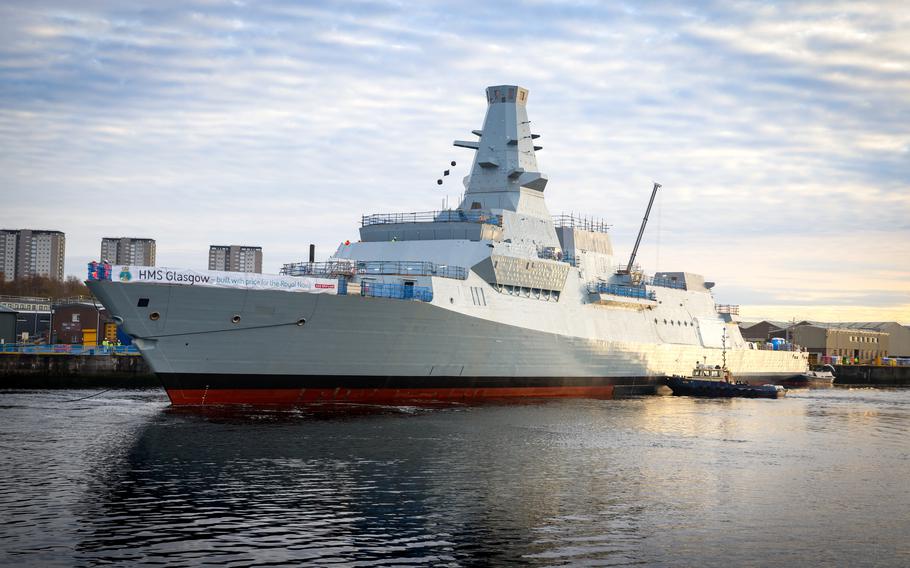
The British ship HMS Glasgow on the Clyde River in 2022. Under the terms of a bilateral defense pact announced this week, the United Kingdom and Norway will operate the British-built Type 26 frigates, designed for anti-submarine warfare, to counter the Russian undersea threat in the north Atlantic. (Bill Spurr/U.K. defense ministry)
NATO allies the United Kingdom and Norway will work together with the aim of countering Russian undersea activity in the north Atlantic Ocean, the result of a bilateral defense pact signed Thursday.
Announced by the British government, the agreement includes closer cooperation in the GIUK gap, a strategic maritime chokepoint long viewed by U.S. military officials as essential to transatlantic security. The abbreviation stands for Greenland, Iceland, United Kingdom.
The GIUK gap provides a primary route from Russia’s Arctic-based Northern Fleet into the Atlantic Ocean. Monitoring activity there allows allied forces to track submarines as they move toward major commercial shipping lanes and military routes linking North America and Europe.
“In this new era of threat and with increasing Russian activity in the North Atlantic, our strength comes from hard power and strong alliances,” U.K. Defense Secretary John Healey said in a statement.
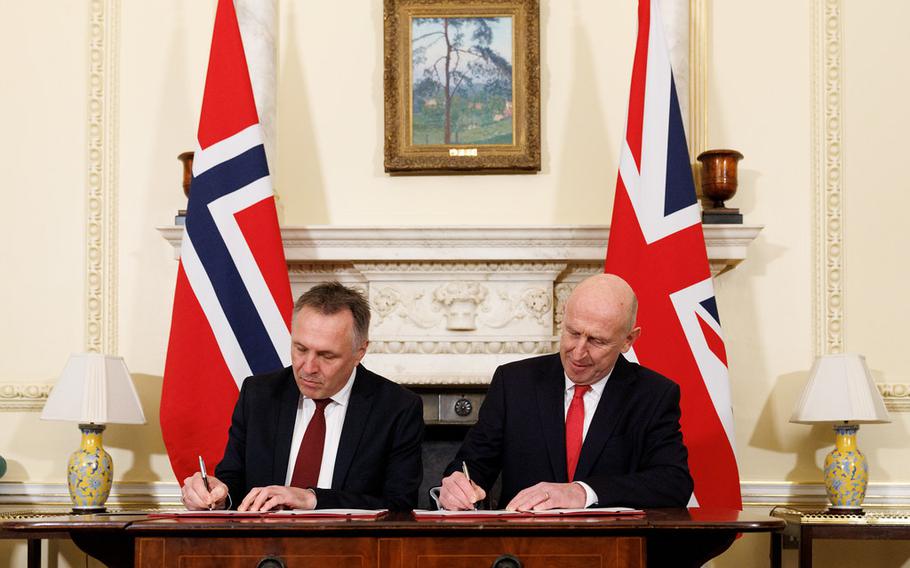
Tore O. Sandvik, left, and John Healey, the defense ministers of Norway and the United Kingdom, sign a bilateral defense agreement Dec. 4, 2025. The deal is aimed at countering Russian undersea activity in the north Atlantic. (John Healy via X)
The deal commits the two countries to closer coordination in hunting Russian submarines and protecting critical undersea infrastructure, including communications cables and energy pipelines.
The efforts will involve joint anti-submarine operations, expanded surveillance and the use of uncrewed systems.
Known as the Lunna House Agreement, the pact follows a 30% increase in Russian vessels “threatening U.K. waters” alone over the past two years, according to U.K. government data.
“We are stepping up on European security and delivering on our NATO-first plan,” Healey said.
The deal builds on Norway’s purchase of British-built Type 26 frigates, which are designed for anti-submarine warfare and will give the two countries a combined fleet of at least 13 ships, according to Thursday’s statement.
Under the agreement, the U.K. and Norway also will lead NATO’s adoption of autonomous systems in the High North.
Additionally, Britain will join a Norwegian program to develop motherships for uncrewed mine-hunting and undersea warfare systems, adopt advanced Norwegian naval strike missiles and deepen collaboration on Sting Ray torpedoes, according to the statement.
The deal aligns with broader NATO efforts to strengthen anti-submarine warfare in the north Atlantic, an area U.S. and allied military officials have identified as increasingly important amid renewed great-power competition.
Last week, Iceland agreed to expand a NATO fuel storage facility near Keflavik International Airport, where U.S. forces sometimes operate, to better support allied ships conducting surveillance and operations in the north Atlantic.