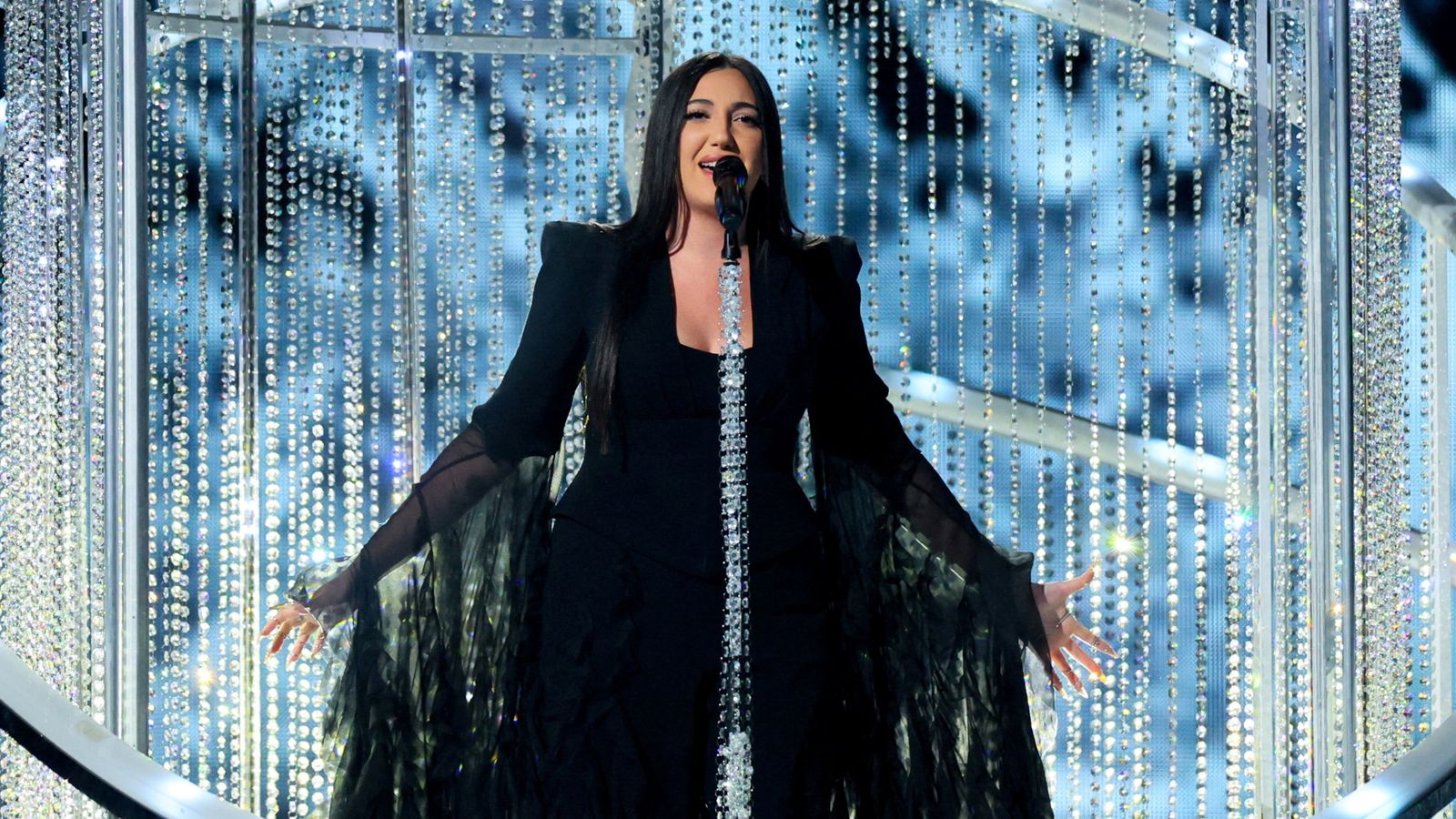
Israel will be allowed to compete in next year’s Eurovision Song Contest, organisers have said – with several broadcasters saying they will now boycott the event.
Dutch broadcaster AVROTROS, Spain’s RTVE, Ireland’s RTE and Slovenia’s RTV immediately issued statements saying they will not participate in the 2026 contest following the European Broadcasting Union’s general assembly meeting on Thursday.
Members were asked to vote in a secret ballot on whether they were happy with new rules announced last month, without going ahead with a vote on participation next year, following criticism from some broadcasters of Israel’s role in the contest amid the war in Gaza.
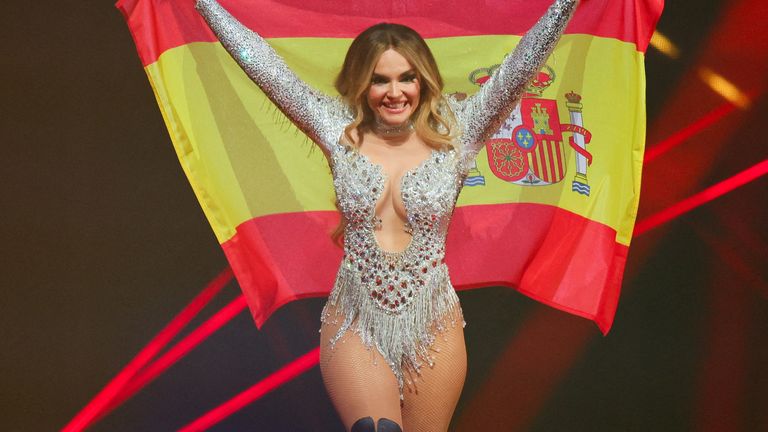
Image:
Spain – represented by Melody earlier this year – is one of the countries that has said it will not take part in 2026. Pic: Reuters
In a statement, the EBU said members had shown “clear support for reforms to reinforce trust and protect neutrality”.
Golan Yochpaz, chief executive of Israel’s public broadcaster KAN, said during the meeting that attempts to remove them from the contest could “only be understood as a cultural boycott”, according to a statement shared by the organisation.
Israel’s president Isaac Herzog posted on X following the announcement, saying: “Israel deserves to be represented on every stage around the world, a cause to which I am fully and actively committed… I hope that the competition will remain one that champions culture, music, friendship between nations, and cross-border cultural understanding.”
The broadcasters from Spain, Ireland, Slovenia and the Netherlands had all issued statements or suggested earlier in the year that they would not participate in 2026 should Israel be allowed to continue in the competition.
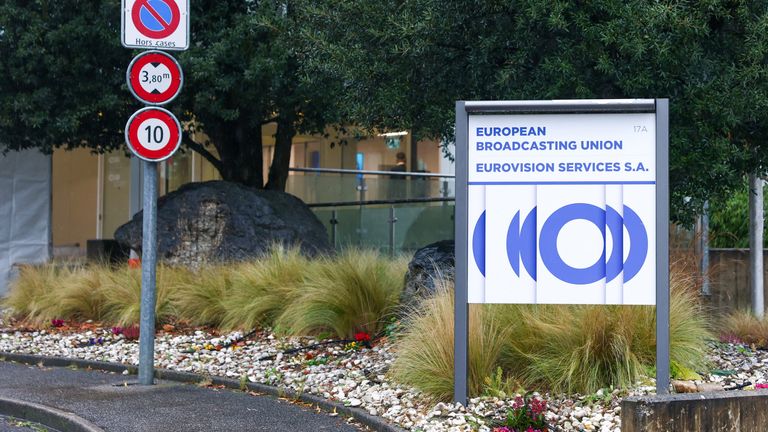
Image:
Members met at the European Broadcasting Union headquarters in Geneva, Switzerland. Pic: REUTERS/Denis Balibouse
In a statement following the general assembly meeting, RTE confirmed it will not participate nor will it broadcast the competition.
“RTE feels that Ireland’s participation remains unconscionable given the appalling loss of lives in Gaza and the humanitarian crisis there which continues to put the lives of so many civilians at risk,” the broadcaster said.
AVROTROS, broadcaster for the Netherlands, said that “under the current circumstances, participation cannot be reconciled with the public values that are fundamental to our organisation”, while Spain’s RTVE highlighted how its board of directors had agreed in September that the country would withdraw “if Israel was part of it”.
This is a big deal for Eurovision, as Spain is one of the “Big Five” broadcasters – a group which also includes France, Germany, Italy and the UK. While the host broadcaster – as last year’s winners this is Austria this year – will often contribute most towards the cost of staging the contest, the Big Five will also make up a significant amount.
Slovenia’s broadcaster RTV said it would not take part “if Israel is included among the participating countries” and that the recent rule changes did not alter its view.
“As a public service broadcaster, RTV Slovenia is committed to upholding ethical principles and expects that equal rules and standards apply to all EBU members and all participating countries.”
Roland Weissman, the director-general of host country Austria’s ORF, said the contest was a competition for broadcasters, “not governments”, and that he had personally advocated for Israel’s participation.
“In the spirit of fostering cultural dialogue and supporting and strengthening the democratic role of public broadcasters, it was important not to burn any bridges,” he said, adding that concerns raised by some members had been taken seriously. “Naturally, I would regret it if broadcasters were to decide against participating. I see the Eurovision Song Contest in Vienna as an opportunity to emphasise what unites us rather than what divides us – United by Music.”
The BBC is yet to comment on today’s developments. Sky News has contacted the broadcaster for comment.
Earlier this year, outgoing BBC director general Tim Davie said the corporation was “aware of the concerns” raised, but the song contest had “never been about politics”.
A spokesperson for the broadcaster sent a similar statement to Sky News at the time, saying: “We are aware of the various views and concerns which have been expressed in recent days in relation to next year’s Eurovision. At this stage, we will continue to be part of the discussions, led by the European Broadcasting Union, with other members and broadcasters.
“Eurovision has never been led by politics, it has been – and is – a celebration of music and culture that brings people together from across the world.”
The rule changes annnounced in November came after Israeli singer Yuval Raphael received the largest number of votes from the public at this year’s contest, held in Basel, Switzerland, in May – ultimately finishing as runner-up to Austria’s entry after the jury votes were counted.
This breaking news story is being updated and more details will be published shortly.
Please refresh the page for the latest version.
You can receive breaking news alerts on a smartphone or tablet via the Sky News app. You can also follow us on WhatsApp and subscribe to our YouTube channel to keep up with the latest news.