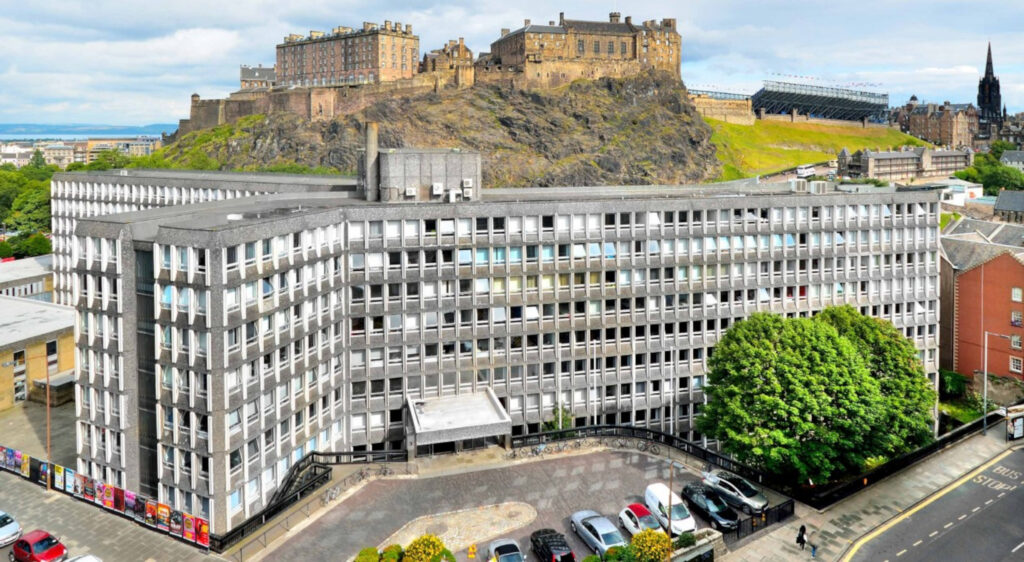
NEW information has been released about the demolition and redevelopment of Argyle House, a brutalist office block on Lady Lawson Street in Edinburgh’s Old Town.
The modernist structure, constructed in the late 60s, has been earmarked by property developers and the building’s owners and lessees for demolition and redevelopment into a mixed-use development comprising residential units, a hotel, and office facilities.
Edinburgh-based property developer Henderson Herd is leading the project as development manager on behalf of owners PGIM and lessees Telereal Trillium.
Henderson Herd says that the building has reached the end of its useful life, and wants to refresh the location, which is in a prime area of the city, in the shadow of Edinburgh Castle.
 Locals have for years decried Argyle House as an “eyesore”, but its brutalist style has its defenders, including leading Scottish Architects Malcolm Fraser, who have lobbied against the building’s demolition (C) Henderson Herd
Currently, the building is operated by tech firm CodeBase, who lease offices and coworking spaces to over 80 firms employing around 900 people maintaining offices in the building.
It emerged last month that CodeBase were not informed that the prior application notice to demolish its building was to be submitted.
Because of the scale of the project, and the number of people affected, planners pledged to hold two consultations to discuss the project with locals and stakeholders.
The first of these was held on Tuesday at the University of Edinburgh’s Futures Institute, where developers released more details of their plans for the site.
The Baird’s Close, which connects West Port and King’s Stable would be reinstated, with a “new public space” also being created.
Early designs show a fairly nondescript block with peaked roof features replacing Argyle House.
Building materials salvaged from the demolition of Argyle House will be reused, as a well as locally sourced rock such as basalt, dolerite, and sandstone.
 Rough artists’ interpretations of what the new building could look like have been produced (C) Henderson Herd
In an outline of plans, Henderson Herd said: “Through ongoing monitoring work, it has been identified that the building is coming to the end of its usable lifespan and no longer meets the needs of the modern occupier.
“The aspiration for the development is to create a high-quality mixed-use development that integrates sympathetically with its sensitive heritage and townscape context and setting.”
As to why it cannot reuse the building that is already there, and which is described by architects as structurally sound, Henderson Herd said: “Arup have undertaken a detailed initial structural assessment of Argyle House including a review of existing records, condition reports and undertaking visual inspections.
“Their findings show that, although the main structural frame is considered sound and well-maintained for the age of the building, there are several significant issues that affect its long-term future and limit options for reuse.”
Henderson Herd added: “Key challenges include:
“Low floor-to-ceiling heights that do not meet modern standards for offices or other uses.
“Carbonation issues with the exposed aggregate precast panels, requiring future maintenance intervention.
“Undersized building foundations against current building code requirements, making structural alterations difficult.
“Extensive upgrades required to meet contemporary standards for fire safety.”
PGIM, an American life insurance company with nearly £1tn in global investments, has owned the building since 2023.
It leases the building to Telereal Trillium, one of the UK’s largest, privately owned property investment and development firms, who in turn sub-lease the building to CodeBase.
Neither PGIM nor Telereal Trillium have so far commented on the plans.
It is understood that discussions about the demolition and redevelopment of Argyle House have been ongoing for years now.
CodeBase has been able to provide assurances about the security of its lease for the next year but may not be able to provide the same confidence going forward.
The brutalist architectural style which informed Argyle House was in-vogue during the 1960s, when the building was constructed.
 The view of the new development from Castle Terrace (C) Henderson Herd
At the time, it was thought that the style would be the wave of the future, but the building – and the style generally – has aged somewhat and now divides locals.
Many detest brutalism and describe the building as an “eyesore”, while its unique presentation and singular vision remains a favourite among architecture enthusiasts.
One of the principal benefits of the project is the perceived benefits to mobility in the area, with reopenings planned for routes blocked off by Argyle House.
Henderson Herd noted: “The reinstatement of Baird’s Close (with steps connecting West Port to King’s Stables) improves the pedestrian permeability of the area, with a lift adjacent to the existing stairs at the junction between Castle Terrace and King’s Stables Road to offer a step-free alternative.”
Argyle House is in the Edinburgh World Heritage Site as well as the Old Town Conservation Area.
The second and final consultation even for the demolition of Argyle House will be held at 2pm on 28 January 2026, again at the Futures Institute.
Related