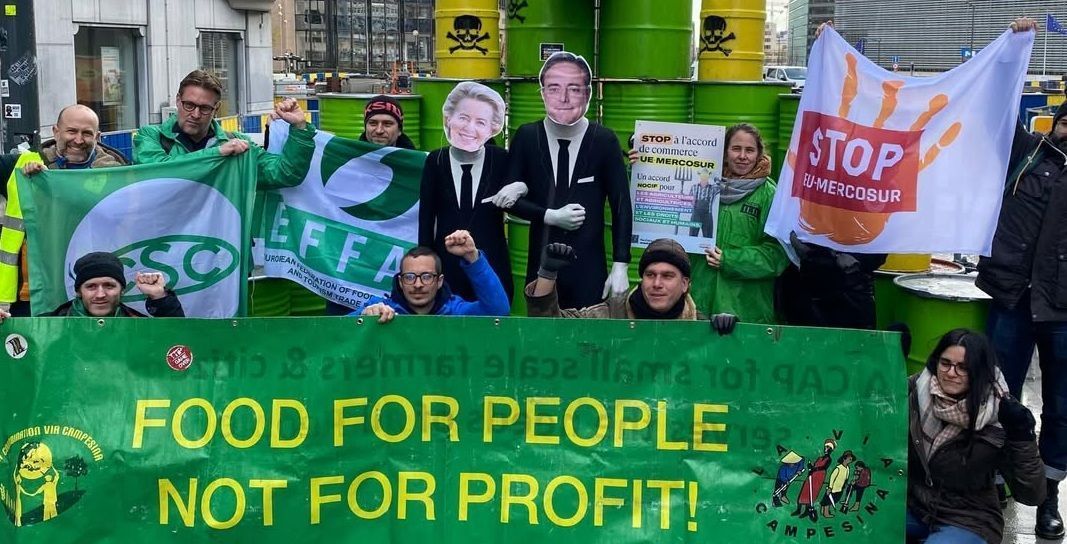
On Monday, 24 November, ECVC farmers mobilised in both Brussels and Strasbourg as the EU-Mercosur Agreement moves dangerously close to approval. In Brussels, farmers gathered beside the Trade Council for the final stage of the Toxic Trade Tour. At the same time, ECVC members protested outside the European Parliament in Strasbourg. Their presence sent a clear signal: Farmers across Europe refuse to accept a free trade agreement that threatens their livelihoods, undermines democratic procedures and weakens environmental and social protections.
ECVC strongly denounces the fact that the European Commission and several Members of the European Parliament are willing to bypass legal safeguards and ignore the concerns of those most affected by the Agreement. The current push to fast-track the EU-Mercosur Agreement appears motivated by political expediency, particularly the intention to proceed quickly so that President Ursula von der Leyen can travel to Brazil on 20 December to ratify the Agreement. For ECVC, pushing such an impactful agreement without transparency, scrutiny, or adequate consultation is unacceptable.
Once again, farmers took to the streets to bring the realities of small-scale farming directly to decision makers. They refuse to allow rural communities to be sacrificed for the benefit of powerful industries. ECVC remains committed to defending food sovereignty and ensuring fair incomes for farmers through effective market regulation, and will continue to fight against the FTA, as Confédération Paysanne, ECVC’s French member organisation, underlined in Strasbourg:
“Nothing is decided yet; it is still possible to block this Agreement! Farmers need income and resources to address issues related to food sovereignty and security, as well as climate and environmental challenges. Europe must find solutions and support farmers. This will not be possible if we are forced to compete with farmers on the other side of the world and if farmers in rural areas disappear.”
AbL, ECVC’s German member organisation, added: “We are not opposed to a solidarity-based alliance between Mercosur and the EU. However, the Agreement negotiated by the EU is not based on solidarity; but only strengthens agribusiness. It will exacerbate deforestation and harm the climate, biodiversity, and small-scale farming on both sides of the Atlantic.”
In recent weeks, numerous democratic rules have been violated in an attempt to advance the Agreement. A fast-track procedure is being used to validate the safeguard clauses, without allowing the committees on International Trade (INTA) and Agriculture (AGRI) to deliver their opinions or amendments. Experts and civil society have already criticised these clauses for functioning primarily as a communication tool rather than a meaningful protective measure. Last week, a scheduled vote on a resolution requesting the opinion of the Court of Justice of the European Union was cancelled by the President of the European Parliament without clear legal justification.
In response to these escalating concerns, ECVC farmers from France and Germany travelled to Strasbourg with tractors and livestock to make their voices heard directly by MEPs. They protested the lack of democratic process and the severe consequences the EU-Mercosur Agreement would have for farmers, workers, human rights defenders and environmental protectors.
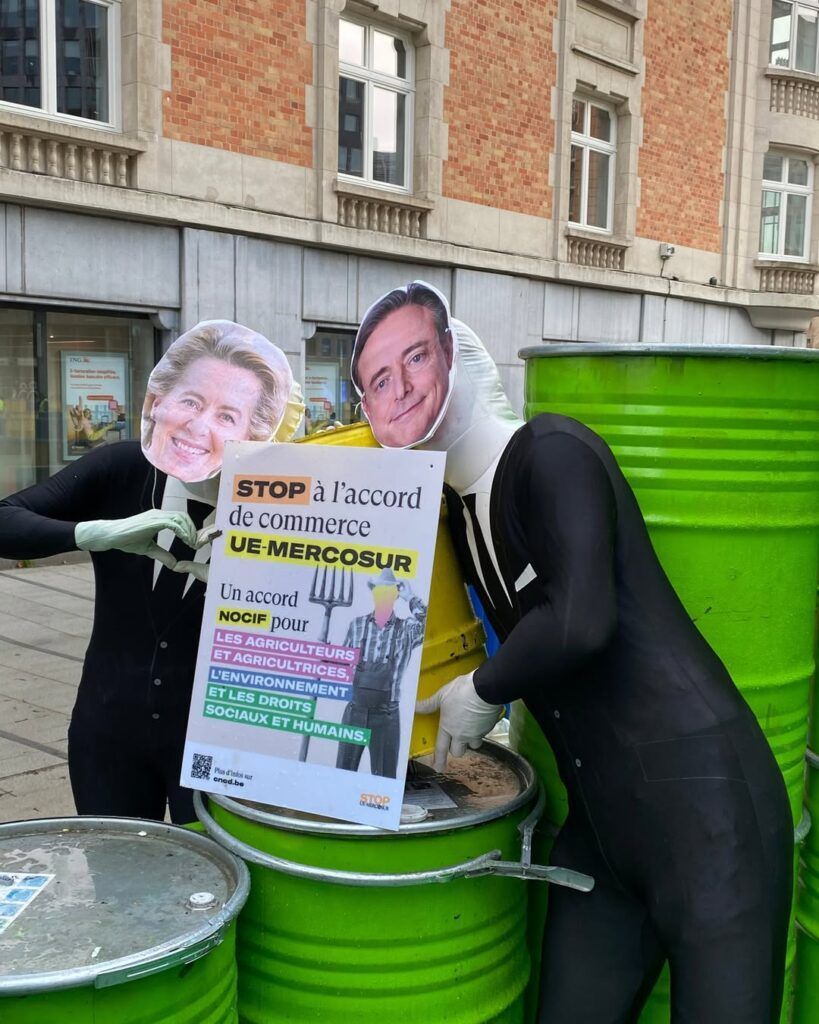
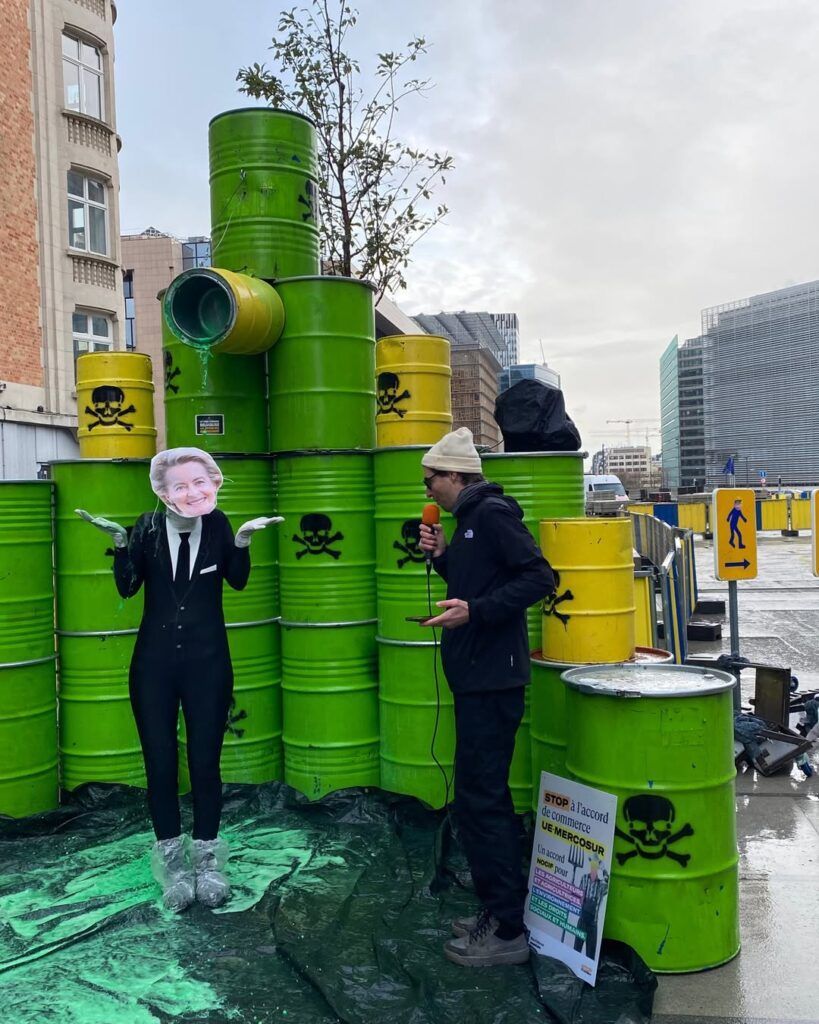
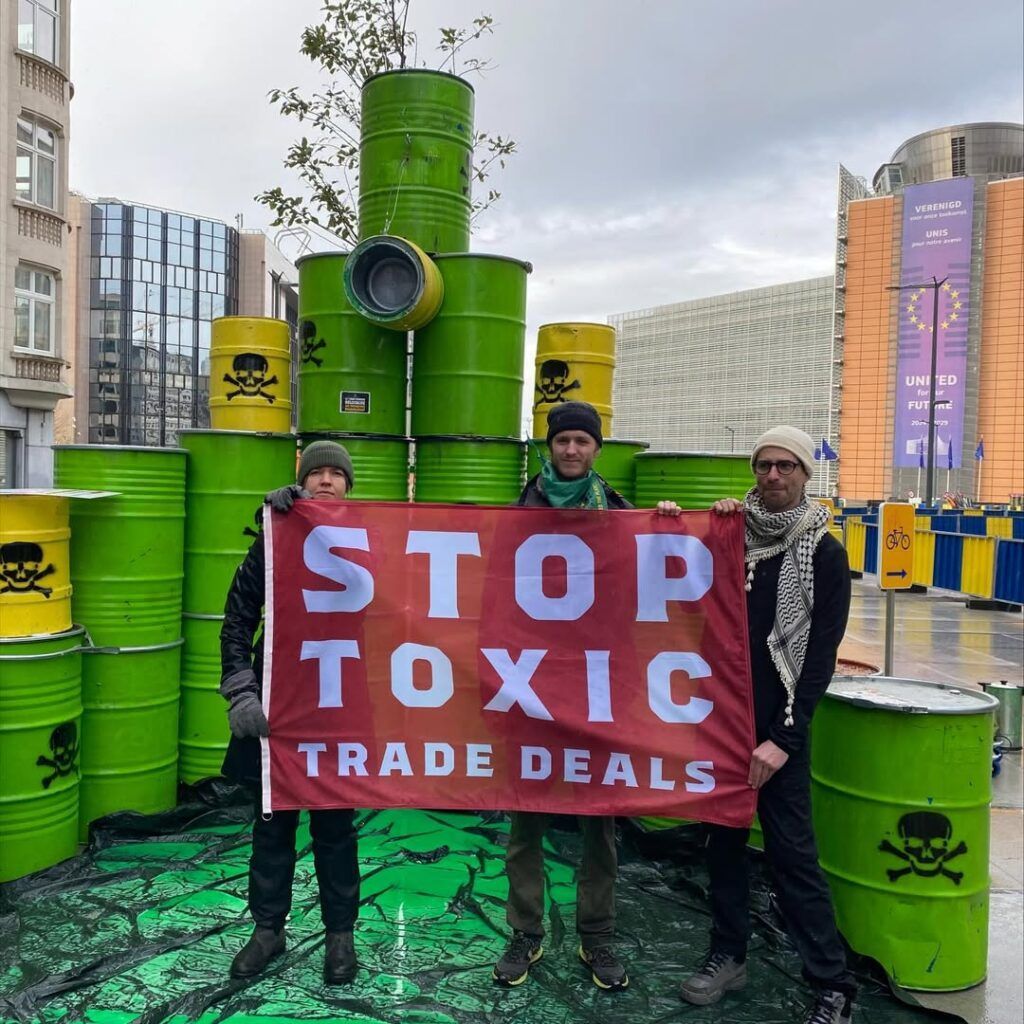
Over the past few weeks, the Toxic Trade Tour has travelled across Europe to highlight the widespread large opposition to the EU-Mercosur Agreement. The tour visited Austria, Germany, Poland, Spain, Portugal, France, the Netherlands and Belgium, and brought together civil society, NGOs, farmers and trade unions. Its final stop took place in Brussels on Monday, 24 November, at the heart of the European institutions, while trade ministers were discussing the Agreement. This meeting was likely the last formal exchange before the expected vote during the European Council on 18 and 19 December.
The concluding action in Brussels brought a broad coalition under a common message: NO to the toxic EU-Mercosur trade deal and YES to food sovereignty, climate justice, and fairer cooperation.
This post is also available in Español and Français.