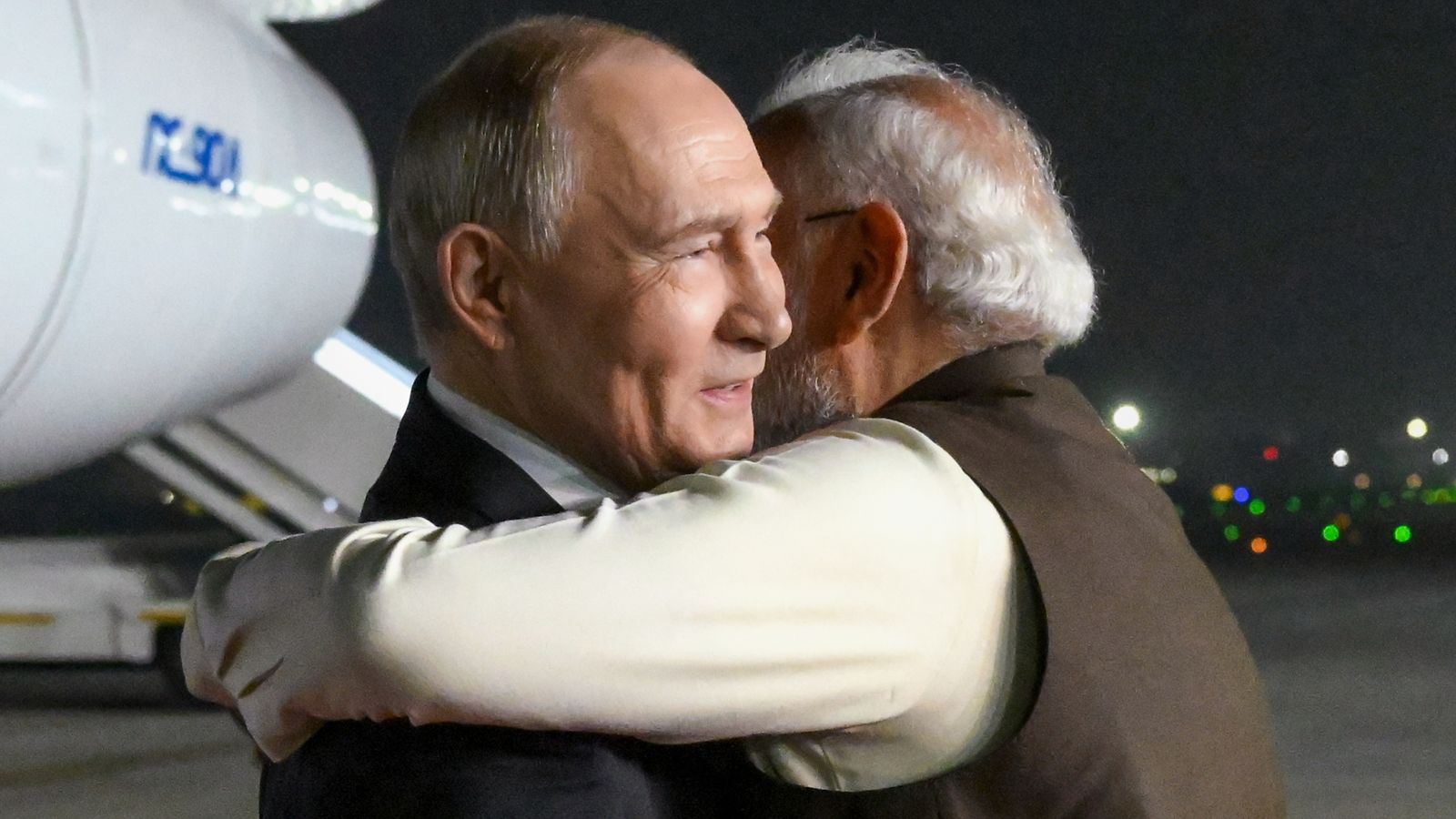
Russian President Vladimir Putin was given a red carpet ceremonial welcome as he arrived in New Delhi for the 23rd India-Russia summit.
Breaking protocol, India’s prime minister Narendra Modi greeted the Russian leader on the tarmac on Thursday evening, offering a handshake and a hug as they left in the same car for a private dinner – a reciprocal gesture after President Putin hosted Mr Modi at his home in Novo-Ogaryovo in July last year.
The India-Russia summit has taken place for more than two decades, except during the COVID-19 pandemic, with the stated aim of strengthening the countries’ links in the strategic defence, civil nuclear, oil and trade sectors.
Trade is high on the Russian president’s agenda this time, as he has arrived with a large business delegation.
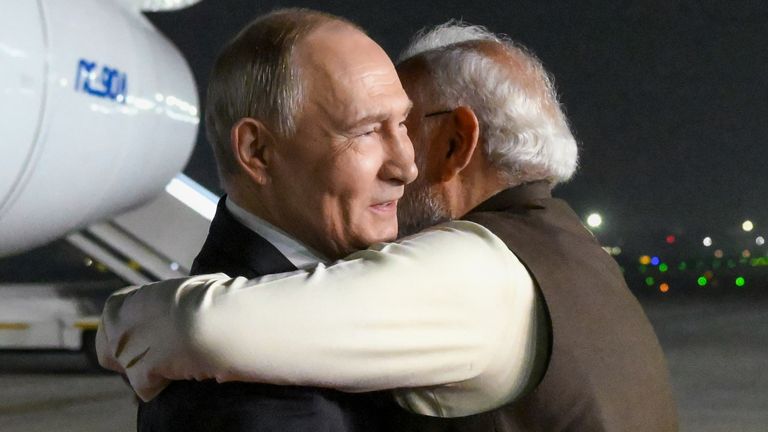
Image:
Vladimir Putin (L) and Narendra Modi embrace at Palam Air Base in New Delhi, India. Pic: Kremlin Pool/AP
What does the summit aim to do?
Trade between the two countries stood at a little under $69bn (£52bn) in 2024-25, heavily skewed in favour of Russia with Indian exports less than $5bn (£3.7bn).
President Putin will use the opportunity to protect and insulate trade and defence ties from sanctions imposed by the US government because of the war in Ukraine.
He told India Today: “Neither I nor PM Modi has ever, despite pressure, used our collaboration to act against anyone. India and Russia do not cause harm to others, and want other countries to take note of this.”
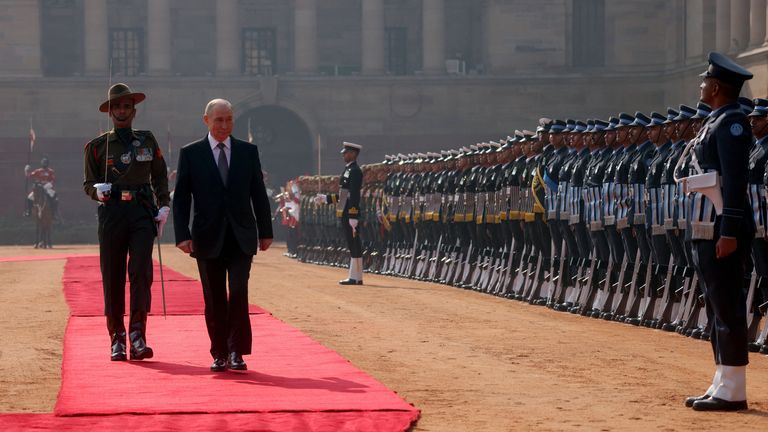
Image:
The Russian leader walks past a guard of honour during a ceremonial reception ahead of trade talks in New Delhi. Pic: Reuters
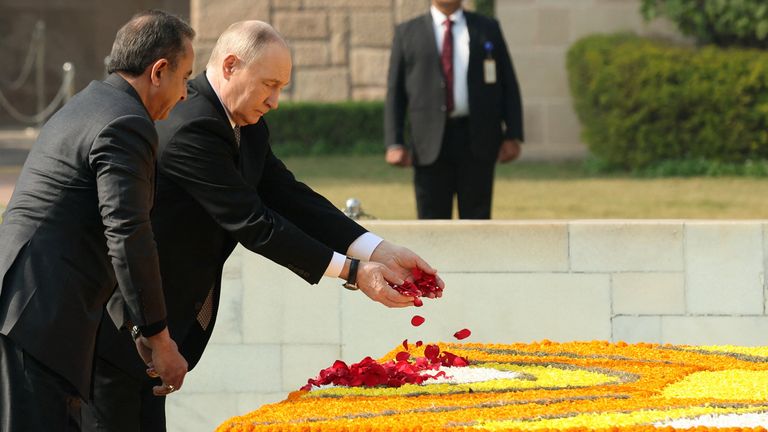
Image:
Mr Putin scatters rose petals at the Mahatma Gandhi memorial in New Delhi. Pic: Reuters
On Tuesday, Russia’s lower house of parliament, the State Duma, ratified the Reciprocal Exchange of Logistic Support (RELOS), a key military agreement with India.
The pact sets the procedure for sending military formations, warships and military aircraft of Russia to India and vice versa, and the organisation of their mutual logistical support.
It would grant India access to Russian naval ports along the Northern Sea Route – the Arctic shortcut between Europe and Asia – from Vladivostok to Murmansk.
For India it’s a chance to emphasise its strategic autonomy and strengthen defence and economic ties independently against US pressure.
Explained: How India-Russia relationship was shaped by Cold War – and why defence ties remain strong today
As Vladimir Putin and Narendra Modi meet, it’s important to remember there is much history to this relationship.
During the Cold War, India was clubbed in the Soviet Union camp, while America favoured Pakistan.
The Soviet Union used to veto resolutions brought by Western nations against India on Kashmir, the liberation of Goa, and Bangladesh.
In turn, India abstained from UN resolutions against the Soviet invasion of Afghanistan. It also voted against condemning Russia’s actions in Chechnya and Abkhazia.
While India has called for a cessation of hostilities in Ukraine and the restoration of peace, it has repeatedly abstained from resolutions on Ukraine at the United Nations and stopped short of condemning Russia’s invasion – showing how the Cold War diplomatic ties linger today.
Over the years, the Russia-India relationship has strengthened, particularly in the defence sector.
However, although Russia has been the largest arms supplier for India, it has been incrementally reduced over the years – with the Modi government increasingly turning to Western countries for defence suppliers.
According to data from the Stockholm International Peace Research Institute, Russian military supplies to India between 2010-14 were 72% – this went down to 55% from 2015-19, and is now at 36%.
Russia remains, though, India’s biggest defence supplier.
Mr Modi said to Mr Putin ahead of their talks: “The world should return to peace, and we support every effort towards peace. India is not neutral; India is on the side of peace. India-Russia relations should grow and touch new heights.
“Since the Ukraine crisis began, we have been in constant discussion. From time to time, you too, as a true friend, have kept us informed about everything. I believe that trust is a great strength, and I have discussed this matter with you many times and also presented it before the world.
“The welfare of nations lies in the path of peace. Together, we will lead the world towards that path. I am fully confident that with the efforts being made in recent days, the world will once again return to the direction of peace.”
Mr Putin told Mr Modi: “We had the opportunity – and you gave me that opportunity – to speak in detail about what is happening on the Ukrainian track and about the steps we are taking jointly with some other partners, including the United States, toward a possible peaceful settlement of this crisis.”
“The two nations also have relations in the military sphere, in space development, artificial intelligence and other areas,” said Mr Putin.
He added: “We have a very trusting relationship in the field of military-technical co-operation, and we intend to move forward in all these areas.”
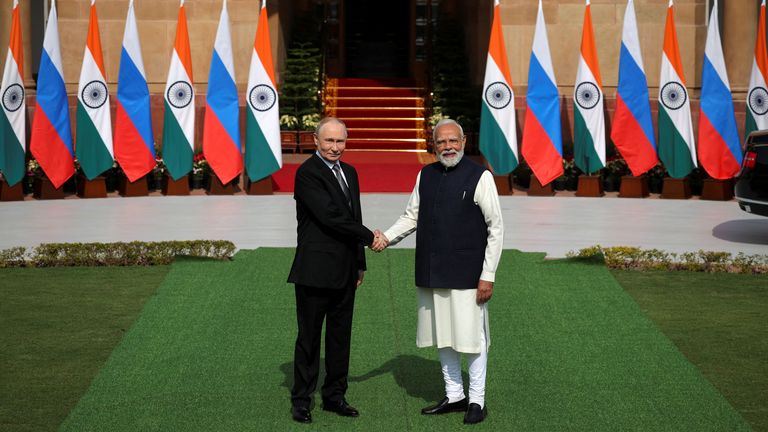
Image:
Mr Putin and Mr Modi ahead of their meeting at Hyderabad House in New Delhi. Pic: Reuters
Why oil and Ukraine matters at Modi-Putin talks
Under Mr Modi’s regime, realpolitik dominates India’s foreign policy.
Since the Ukraine war, India has upped its annual imports of discounted Russian crude oil from 2% in 2021 to almost 40% in the last three years.
In August, US President Donald Trump put an additional 25% punishment tariff on India for buying Russian oil, taking the total duties to 50% – one of the highest rates in the world.
Washington justified its actions as a national security concern, saying the profits from oil sales were fuelling Moscow’s war machine in Ukraine and so applied aggressive economic leverage.
Mr Trump’s trade adviser Peter Navarro even went on to describe the Russia-Ukraine conflict as “Modi’s war”, and said “the largest democracy in the world works as laundromat for the Kremlin”.
India denied these allegations, saying the discounted oil imports are based on the “objective of ensuring energy security of 1.4 billion people of India”.
Mr Putin said: “The US still buys nuclear fuel from Russia for its own power plants, including uranium for reactors operating in the US. Why should India not have the same privilege?”
Read more on Sky News:
Iconic Bollywood star dies
New Russia sanctions ‘pointless’
In its bid to mend ties, India has ramped up purchases of oil and gas from the US and begun cutting back on Russian oil imports.
It is also in the final phase of negotiations for a free trade agreement.