A drone strike on an oil-loading facility off Russia’s Black Sea coast has ignited a diplomatic spat between Ukraine and Kazakhstan, exposed the Central Asian country’s reliance on a single oil pipeline for exports, and possibly endangered gasoline supplies in Europe.
Naval drones hit a large floating circular structure 5 kilometers out to sea near the port of Novorossiysk, where Russia’s Black Sea fleet is based, on November 28.
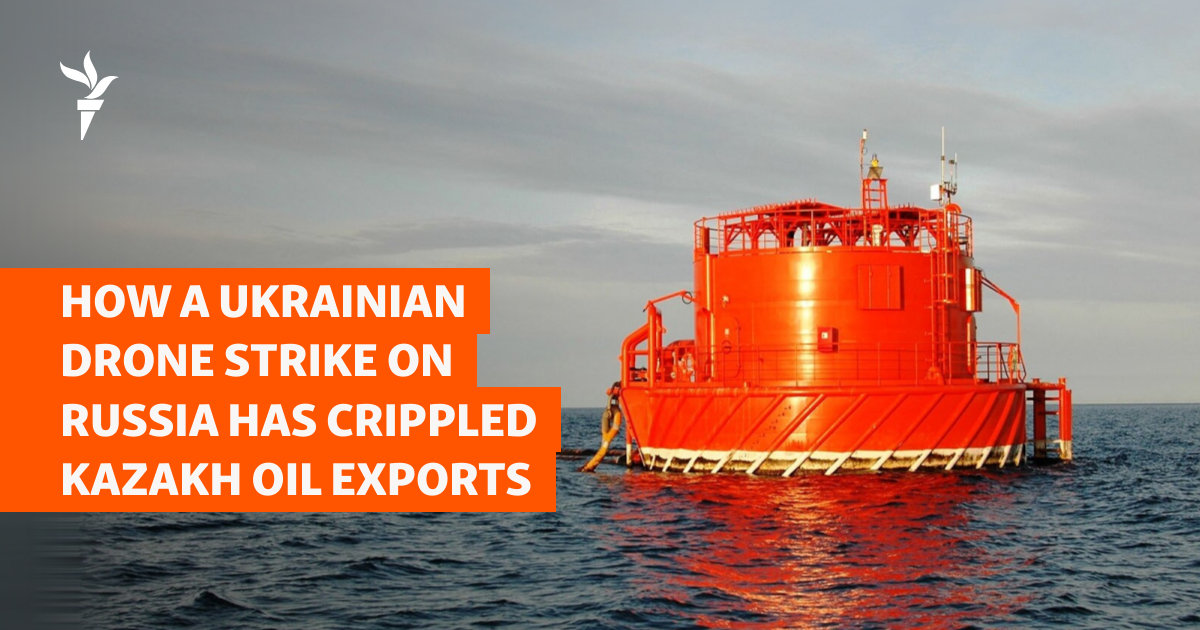
The object was a Single Point Mooring (SPM), an offshore facility for pumping oil onto tankers. There are three SPMs at Novorossiysk. One was already undergoing maintenance. The hit appears to have had a devastating impact on the port’s capacity for loading oil.
“Each mooring’s capacity is 800,000 barrels per day. Operations will now effectively fall to one-third of normal offshore loading capacity,” Vlad Paddack, a fellow at Nightingale Intelligence, a political foresight firm, told RFE/RL.
This is bad for Russia, which loads oil from its north Caucasus oilfields through the site. But it’s much worse for Kazakhstan, which exports 80 percent of its oil through a single pipeline to Novorossiysk.
“Kazakhstan has found itself in a situation where it has built its main export route through one country: Russia,” Kazakh political analyst Dimash Alzhanov said.
Speaking to RFE/RL’s Kazakh Service, he said the country was now a “hostage” to political decisions taken “many years ago.”
A Strategic Vulnerability
The pipeline operator, the Caspian Pipeline Consortium (CPC), did not immediately respond to RFE/RL requests for comment on the strike, which it has denounced as “an intended terror attack.”
According to Sergey Vakulenko, a senior fellow at the Carnegie Russia Eurasia Center, overseas oil sales provide some 40 percent of Kazakhstan’s entire export earnings.
The Kazakh government lodged an official protest with the Ukrainian government over what it called “the third act of aggression against an exclusively civilian facility.” Earlier this year, a drone strike damaged a CPC pumping station in Russia’s Krasnodar region, followed by a further hit on its office in Novorossiysk.
Ukraine has issued a scathing response to the Kazakh complaint.
Stating that its armed forces are “systematically weakening the aggressor’s military-industrial potential,” it noted “the absence of previous statements by the Kazakh side condemning the Russian Federation’s attacks on civilians in Ukraine.”
As the diplomatic fallout spreads, Kazakhstan has a problem.
“Two new SPMs nearing completion in Dubai cannot be installed quickly; delivery, installation, and commissioning will take several months. Given the latest disruptions, the full three SPMs will not be operational before summer-autumn 2026,” said Paddack.
“A modern SPM comparable to CPC’s units costs $80-120 million, making replacement and unplanned infrastructure work a significant financial burden,” he added.
Additionally, even when everything is repaired and replaced, Ukraine could try to hit it again. But Kazakh reliance on European markets is only half the picture. The relationship is a two-way street.
Unintended Consequences
Joe Webster, senior fellow at the Atlantic Council, told RFE/RL that the Kazakh CPC blend is “light and sweet” -– perfect for gasoline production.
“Kazakhstan is the third-largest partner for the European Union in terms of petroleum oils after the US and Norway. About one in nine imports, or barrels of imports, of petroleum oils originate from Kazakhstan,” he said.
In other words, a loss of Kazakh oil compounds Europe’s existing problems with replacing Russian supplies it has massively reduced in response to the Kremlin’s full-scale invasion of Ukraine in 2022.
“Candidly, I worry that the CPC outages might impact Europe. They might hurt Europe more than they hurt Russia. So, I think it’s fair to question whether or not these strikes are strategically optimal,” added Webster.
Sergey Vakulenko, from Carnegie, raised a similar thought about Ukrainian actions having unexpected side effects.
While they do hit Russia’s export volumes, taking Kazakh oil off the market may also mean that “India, China, and Turkey will be more willing to buy Russian oil” at higher prices than they currently do, he wrote.
Another aspect is Western involvement in the Kazakh oil industry, which has benefited from investments by companies such as Chevron, ExxonMobil, Shell, and others. Indeed, Chevron has a 15 percent stake in CPC itself.
It could be that, for Kazakhstan, the best hope of maintaining oil exports through the CPC pipeline to Russia will be Western countries pressuring Kyiv to hold back on future strikes.
Few Other Options
Kazakhstan’s vulnerability has led to renewed discussion about whether it can diversify its export routes.
Kazakhstan’s second-largest route involves using oil tankers to cross the Caspian Sea to Baku, in Azerbaijan. From there, the BTC pipeline runs through Georgia to Ceyhan, by Turkey’s Mediterranean coast.
In 2024, some 1.5 million tons of oil were pumped through the BTC. But this compares to 63 million tons along the CDC pipeline. Expanding this is limited by the number of oil tankers in the Caspian, as well as the capacity of the pipeline itself. The BTC route is significantly more expensive, too.
Kazakhstan also exports some oil to European markets via the Druzhba pipeline, running through Russia and Belarus. It has also been hit by repeated Ukrainian drone strikes.
So, can Kazakhstan look east?
World Bank figures from 2023 show that it exported oil worth $3.81 billion to China – compared to $23.6 billion to Europe.
But making a strategic switch to its huge, prosperous neighbor is not easy.
“I don’t think the demand in Xinjiang, western China, would be sufficient to absorb all those barrels,” said Webster.
Building a pipeline running to China’s powerhouse eastern seaboard would, he added, be prohibitively expensive. “I don’t know why Chinese oil companies would even consider that. So, I think the probability of Kazakhstan redirecting oil from Europe to China is very low.”