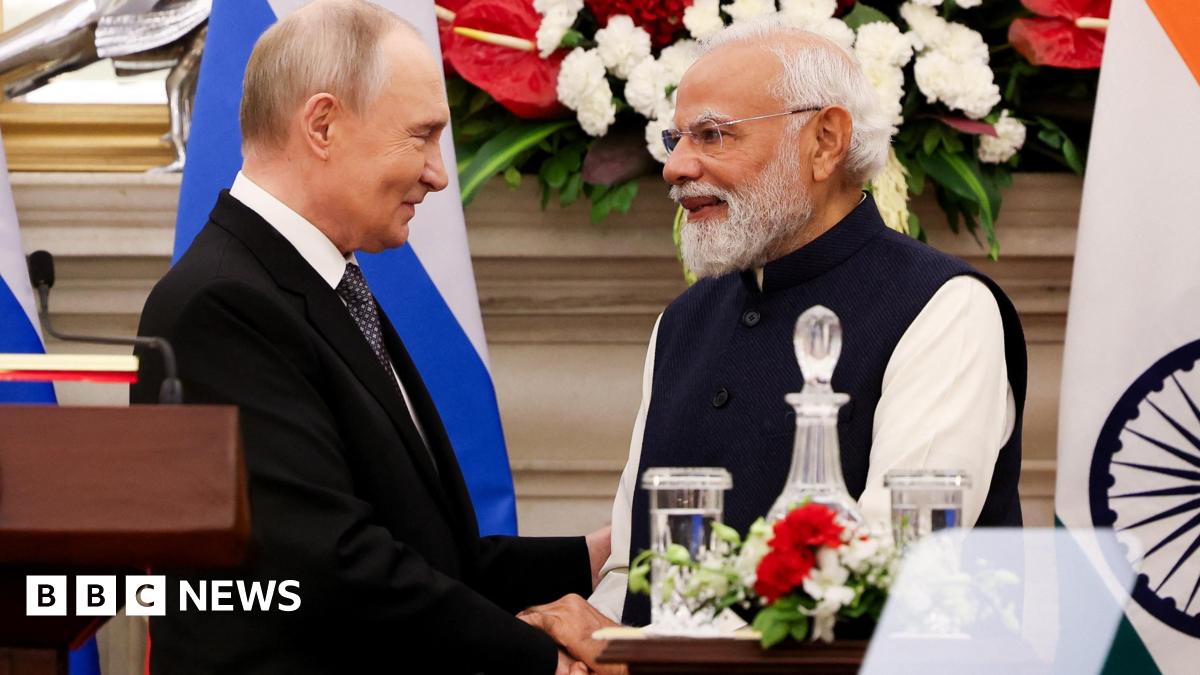
The two leaders exchanged memorandums during Friday’s briefing, outlining mutual objectives in areas including trade and agriculture.
Modi announced two new 30-day visa schemes for Russian tourists visiting India, and said that two new Indian consulates had opened in Russia.
Russia Today, a Kremlin-funded, state-controlled TV network, would also be launched in India, the prime minister said.
No major defence deals were announced, but the two men said there were agreements signed on shipbuilding, investments in civil nuclear energy and critical minerals.
India and Russia also agreed on an economic programme valid until 2030, the leaders said, spanning jobs, shipping and the health industry.
Putin said he was confident about increasing current bilateral trade from $60bn to $100bn in the coming years.
Modi said that “energy security has been a strong and important pillar of the India-Russia partnership”, but made no specific reference to oil.
India – the world’s third largest consumer of crude oil – has been buying large volumes from Russia since the Kremlin’s full-scale invasion of Ukraine in 2022.
But some Indian firms have already started reducing oil imports from Russia to comply with US sanctions.
Putin also referenced a “flagship project”: building India’s largest nuclear power plant, that he said Moscow would help with.
In a joint statement released after their meeting, the leaders said their partnership was being “reoriented toward joint research and development, as well as the production of advanced defence platforms”.
Putin added that he and Modi were cooperating on foreign policy, with their coalition of Brics countries promoting a “more just” and “multi-polar” world.
Brics is an informal alliance of several major developing countries – including India, Russia, China, Brazil and South Africa – which formed in 2006, broadly to challenge the political and economic power of North America and Western European nations.