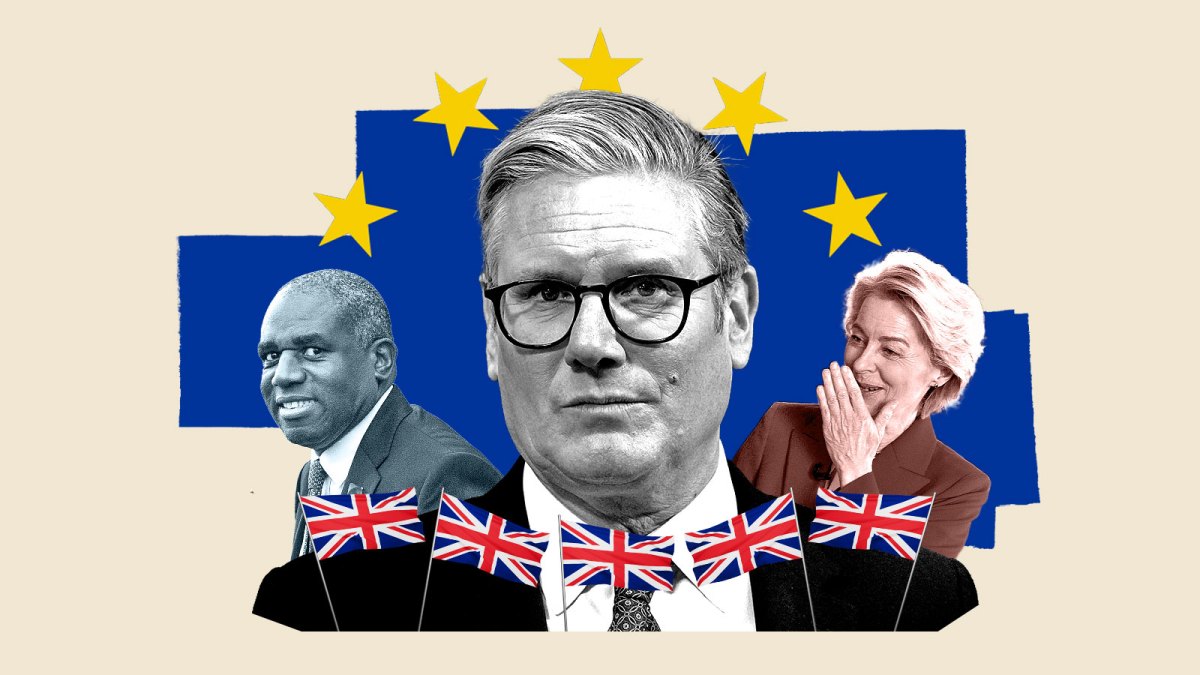
It was the moment that David Lammy came perilously close to saying the quiet bit out loud.
Perhaps lulled into a false sense of security, the deputy prime minister moved decisively this week beyond Labour’s stated position on Brexit.
Rejoining the EU customs union, he suggested, was moving back onto Labour’s political agenda a decade since the vote to leave.
“That is not currently our policy. That’s not currently where we are,” he began cautiously. But then he added: “You can see countries like Turkey with a customs union seemingly benefiting and seeing growth in their economy. That’s self-evident.”
Pushed on his personal view, Lammy burst out laughing, telling The News Agents podcast: “That would be big headlines. That I’m not going to do.”
Unfortunately for Lammy, making headlines was exactly what he did by becoming the first cabinet minister to publicly suggest that rejoining the customs union could be in Britain’s national interest.
There was frustration in Downing Street with Lammy’s failure to stick within the guardrails of the official line — that Britain wants a closer relationship with the EU but will not join a customs union. However, given Starmer’s weakened authority, and his friendship with Lammy, nobody is going to publicly rebuke him.
His comments also accurately reflect a wider conversation that is going on in senior Labour circles about whether the party needs to be less cautious about Brexit.
Some, like Lammy, have argued that Labour’s next manifesto should contain a pledge to negotiate a new bespoke trading relationship with the EU, one that would involve Britain’s membership of the customs union.
Baroness Shafik, the prime minister’s chief economic adviser, even suggested bringing it forward as a potential growth measure in the budget.

Baroness Shafik
JASON ALDEN/GETTY IMAGES
Starmer, who was shadow Brexit secretary during Labour’s anguished internal debate on its stance after the 2016 referendum, is not there yet. But he does have a newfound enthusiasm for talking about the subject.
On Monday the prime minister went full white tie and addressed the Lady Mayor’s banquet in the City. While he respected Brexit, “how it was sold and delivered was wrong”, he said. “Wild promises were made to the British people and not fulfilled. We are still dealing with the consequences today, in our economy and in trust — in the degradation of political debate.”

Sir Keir Starmer speaks during the Lady Mayor’s banquet at the Guildhall in London
CHRIS J RATCLIFFE/REUTERS
In No 10 the view is that the public is ready for a new conversation about Brexit. Polling suggests that Britain is no longer the same nation that voted by 52 per cent to 48 to leave. In one YouGov survey almost two thirds of voters wanted closer ties with the European Union. And negotiations with Brussels are already under way.
By the end of next year the government hopes to have two issues resolved — closer alignment on agricultural standards and a youth mobility scheme that could enable tens of thousands of young Europeans to come to the UK.
Starmer believes the change of mood presents an opportunity to portray Nigel Farage as the man who delivered Brexit then walked away, whose “easy slogans and easy promises turned to dust”.
The perceived failure to deliver on the promises of Brexit comes up regularly in Labour’s focus groups. Senior Labour figures believe that Farage is weak on Brexit and that his claim to be able to fundamentally renegotiate the deal is a fantasy. The reality, they argue, is that Farage would prompt a trade war, pushing up food prices and putting jobs at risk.
Starmer is expected to ratchet up the rhetoric next year. In an interview with The Economist this week he suggested that the prospect of Farage in No 10 was the stuff of nightmares.
“I often say: I’m pragmatic, I want a Labour government, I’m leading a Labour government, I’m proud of the change Labour governments bring about,” he said. “But if there is a Conservative government, I can sleep at night. If there was a right-wing government in the United Kingdom, that would be a different proposition.”
A Farage government, Starmer said, would “do huge damage to our country, to our society, to our global standing and destroy much of our country.”

Nigel Farage
ANDREW HARRER/GETTY IMAGES
But as Lammy’s comments demonstrate, there is a delicate line between pushing for a closer relationship with the EU and castigating Brexit.
While Starmer is attempting to play the man not the ball, focusing on the way Brexit was delivered rather than the vote itself, others have shown much less caution in their rhetoric. Some sounded almost gleeful in doing so, for instance Stephen Kinnock, a minister who campaigned for a second referendum, calling it a “huge act of economic self-harm”.
Anthony Wells, the global head of politics at YouGov, said voters had moved decisively against Brexit in recent years but cautioned that they might not like the reality of a protracted renegotiation with the EU.
He said: “You have to remember that even back in the 2016 referendum the public was split 52 to 48 per cent on whether we should leave the EU at all and since then the mood has shifted decisively against Brexit. There is now majority support for a closer relationship with Europe, including in areas such as the single market and customs union, albeit to a lesser extent.
“The question is whether, when it came to it, voters would really want to open the can of worms that such a change in approach would involve.”

The UK-EU summit at Lancaster House in London in May
JASON ALDEN/EPA
Inside the government, there is a realisation that any wider deal would not be straightforward. Even Starmer’s more modest plans for a reset with Brussels by aligning the UK with the EU’s animal and plant health rules have become bogged down in complicated technical details that are hard to resolve and sometimes politically sensitive.
Whitehall figures complain that at a political level, the EU is not focused on the talks, leaving it to officials who cannot make decisions and are not addressing some of the crucial issues where compromises will need to be found.
The UK is looking for opt-outs in areas, such as the ability to pursue genetic modification technology and wants to ensure ing that the government’s new growth measures, in areas such as planning reforms, do not fall foul of EU rules. But progress is painfully slow, and the economic upsides of the deal will be incremental rather than game-changing.
The Centre for European Reform think tank has suggested that the reset would raise GDP by only about 0.3 per cent in the long run.
• Daniel Finkelstein: Logical step for Labour is to reverse Brexit
One area which could move the dial economically is youth mobility. The EU is demanding that the planned “youth experience scheme” should have no limit on numbers, but with an emergency clause if there is a sudden surge.
Some in government, particularly the Treasury, do not object to the plan, which they believe could help offset some of the economic headwinds by restricting migration elsewhere. But the Home Office under Shabana Mahmood is said to be against it, and there is so far no agreement on the UK’s red lines in the talks.
Perhaps the government’s biggest challenge in attempting to weaponise Brexit against Farage lies in the very charge it is making. The accusation from Starmer and other ministers is that Farage created Brexit then walked away.
Farage’s allies point to the fact he was not an MP. It was the Tories who delivered Brexit, and he has been a vocal critic. When he gets into No 10, they say, he will “finish the job himself”. At this rate Starmer’s nightmare could well end up becoming a reality.