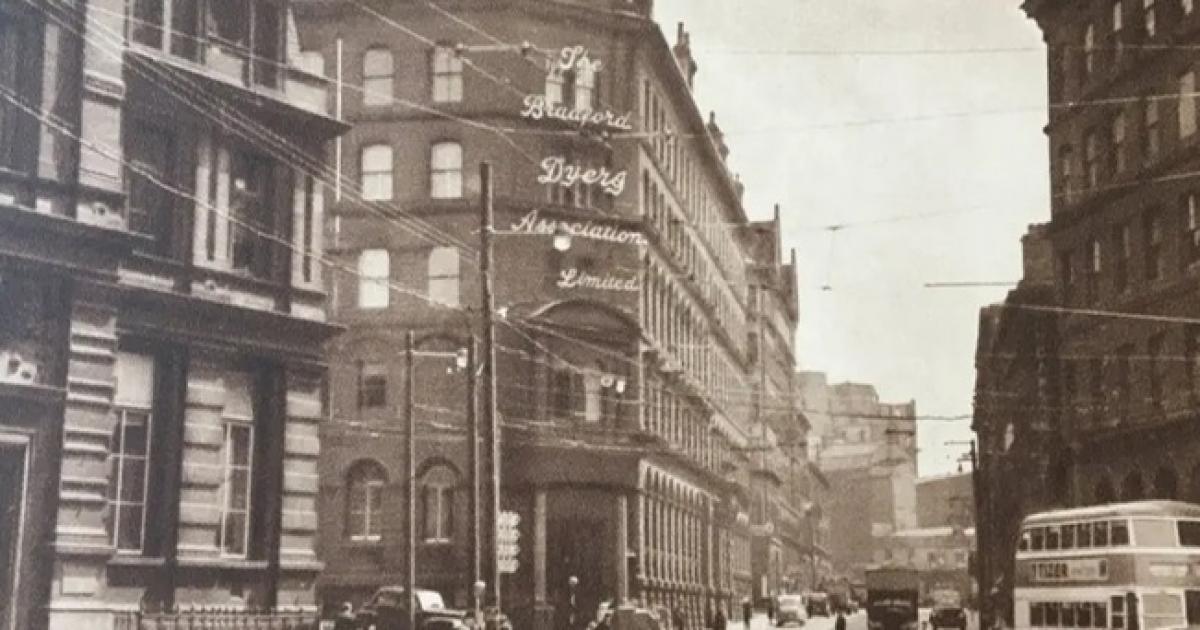
Little Germany is a clear exception, firstly because it is far from lost or forgotten (most Bradfordians would know where it is if asked) and secondly because it didn’t start out as a neighbourhood. In fact, it has only been over the past few decades that Little Germany has welcomed its first residents.
The name ‘Little Germany’ was given to this area because of the many German wool merchants who constructed buildings there in the 19th Century, in particular Jewish Germans. Other names originally given to it included ‘Germania’ and ‘New Germany’ but by the 1870s people had settled on Little Germany.
Its modern boundaries are quite well set out as Church Bank then Barkerend Road to the northwest until it meets the Shipley Airedale Road, down to the east until it meets with Leeds Road, then along Leeds Road to the south, finally up Well Street to the southwest until meeting Church Bank.
The Junction pub, which was demolished when Leeds Road was widened
The origins of the district go back to the 1850s when it was still largely fields, most of the industrial development in Bradford so far being around the opposite side of town. It was earmarked for development as a commercial district with good proximity to the Bradford Canal and Bradford Market Street Station for transporting materials and goods.
From 1855 warehouses began to be erected, beginning at the bottom at Leeds Road and Vicar Lane. The architecture was mostly a neoclassical design with an Italian influence, making it distinct from other parts of the town. As some of the land had been used for mining, there were reported difficulties with construction as sink holes appeared, but these were filled in and by 1890 most of the architecture was complete. In total, 85 buildings were put up. Today, 55 of these are listed.
Whilst the area had a distinct identity with its architectural character, by the late 19th Century this side of Bradford was densely packed with back-to-back terraced housing and mills. Consequently, Little Germany was tightly surrounded by adjacent neighbourhoods of Wapping, Eastbrook and George Street – it was not so easy to see where it began and ended. In some respects, this included merging into Eastbrook with the presence of Eastbrook Chapel, later Eastbrook Hall, in Little Germany reflecting this.
Eastbrook Hall on the bottom of Leeds Road
Whilst the district was dominated by warehouse buildings, a chapel and a Quaker school were erected in the area. In 1929 Bradford Civic Playhouse opened on Chapel Street with JB Priestley its president from 1932 until his death in 1984. The theatre was destroyed by fire in 1935, but a new theatre was built on the site in 1937, incorporating a cinema, and was later called The Priestley.
Bradford Playhouse remains a popular feature of Little Germany
The post-war period marked a decline in Bradford’s textile industry and many of Little Germany’s warehouses became difficult to repurpose. Alongside this, remodelling of the city centre by infamous City Engineer Stanley Wardley, including the widening of Leeds Road, resulted in Little Germany being largely cut off. It began to decline as buildings were redundant and left to become derelict.
In 1950s, Bradford Council’s proposals for what is now the Shipley Airedale Road were to put it straight through Little Germany. As this was supposed to be a motorway, it would have meant the entire district flattened. Thankfully, the route was amended and the road now skirts the eastern part. In some respects this and the widening of Leeds Road and Church Bank have made the boundaries of Little Germany much clearer to see.
But things got worse before getting better: in 1974 Bradford Council put up a seven-storey concrete extension on the side of Olicana House, a stone building, entirely out of character with the area. Other building permitted in Little Germany involved the use of concrete and no consideration of aesthetics. By the 1980s, Eastbrook Hall at the bottom of Leeds Road was derelict and in 1966 a major fire destroyed much of it except its beautiful frontage.
But there was some hope for this unique district: in 2002 the Chamber of Commerce, which had its offices in Little Germany, set up the Little Germany Urban Village Company to breathe new life into the area by attracting investors to renovate the old buildings into residential accommodation and flexible workspace for modern businesses. The vision was to turn Little Germany into a village with a mix of residential and business occupiers. A master plan was put together and Bradford Council lobbied to adopt it as policy, but only went as far as recognising it as supplementary planning guidance, meaning they’d take it into consideration reviewing planning decisions but could ignore it.
Still, there was a regeneration of Little Germany from the 2000s onwards and it became synonymous with city centre living, something Bradford Council had begun to promote. It took a backward step with the demolition of the Forster Square area in 2006 and the infamous ‘hole in the ground’ for several years cutting off Little Germany and contributing towards its decline yet again. However, it continues to be a place to set up home or work. In recent years it’s been a popular backdrop for period dramas such as Downton Abbey, Gentleman Jack, Peaky Blinders and Testament of Youth.
Overall, Little Germany has been a success story in city centre regeneration. With its preserved historic buildings and established community, it is likely to carry on attracting residents and businesses and being a distinct place.
* The Neighbourhood Project has produced an online video on the history of Little Germany. View it at https://www.youtube.com/@theneighbourhoodproject
* Jonathan Crewdson is Director of The Neighbourhood Project CIC.