Rome may sit at the top of many tourists’ bucket lists, but for many travellers, the reality does not always live up to that postcard-perfect dream holiday. Record-breaking visitor numbers – over 22.2 million arrivals in 2024 and even higher estimates predicted for this year – have left the Italian capital straining under the weight of its own popularity, resulting in crowded landmarks, long queues and packed piazzas.
It’s no surprise, therefore, that holidaymakers are being pushed away from Rome to look elsewhere. Luckily, for those still craving ancient history, grand architecture and authentic Mediterranean charm, there is no need to give up the search. There is a Spanish city that offers all of that and more, without the overwhelming crush of the 70,000-or-so tourists that descend on Rome each day.
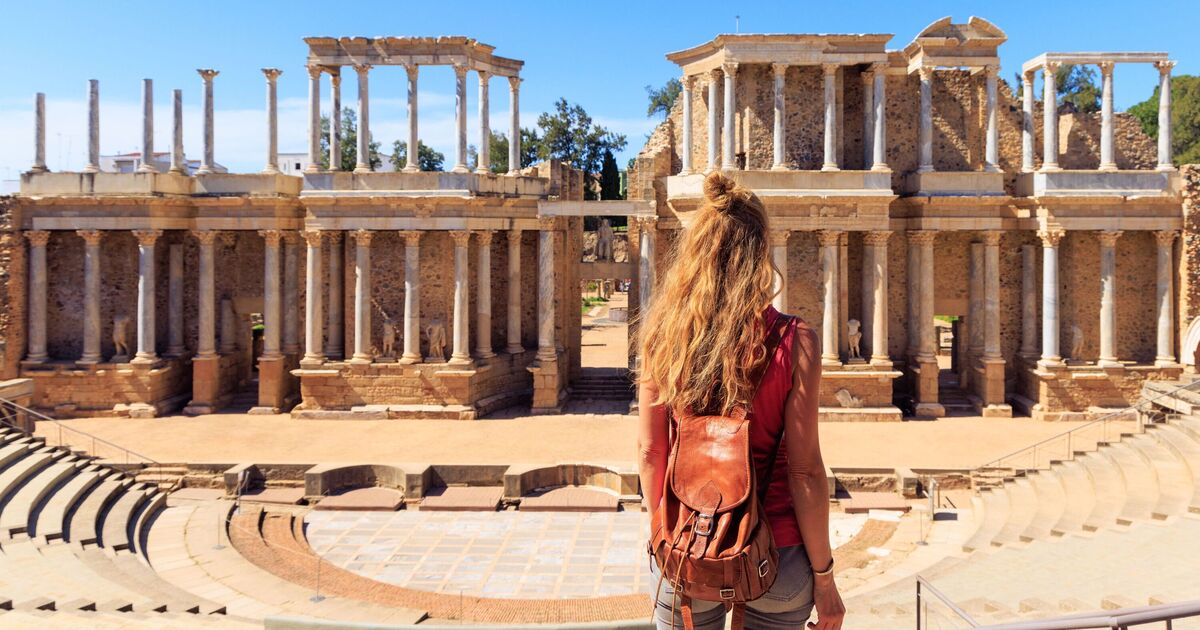
Tucked away in Western Spain, in the province of Badajoz, lies the city of Mérida, the capital of the autonomous community of Extremadura. According to Travel guru and TikToker Carlos Lavilla, who has spent decades exploring Spain, Mérida is a “small Rome with no crowds”, boasting stunning Roman architecture from a theatre to aqueducts and bridges.
Mérida was founded by the Roman Empire under Emperor Augustus as Augusta Emerita in the 1st century BC to accommodate discharged soldiers, eventually prospering as one of the largest cities in Hispania – the Roman name for the Iberian Peninsula.
One of the best preserved archaeological sites in Spain, the Archaeological Ensemble of Mérida was recognised by UNESCO as a World Heritage Site in 1993. Located on the famous Silver Way (the Via de la Plata), the walled city of Mérida flourished and boasts several public entertainments, most notably the Roman theatre, amphitheatre and circus, which can still be seen today.
The well-preserved Roman theatre was capable of holding 6,000 spectators and retains many of its stunning columns and statues, while the amphitheatre can hold over 15,000 people.
The Roman circus is one of the best-preserved examples from the Roman Empire, accommodating up to 30,000 spectators. Meanwhile, the Milagros aqueduct, known as the “miraculous” aqueduct, earned its name due to its colossal size, reaching heights of 89 feet at certain points.
The Puente Romano, the Roman bridge that spans the River Guadiana with 60 semicircular arches, is another remarkable example of Roman civil engineering’s remarkable feat. At over 2,600 feet long, it is one of the longest bridges from antiquity and is still used by pedestrians today, while the steel tension Lusitania bridge, with its elegant arch, was built to handle the city’s vehicular traffic.
Mérida has a Mediterranean climate with Atlantic influences, thanks to its proximity to the Portuguese coast. The winters are mild, with minimum temperatures rarely below 0C, while summers are hot with maximum temperatures usually in the mid to high 30s.
Brits can visit Mérida via Seville Airport (SVQ), which can be reached from the UK through direct flights from several major airports, including Gatwick, Stansted, Bristol and Manchester.
Budget carriers like easyJet, Ryanair and Vueling frequently operate this route, with prices starting from just £15 with Ryanair in January, according to Skyscanner. Once in Seville, you can either hire a car and make the two-hour drive to Mérida yourself via the A-66 motorway, or the bus company ALSA offers connections from Seville to Mérida.