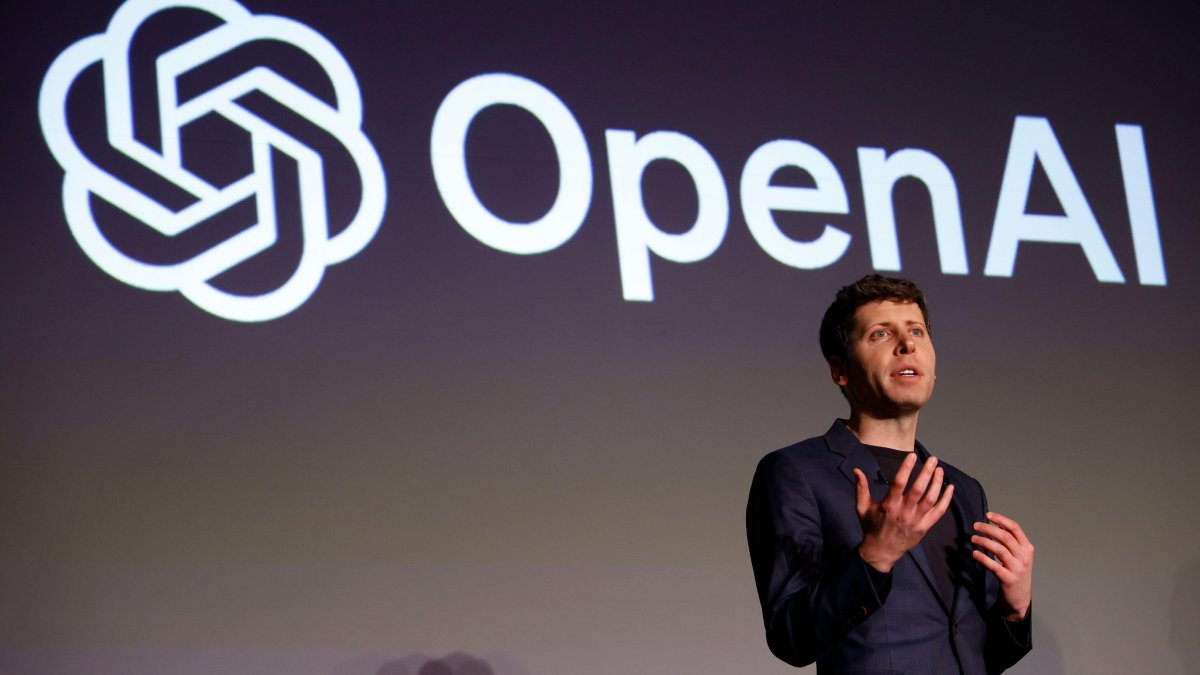
From the moment that OpenAI released ChatGPT just over three years ago, Sam Altman has been living in, and selling, a fairytale.
It was a tale in which a tiny research lab invents a world-altering, almost magical technology — right under the noses of the largest tech companies on the planet. This invention would banish disease, unlock the mysteries of the universe, and spur an era of unfathomable human prosperity.
It was quite the yarn.
Reality, however, has rather rudely crashed onto the scene, and threatens to shunt Altman to the periphery of the tale he has been so busy authoring.
The 40-year-old is being buffeted by two forces at once. The first is competition. Days after ChatGPT was released in November 2022, Sundar Pichai, chief executive of Google owner Alphabet, called a “code red” inside the search giant.
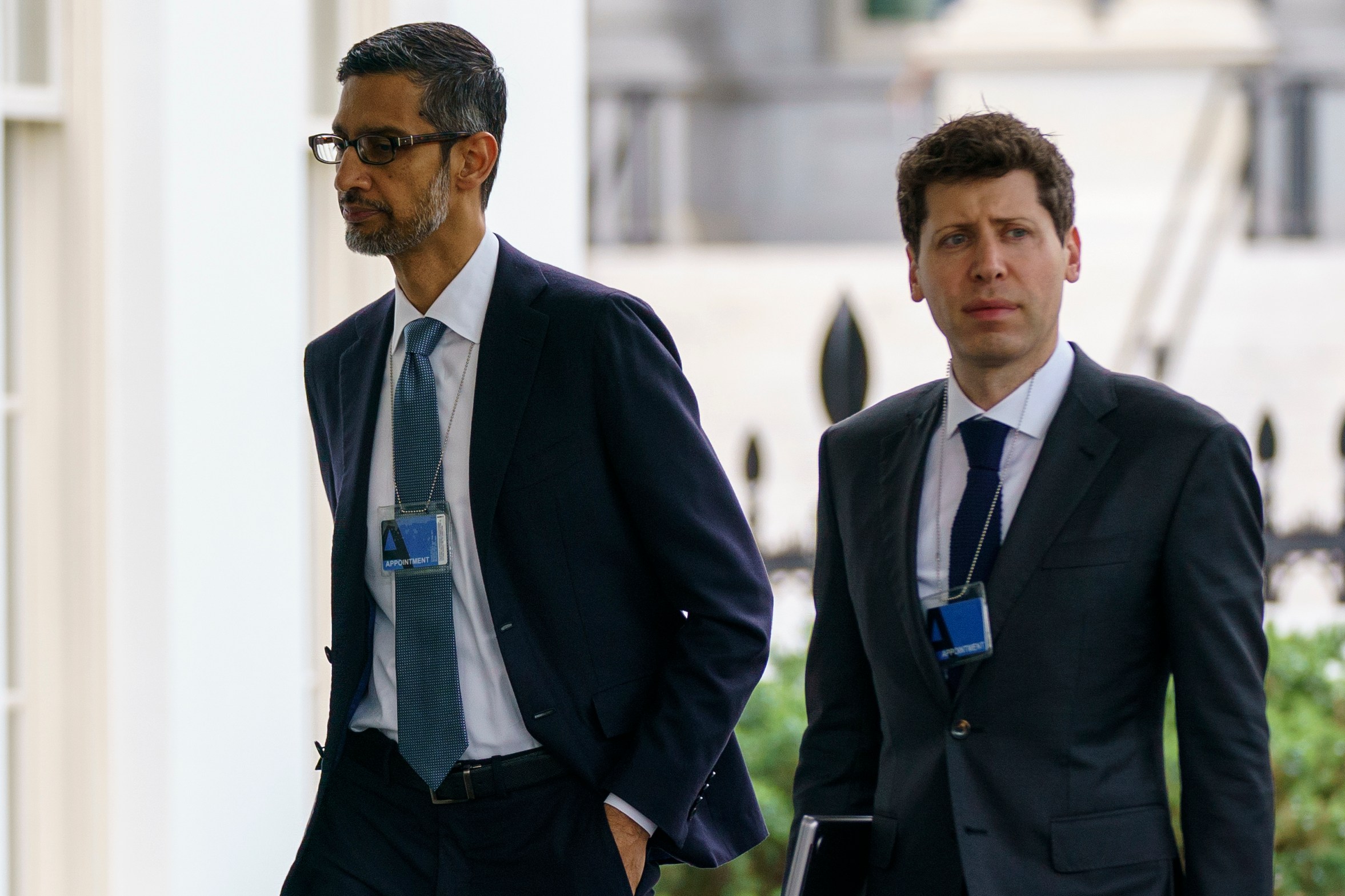
Sundar Pichai, left, with Altman before a White House meeting in 2023. Now the Alphabet chief has parked his tanks on OpenAI’s lawn
EVAN VUCCI/AP
• Google has signalled the death of googling. What comes next?
The Google owner was renowned for its technological nous. But somehow, OpenAI, a non-profit research lab, had invented a chatbot that threatened Alphabet’s core search business. Pichai called all hands on deck to roll out a rival product as quickly as possible.
OpenAI, meanwhile, became the toast of the town. People signed up in their millions to ChatGPT. By sheer user numbers, it was the fastest-growing consumer product in history, going from zero to 800 million users in three years.
Sales soared, but so did the company’s losses. Investors, however, didn’t mind — they were desperate to give Altman all the money he wanted. He was building the future; OpenAI was the clear leader in the field, and they wanted a piece.
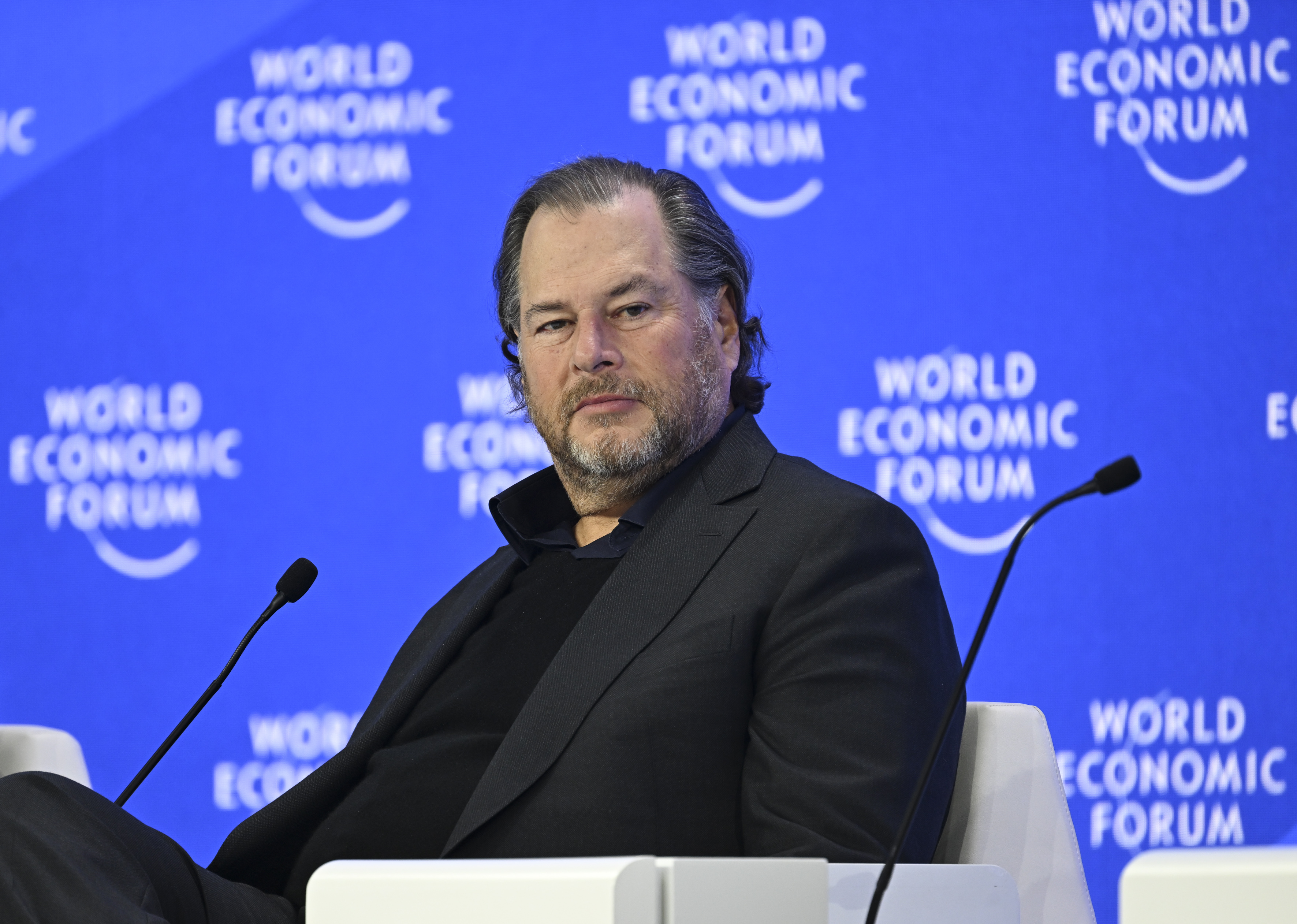
Fast forward to last month and Google’s release of the latest version of its rival Gemini model. It beat ChatGPT across nearly every benchmark. “Holy shit”, wrote Salesforce chief Marc Benioff. “I’ve used ChatGPT every day for 3 years. Just spent 2 hours on Gemini 3. I’m not going back.

Altman still had the ear of the US president in January. But by November, Marc Benioff, below, was saying of ChatGPT: “I’m not going back”
JIM WATSON/AFP
HALIL SAGIRKAYA/GETTY IMAGES
“The leap is insane — reasoning, speed, images, video … everything is sharper and faster. It feels like the world just changed, again.”
And it wasn’t just Google. Anthropic, OpenAI’s cross-town rival, released an updated version of Claude, which also outperformed ChatGPT on numerous metrics. Meanwhile DeepSeek, the Chinese competitor building “open-source” models, put out a new version that became the world’s first free AI tool able to notch a gold medal at the prestigious International Mathematical Olympiad. Upon the announcement, a user on X wrote: “Rest in Peace, ChatGPT.”
• $300bn AI start-up Anthropic prepares blockbuster IPO
In short, the world has caught up. This led to a poignantly circular moment last week when Altman issued his own “code red”. Think of it as pulling the corporate fire alarm — an order to drop everything and focus on one thing: ChatGPT. Altman wrote: “We know we have some work to do, but we are catching up fast.”
Digital intelligence is rapidly heading towards commoditisation. No company holds a lead in capabilities for long. It will be ubiquitous, and virtually free. Benioff made this point in a follow-up post last week, saying: “LLMs [large language models] are the new disk drives: commodity infrastructure you hot-swap for whoever’s cheapest + best.”
So the question then becomes: who can turn AI into a viable product? Who can build the tools that hundreds of millions of people will pay for, or that advertisers will pay to show up alongside?
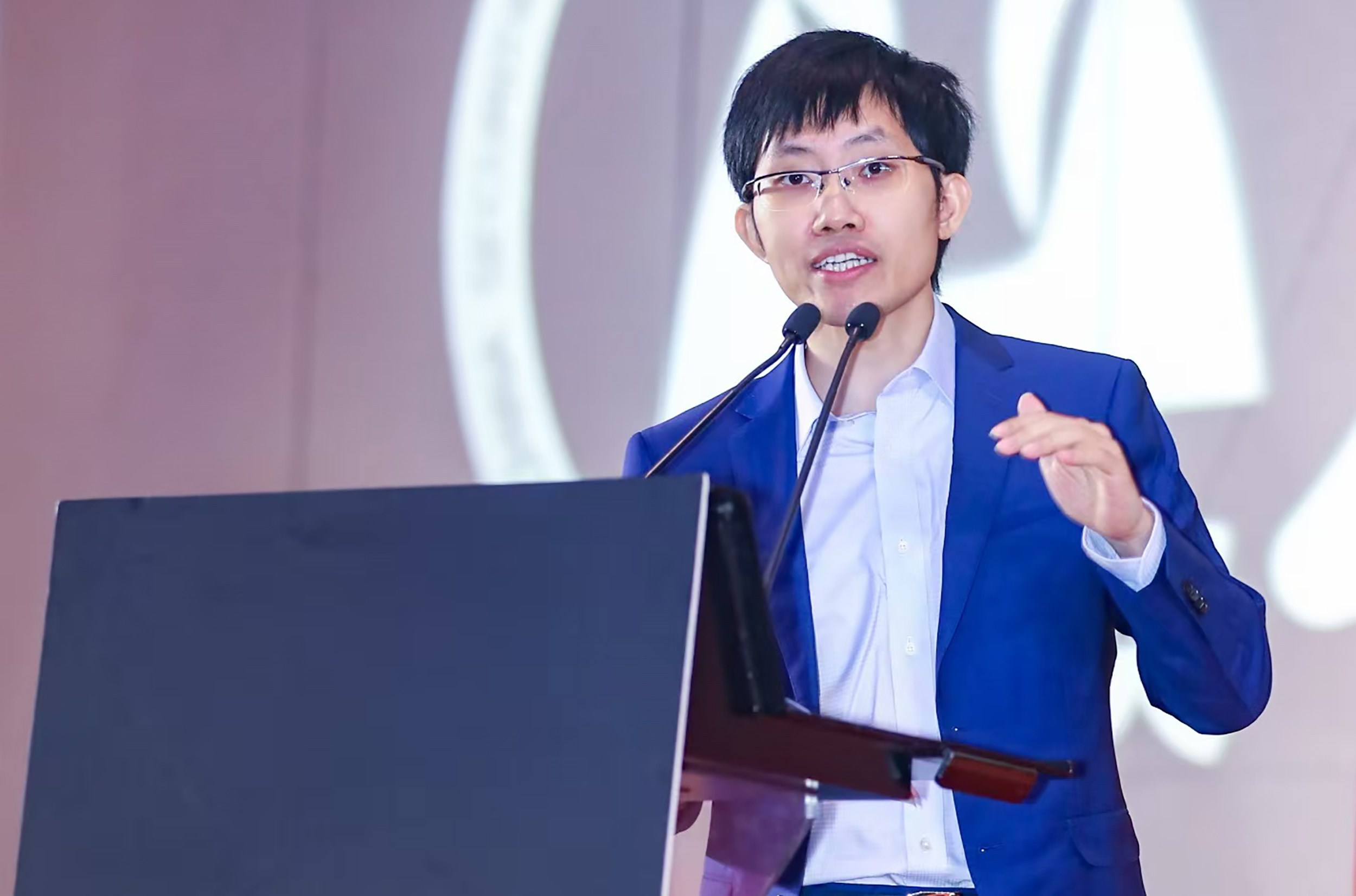
Among the pretenders to Altman’s crown is DeepSeek founder Liang Wenfeng
GETTY IMAGES
It must be said, however, that even if its lead has been vaporised, OpenAI’s rise stands as one of the most stunning ascents in corporate history. To build something that in three years goes from zero to being used by nearly a billion people is nothing short of extraordinary.
Which leads to the second force that has crashed down on Altman’s head: the markets. Silicon Valley is in the fairytale business. Venture capitalists back ideas with a low probability of success. In that model, financials don’t matter much, especially in the early days. Often, they don’t even exist. You’re buying a napkin sketch.
• Comment: Investors are on edge as talk of an AI bubble gets louder
It brings to mind a quote from Bill Gurley, a legendary venture capitalist, who once said: “In Silicon Valley, if there was a scale of financial sophistication between 1 and 10, and you would say a really smart person in New York is an 8.5, the average Silicon Valley person … is a 2.”
The problem for OpenAI is that it has grown so fast, its capital needs are so acute, and the deals it has cut are so vast that Wall Street has been pulled into this story — and it does not like what it sees.
Analysts at HSBC, for example, recently laid out how even under its most optimistic scenario, OpenAI will need to raise $200 billion (£150 billion) from investors in the next fours years to close the gap between projected sales and its exploding spending plans.
How optimistic? HSBC’s model assumes that ChatGPT will, by 2030, grow to three billion users — roughly quadruple its current tally of 800 million — and nab nearly half of the global population over 15 years old. It also assumes that the proportion of paying subscribers — about 8 per cent of users are estimated to pay for ChatGPT each month — grows to 10 per cent.
Yet even if Altman manages such a heroic performance, he would still fall $200 billion short of the cash he needs. That is because he has pledged to spend $1.4 trillion on data centres, even though OpenAI brings in “just” $20 billion in annual sales, less than 2 per cent of his pledged outlay.
Deutsche Bank piled on last week, publishing a chart that showed what an outlier OpenAI is in corporate history. It plotted the San Francisco company’s projected total losses at $140 billion before it finally turns a profit. Compared to other companies that famously spent years in the red — such as Amazon, Spotify and Tesla — they all racked up less than $10 billion in accumulated losses. OpenAI is in another stratosphere.
The OpenAI fairytale, in other words, is over. The competitive “moat” that it appeared to have has been eroded.
And yet, it is still Altman’s game to lose. With ChatGPT, OpenAI has built the best brand in AI. He now needs to match this with a suite of products that people will pay for. “We want to be people’s personal AI subscription,” Altman said recently. In a crowded field, that is no small task.
As for how to pay for it all? If HSBC’s projections are to be believed, the only realistic option is a stock market float. And it will then be up to Altman to sell his story to a new audience — an audience that has little taste for fairytales.