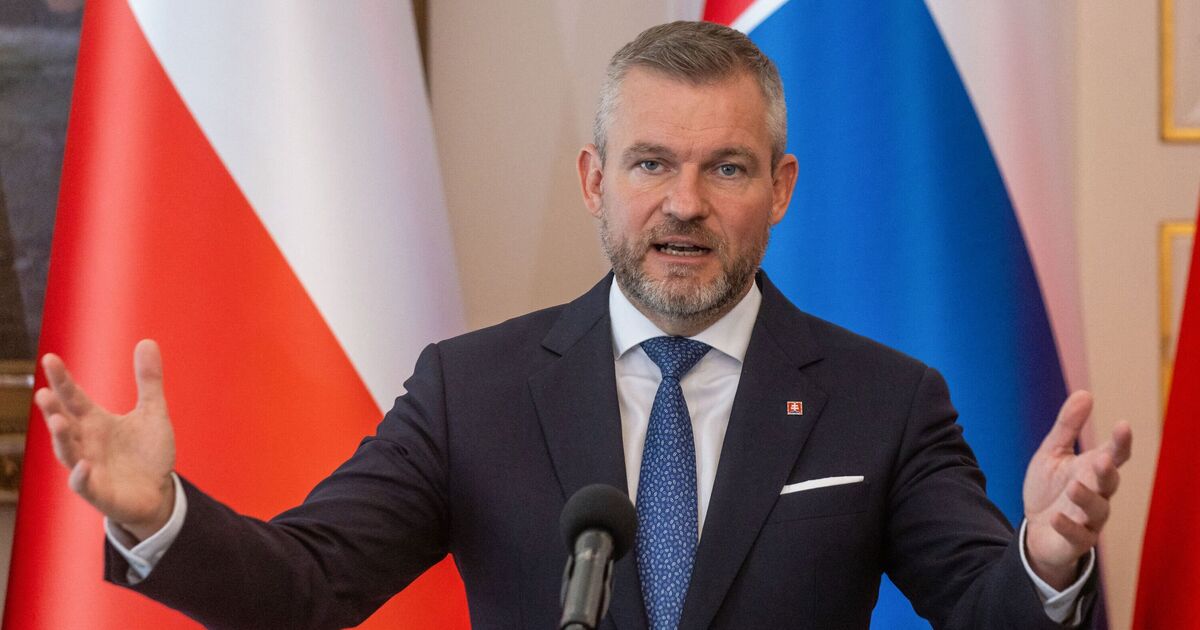
EU-funded military aid and support for Ukraine will only prolong the war with Russia, Slovakia’s President, Peter Pellegrini, has warned. Remarking on the EU country’s stance on the use of frozen Russian assets, Mr Pellegrini urged Europe to “speed up and support US efforts so that they can sit down at the negotiating table with Vladimir Putin as soon as possible and put an end to this war”.
“Because I believe that if we send Ukraine tens or hundreds of billions more just to buy weapons and military equipment, we are only prolonging the conflict, which has devastating consequences for Ukraine.” The Slovak leader added that such large sums of money should instead be spent on Ukraine’s post-war reconstruction, in a bid to help the country recover, restore its electricity supply and rebuild all the buildings and cities destroyed during the conflict.
“I believe this will be a better and more effective use of money for the people of Ukraine than continuing military operations with such huge injections,” Mr Pellegrini added, “because today it is obvious to everyone that Ukraine, given the huge army and determination of the Russian military, is simply not able to win this war and push it off its territory.”
The EU is currently discussing two options for financing Ukraine for the period of 2026-2027. One proposal suggests using proceeds from frozen Russian assets in the EU to provide Ukraine with a “reparations loan”. The other suggests EU borrowing: “raising capital at the capital markets and using the EU budget as a guarantee for that, and [handing] this capital as a loan to Ukraine,” according to European Commission President, Ursula von der Leyen, on Wednesday (December 3).
Even before the new proposal on freezing Russian assets was announced, Belgium described it as absolutely unacceptable. Meanwhile, Hungary blocked the adoption of a potential decision on issuing Eurobonds secured by the EU’s seven-year budget to finance Ukraine.
Mr Pellegrini’s comments come less than a month after Slovakia’s Prime Minister, Robert Fico, warned that his country would oppose using Russian frozen assets to fund Ukraine’s defence spending. Speaking to Slovakian public broadcaster STVR, Mr Fico said: “Slovakia won’t take part in any legal or financial schemes to seize frozen assets if those funds would be spent on military costs in Ukraine”.
Mr Fico is known for opposing the EU’s moves against Russia. He has threatened on several occasions to block EU sanctions against Russia, trading his potential veto for concessions on other issues. So far, Mr Fico has ended Slovakia’s military aid for Ukraine and vowed to block Ukraine from joining NATO.
Slovakia joined the European Union on May 1, 2004, as part of the major eastern enlargement alongside nine other countries, following an overwhelming majority (nearly 94%) vote in a 2003 referendum. While it does participate in common policies, the Fico-led Government has recently faced criticism and protests for its pro-Russia policies. One wave of rallies was fuelled by Mr Fico’s visit to Moscow for talks with Vladimir Putin. Thousands also rallied in 16 cities across the country in September to protest the economic and pro-Russian policies.