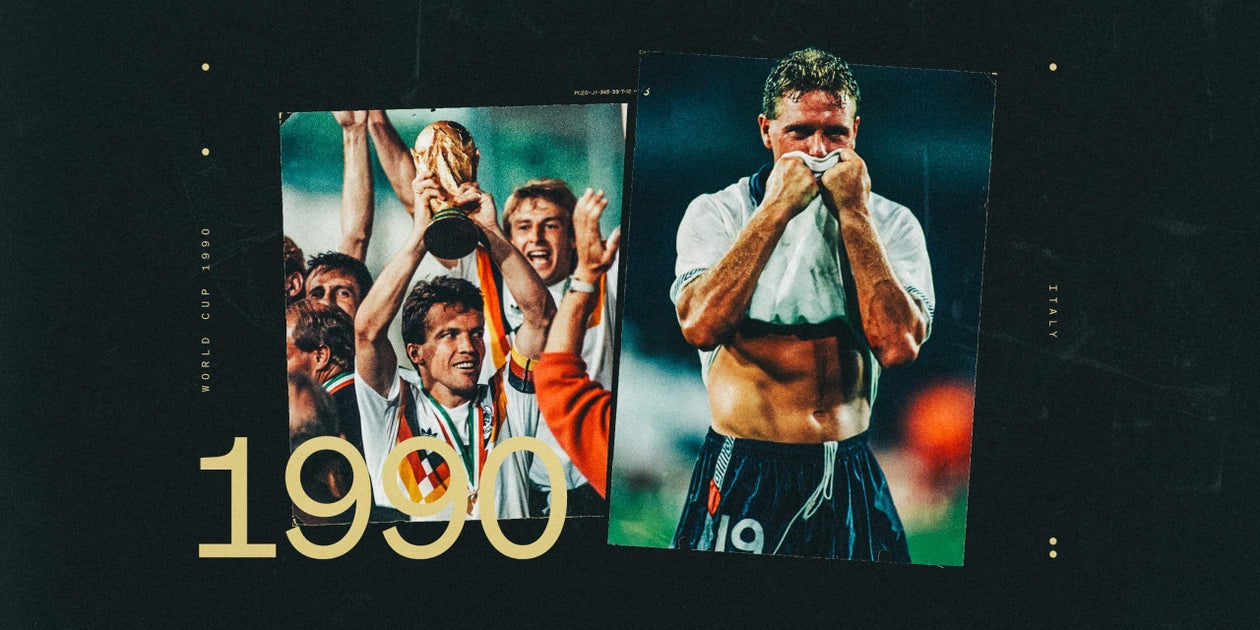
This is the 14th in a series by The Athletic looking back at the winners of each men’s World Cup.
Previously, we’ve looked at Uruguay in 1930, Italy in 1934 and again in 1938, Uruguay in 1950, West Germany in 1954, before a Brazilian double in 1958 and 1962, an England success in 1966, another Brazil win in 1970, a second West Germany triumph in 1974, Argentina’s long-awaited win in 1978, Italy’s third in 1982, and Argentina’s second in 1986.
This time, it’s West Germany in 1990.
Introduction
This is remembered as the most negative, defensive World Cup, supported by the lowest goals-per-game figure on record, 2.21. It was so disastrous that FIFA and IFAB felt compelled to improve the spectacle afterwards, largely by clamping down on dangerous tackles and introducing the backpass law — although not, as was floated by some, by increasing the size of the goals.
West Germany won the competition in somewhat unglamorous fashion, as their key matches were dominated by penalties and opposition red cards.
But in the group stage, they played some good football, and in the knockout stage, they at least attempted to, which was more than most of their opponents could claim.
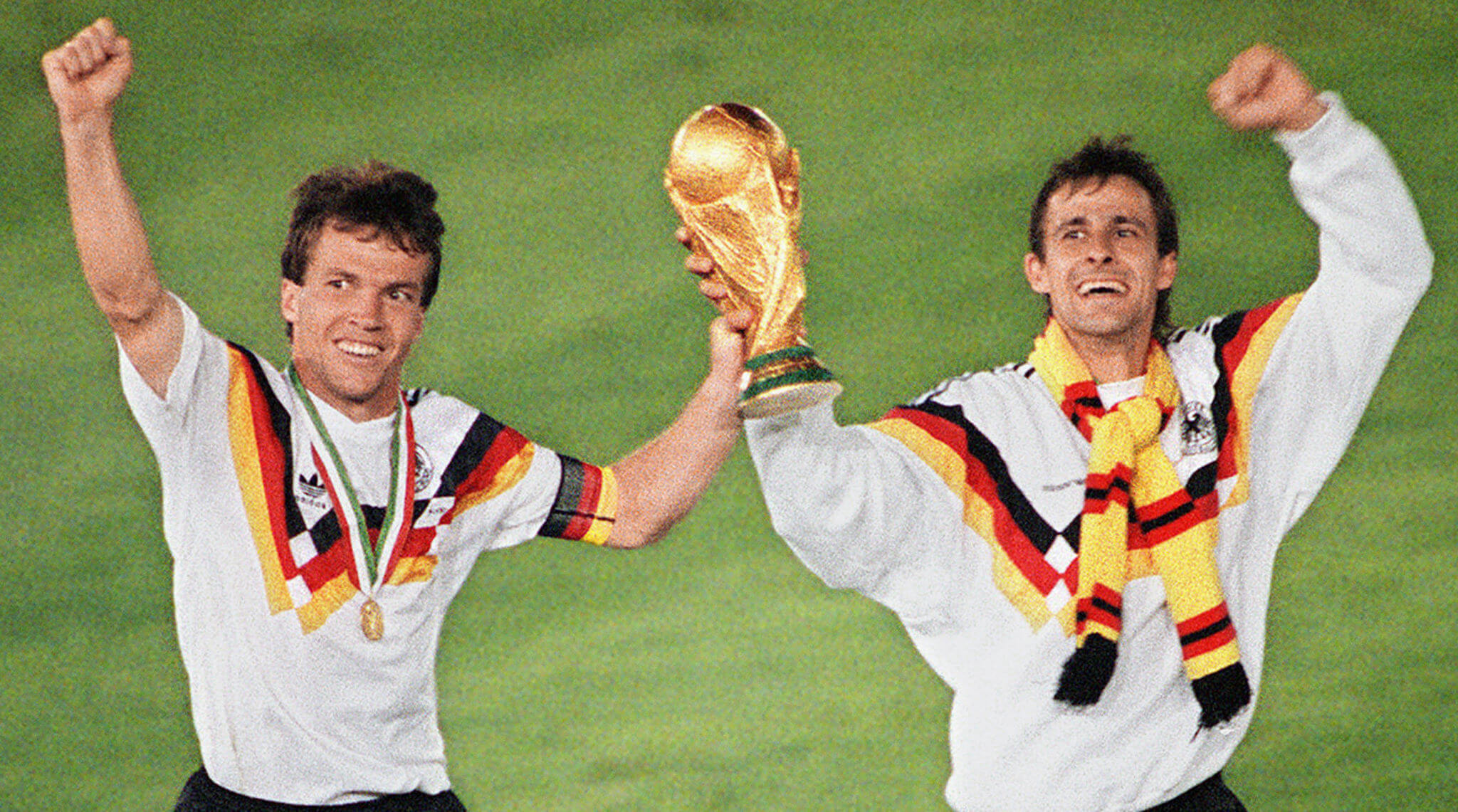
West Germany’s Lothar Matthaus and forward Pierre Littbarski (AFP via Getty Images)
The manager
Franz Beckenbauer had skippered West Germany to World Cup glory in 1974 and was always bound to become the national side’s manager. Having taken them to the final four years beforehand, here he became the second man to win the World Cup as player and manager, following Mario Zagallo. Didier Deschamps became the third in 2108. Beckenbauer also had runners-up medals as both player and manager, incidentally.
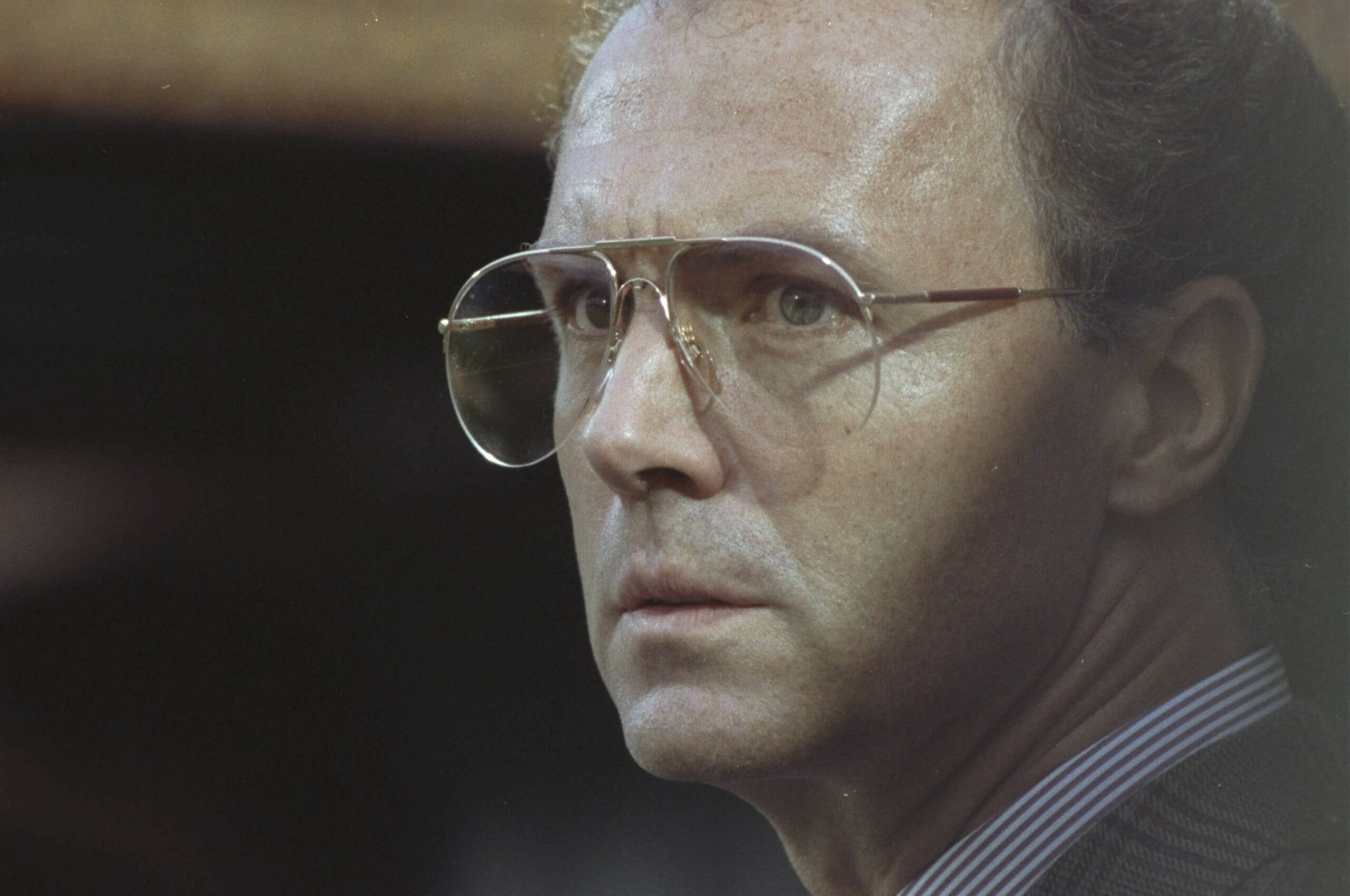
Franz Beckenbauer won the World Cup as both a player and a manager (Bob Martin/Allsport)
Regarded as somewhat tempestuous and immature in coaching terms at the 1986 World Cup, Beckenbauer had become calmer, more respected and probably a better tactician too. But while he was one of the more revered coaches to have won the World Cup because of his stature as a player, he probably made fewer decisive interventions than coaches of the World Cup-winning sides in 1978, 1982 or 1986, when specific tactical decisions proved crucial. Beckenbauer played the expected system, and trusted his players to do their thing.
Tactics
The classic German style — at least during this period.
Beckenbauer used the type of 3-5-2 system he would have enjoyed playing in himself, with legendary Bayern Munich sweeper Klaus Augenthaler (nicknamed ‘Auge’ — the eye) playing the Beckenbauer role — albeit less elegantly — as a sweeper behind two man-marking centre-backs. Both their semi-final and final opponents, England and Argentina, essentially used the same system.
The most famous marking job was performed by centre-back Guido Buchwald, who shadowed Diego Maradona so tirelessly in the final that he later became nicknamed ‘Diego’ back in Germany. Beckenbauer, usually reluctant to praise individuals, later said Buchwald had been the side’s star performer.
Much of the attacking impetus came from the wing-backs, with Stefan Reuter or Thomas Berthold down the right and, in particular, Andreas Brehme down the left, a player who was tireless and capable of good deliveries into the box. But the midfield was genuinely technical and inventive too, with Uwe Bein starting every game until being injured late against Czechoslovakia, Thomas Hassler a genuine playmaker, Pierre Littbarski a small, evasive dribbler and Lothar Matthaus the real star.
🎯 Andi Brehme hit a superb winner in the last 16, was crucially on target in the semi-final, and scored the goal that won West Germany the 1990 #WorldCup. He was a left-back 🤯
🎂 Happy birthday to a multifunctional legend 🏆#HBD | @DFB_Team_ENpic.twitter.com/1RufVkvwB7
— FIFA World Cup (@FIFAWorldCup) November 9, 2021
Up front, Beckenbauer generally used Jurgen Klinsmann and Rudi Voller; neither of them was quite a goal-poacher in the Gerd Muller mould, but they were excellent at running the channels, which was important in the absence of natural wingers, and timing their runs into goalscoring positions.
Star player
West Germany probably had three genuinely world-class players. Klinsmann was a top-class striker, Brehme an unusually complete wing-back, and in midfield they had Matthaus, a brilliant playmaker.
Though Matthaus would later drop back into a more defensive role, and, in the classic German style, eventually became a sweeper, here he was a brilliant attacking midfielder, driving at the opposition and offering a consistent goalscoring threat from the edge of the box. “Lothar is the universal player,” said his manager at Inter, Giovanni Trapattoni. “He is the complete modern footballer.”
He was most impressive against Yugoslavia in the opening game, scoring two wonderful goals. First he received the ball with his back to goal, turned onto his left foot and curled a low shot home into the bottom corner. Later, he dribbled from his own half into a familiar position on the edge of the box and fired home a shot with his right. He was impressive throughout the tournament, although, as is often the case with star players, more subdued in the final.
🇩🇪 Matthaus = midfield magician. 🪄#GoalOfTheDay | #FIFAWorldCup pic.twitter.com/6220pa1k7S
— FIFA World Cup (@FIFAWorldCup) June 10, 2024
The final
A repeat of the previous final, the only time this has happened to date. West Germany defeated Argentina 1-0 in what was, at the time, widely regarded as the worst World Cup final in history. It was the first final to feature fewer than three goals. It was also the first time any side had kept a clean sheet in a final, which is to West Germany’s credit. But, really, Argentina barely tried to score.
As The New York Times’ Michael Janofsky put it, this was a match “that typified the enduring themes of the monthlong tournament — few goals, nasty play and dull games.” Both sides used close, aggressive man-marking, which largely rendered the attackers useless, although Voller did have several chances to score — his movement was fantastic, but he was repeatedly off-balance when meeting crosses, usually from Brehme.
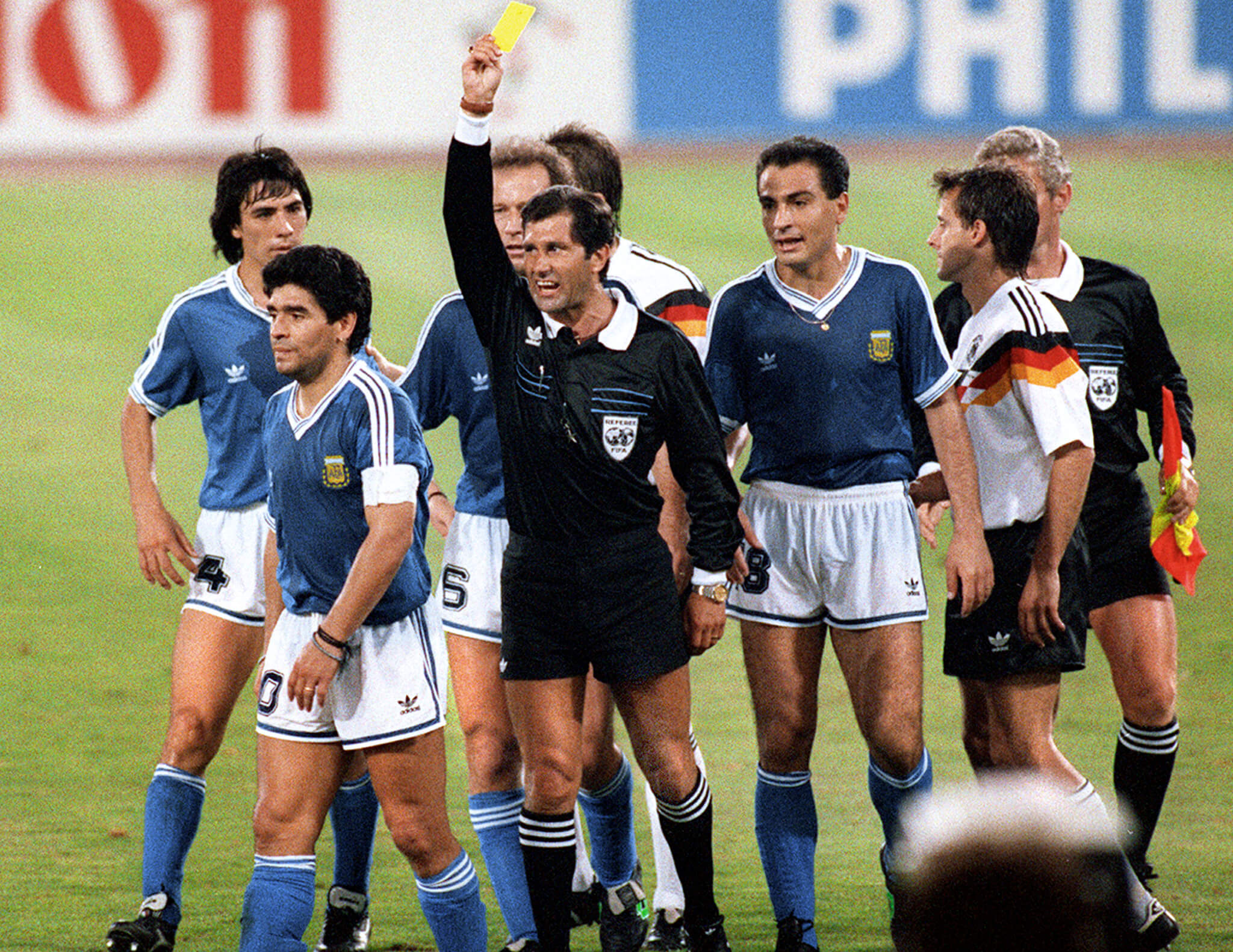
Argentina picked up three yellow cards and two reds in the 1990 final (AFP via Getty Images)
Argentina lost it as much as West Germany won it, not merely because of their defensive approach, but because they had two men sent off, and conceded a penalty. The first dismissal came 20 minutes into the second half, when Pedro Monzon, a half-time substitute, was beaten by Klinsmann out wide, and attempted to stop him with a terrible, straight-leg challenge into Klinsmann’s shin. The first World Cup final red card was brandished by Mexican referee Edgardo Codesal in a magnificently performative manner.
Codesal was again the centre of attention when he pointed to the spot when Roberto Sensini — a midfielder deputising in defence after Monzon’s red card — brought down Voller in the box. The penalty decision was considered controversial at the time, partly as the German strikers had a tendency to go down somewhat easily. But Sensini went to ground, put his leg across Voller’s path and got nowhere near the ball. Voller later suggested the decision was almost for ‘accumulation’, after a couple of other penalty appeals had been turned down. Brehme duly scored the penalty.
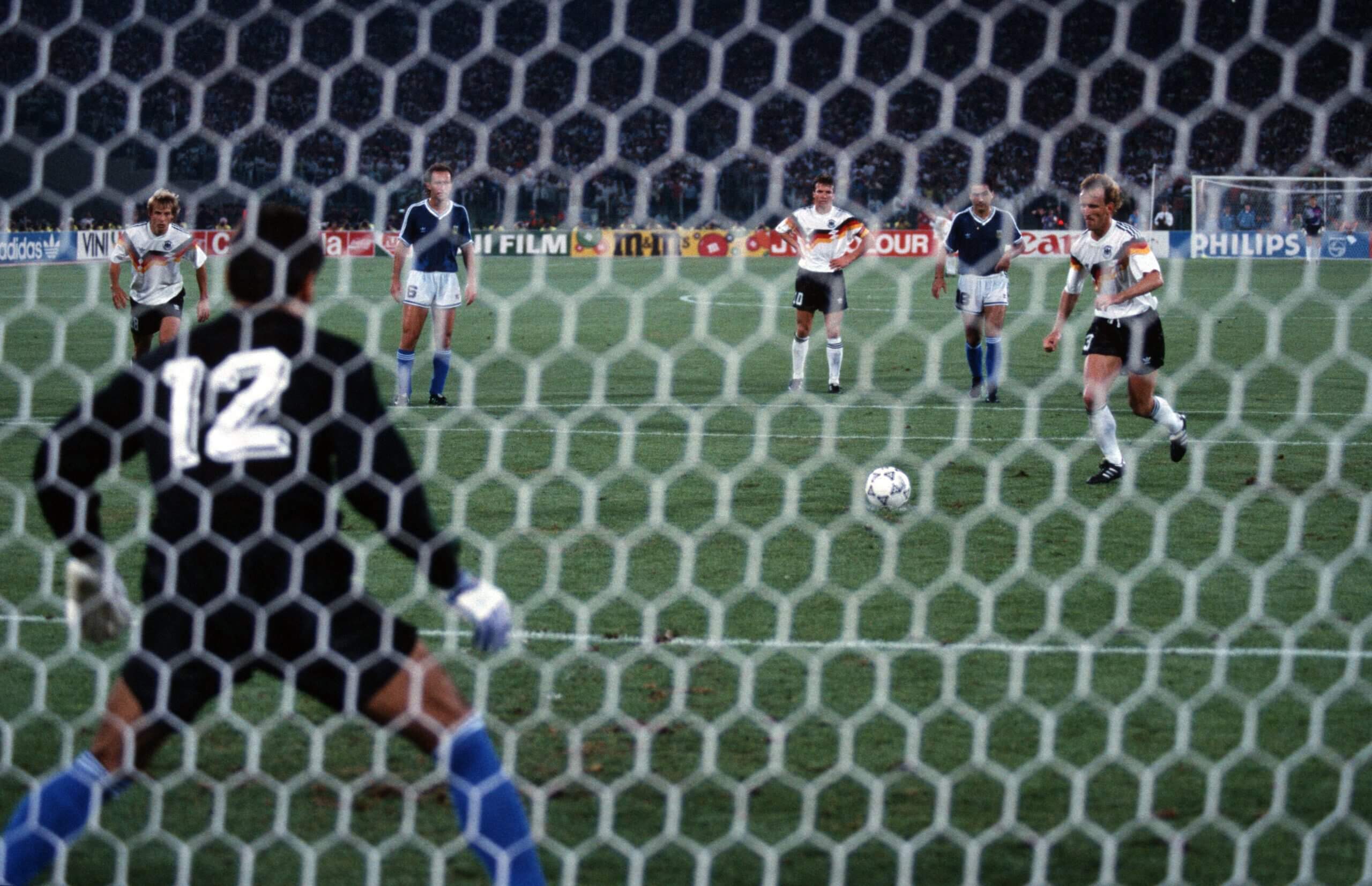
Andreas Brehme took the winning penalty with his (theoretically) weaker foot (Bongarts/Getty Images)
Beckenbauer said the awarding of the penalty was not the crucial factor in the outcome, because, “in any case we would have scored, even if it had taken extra time… 1-0 with a penalty doesn’t give a fair idea of the game. We could have won 3-0. I don’t remember a single chance Argentina had to score.” He was right. They had one shot in the entire game, a Maradona free kick which went over the bar. West Germany had 23 shots… and only two were on target, one of them the penalty.
Argentina’s second red card was shown to Gustavo Dezotti, a somewhat forgettable No 9 who was playing because Claudio Caniggia was suspended, who reacted to Jurgen Kohler trying to waste time by dragging him down by the neck.
Argentina went into the final with four players suspended, and had two sent off in the final. It would have been a travesty — if somewhat fitting for this World Cup — if this Argentina side had won the tournament. They played seven matches, won two, and scored five goals.
It’s not often West Germany were the neutral’s favourites — it was very much the opposite when they’d won the 1954 and 1974 editions — but this was the right outcome. It was also the final match West Germany ever played; they would subsequently compete as simply Germany after reunification. Beckenbauer claimed that with the introduction of players from the East, Germany would be unbeatable.
You might be surprised to learn
When left-back Brehme slotted home the decisive penalty, there were two surprising things.
First, that the penalty wasn’t taken by Matthaus, who had scored the winning penalty in the 1-0 quarter-final win over Czechoslovakia. He’d been forced to replace his boots midway through the game, didn’t feel comfortable in the new ones, and so didn’t fancy taking the penalty.
Second, that Brehme scored the crucial penalty with his right foot — four years earlier, he’d converted in a shootout against Mexico with his left. “In 1986, I was asked why I’d taken a penalty with my left foot, as the interviewer knew I often used my right,” he told FourFourTwo magazine in 2022. “I hadn’t even noticed. It makes no difference.”
That was what Brehme, who died last year aged 63, encapsulated — he genuinely didn’t know which foot was better. He seemingly he had more power with his left, taking corners and free-kicks with it in an explosive, pivoting fashion, but was more accurate with his right, so (generally) used that for precise, measured penalties — and indeed for a lovely, delicate curled goal in the win over the Netherlands. The Dutch had been so scared of his attacking quality that winger John van ‘t Schip was ordered to man-mark him, an almost unprecedented level of attention for an opposition wing-back.
Many of West Germany’s best moments in the final came from his crosses and set-piece deliveries, so it was right that he was the match-winner from the spot.
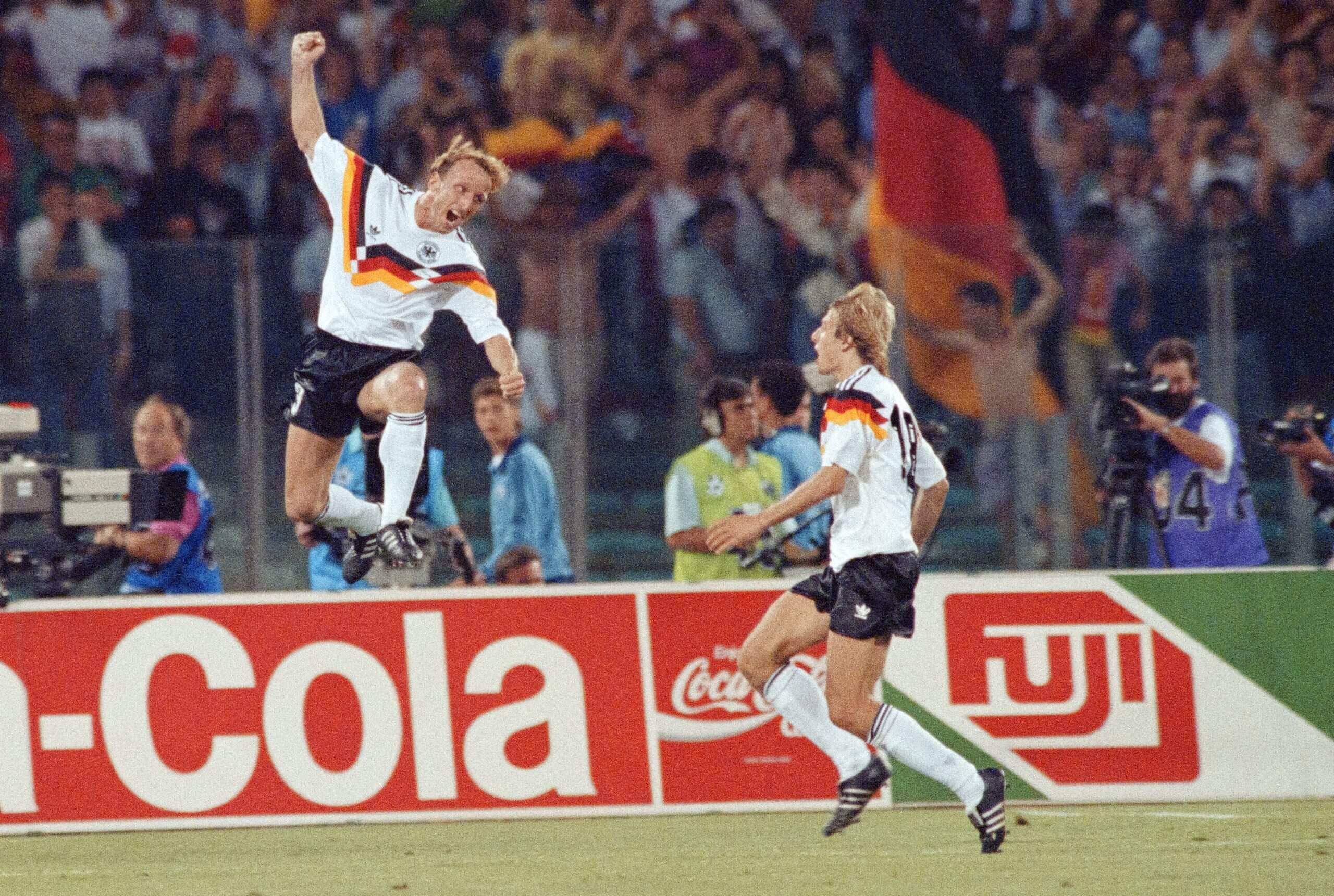
Brehme celebrates his goal in the final (Getty Images)
The defining moment
It’s surprisingly tough to find a genuinely legendary moment from West Germany’s triumph. Ultimately, their three goals in their final three games were two penalties and a crazily deflected Brehme free kick in the semi-final win on penalties over England. That match is actually more ‘celebrated’ by the losers. While England were denied a place on the World Cup final on penalty kicks, the game is nevertheless held up at the moment football in England reached a wider audience, thanks to the emotions of watching Gary Lineker’s late equaliser, Paul Gascoigne’s tears and Stuart Pearce and Chris Waddle’s shootout misses.
Probably the most replayed from West Germany’s run campaign is striker Voller’s spat with Frank Rijkaard in the round of 16 contest, which led to both being dismissed and the match being played ten-against-ten for the majority, with West Germany running out 2-1 winners in an enjoyably open game.
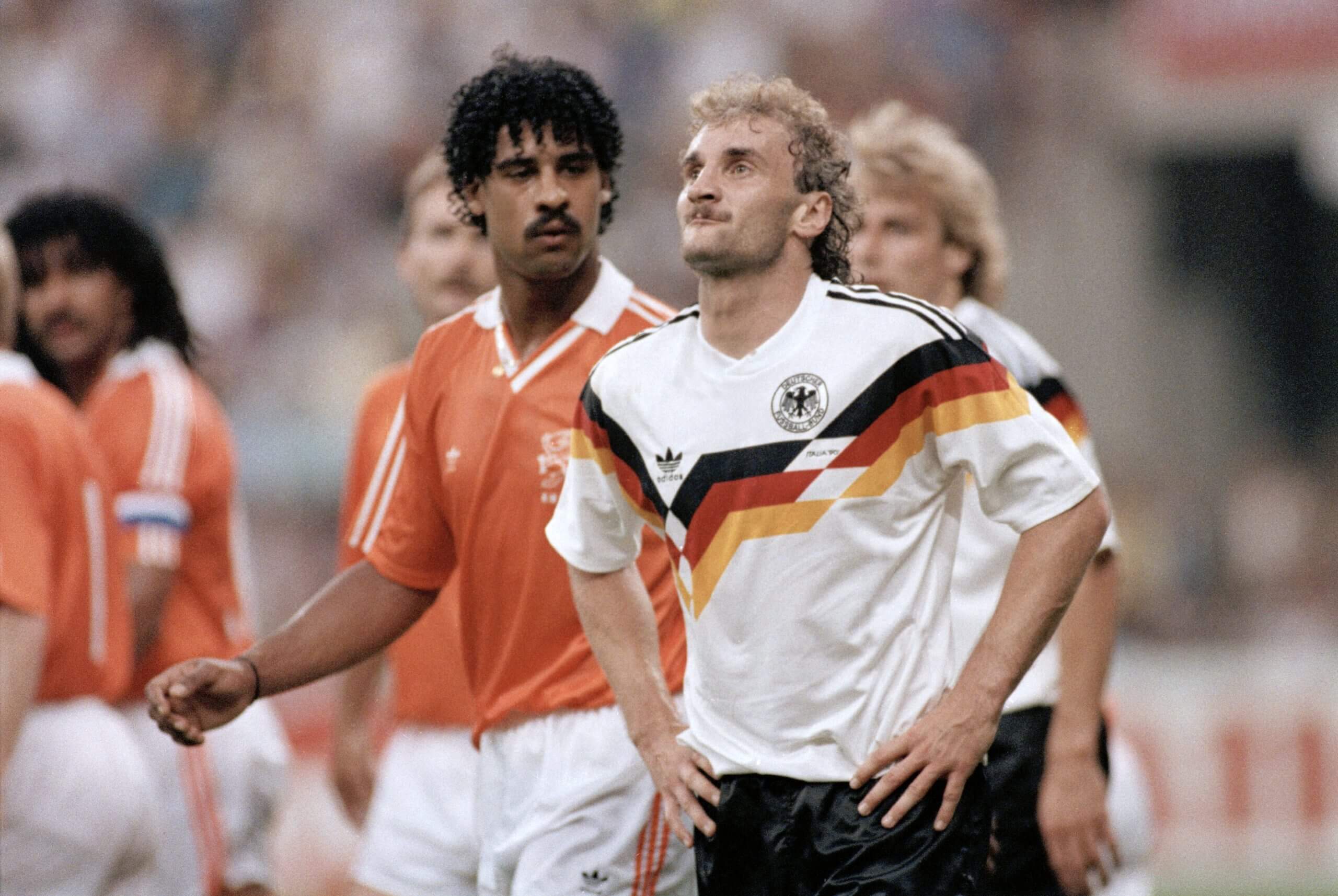
(David Cannon/Getty Images)
Matthaus scored a couple of fine goals in the group stage, but maybe the most iconic single moment is Klinsmann’s near-post, glancing diving header in the thumping 4-1 win over Yugoslavia in the opening game, the type of goal that he specialised in.
Were they definitely the best side?
Yes, which says much about the tournament — that a team triumphed in such underwhelming fashion, and yet were still clearly the best side.
But West Germany played genuinely good, open, attacking football in the group stage. Their win over the Dutch was exciting, and their performance in a 1-0 quarter-final win over Czechoslovakia was more impressive than the scoreline would suggest. They are remembered largely on the basis of a penalty shootout win over England in the semi-final, and a scruffy 1-0 win over Argentina. But West Germany often offered more technical quality than they were given credit for.
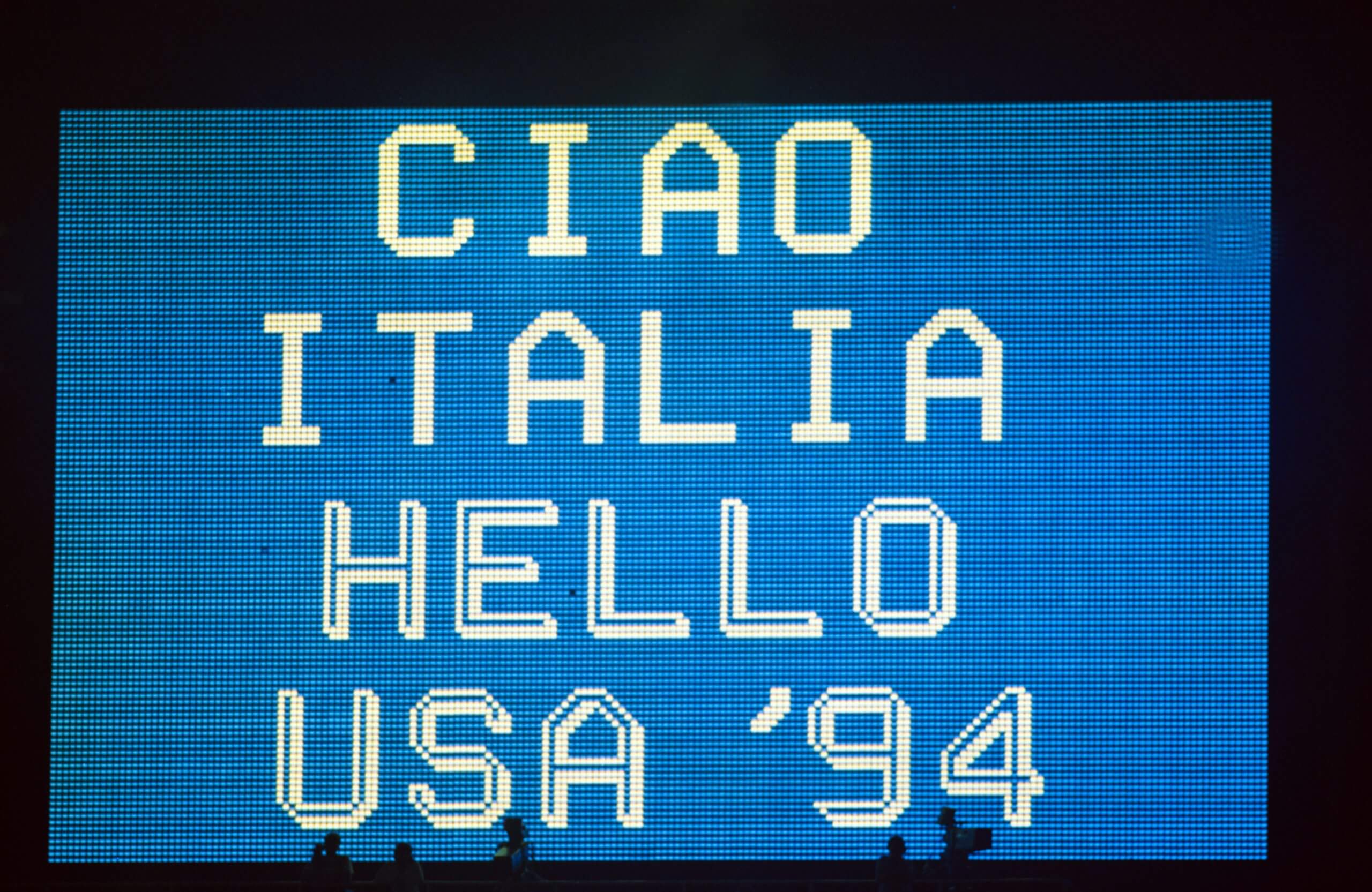
The scoreboard in Rome in 1990 tees up the next World Cup (Allsport/Getty Images/Hulton Archive)