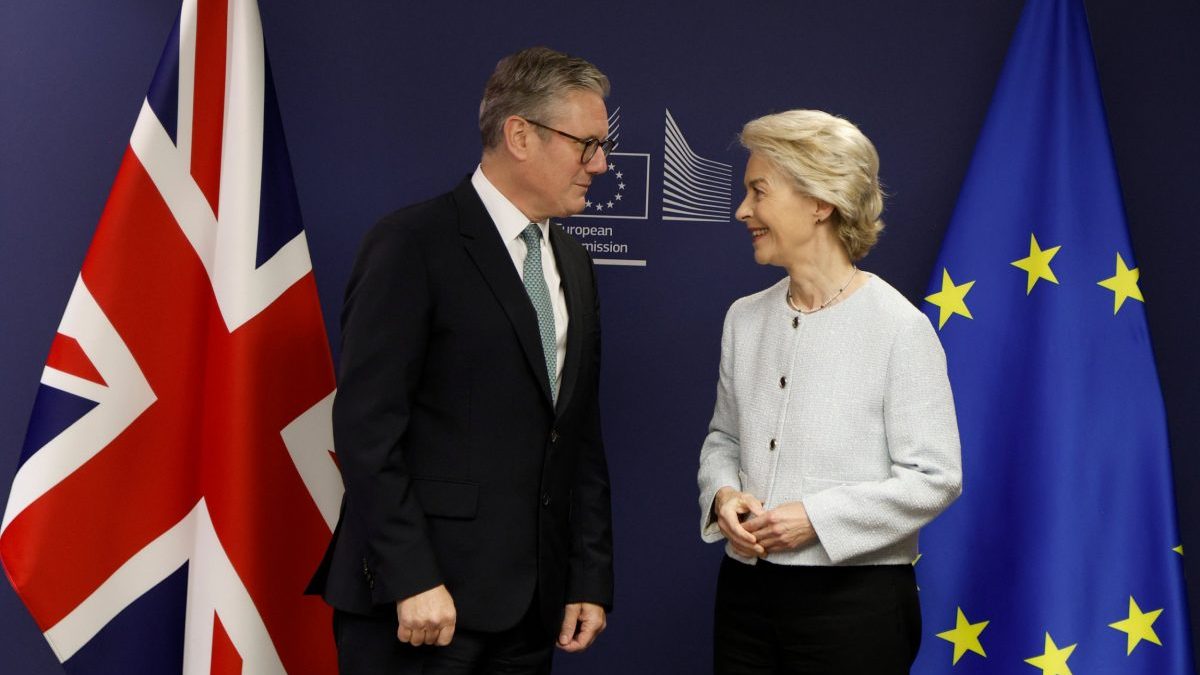
Brussels is on a fresh collision course with the UK over plans to promote a “buy European” plan which could shut out British firms and risks breaching the post-Brexit trade deal.
Sir Keir Starmer is pushing for closer economic ties with the EU under his “reset” of relations with the continent, which he hopes will boost the UK economy.
But trade experts and businesses have raised the alarm about a string of recent moves towards greater protectionism in Europe, which come in response to Donald Trump’s trade wars and the rise of Chinese industry.
The UK Government has refused to criticise the EU publicly over the policy shifts, but The i Paper understands ministers are privately pushing their Brussels counterparts not to exclude Britain from future economic plans and to honour the promises previously made.
The looming clash comes after the collapse of talks for Britain to enter the first round of bids for a new €150bn (£131bn) collective weapons fund following a row over how much the UK should pay to take part in the scheme.
The Trade and Cooperation Agreement (TCA), which was struck by former prime minister Boris Johnson in 2020 and is the main document governing post-Brexit trade relations, dictates that the UK should maintain access to the EU’s market and British companies should be able to bid for important procurement contracts.
But the European Commission and key EU member states, in particular France, have been talking publicly about the need to give greater priority to firms based inside the bloc.
‘Made in Europe’ policy shift
The “Apply AI strategy” published in October says that EU countries should adopt a “buy European” approach to innovative technology, particularly in the public sector.
And talking at a summit last week, French President Emmanuel Macron urged EU companies: “When there is an existing, competitive European solution, please adopt it.” He added that AI investment should prioritise local providers, saying: “In China, you have a Chinese exclusivity; in the US, you have a US preference. The European Union is the only place in the world where you have a non-European preference de facto.”
And in recent days, it has emerged that the Commission is considering forcing manufacturers to source more of their parts from inside the EU with a “made in Europe” policy that would push quotas of 70 per cent of the components of some goods coming from within the bloc.
These policy moves would potentially make it harder for British technology firms to sell services to European governments, and for UK-based manufacturers of products such as cars to export freely to the continent.
David Henig, director of the UK Trade Policy Project, warned: “Buy Europe is a serious prospect, and likely to breach existing EU agreements, including the TCA with the UK. More to the point, it will affect UK companies and create more ambiguous scenarios for Northern Ireland.
‘Difficult relationships unresolved’ by Brexit reset
“EU steel proposals provide a clue to the direction of travel, and as yet, the UK doesn’t seem to have a good handling strategy. How wide this goes, we don’t yet know, but it is a reminder of difficult relationships unresolved as yet by the reset.”
Dom Hallas, of the Startup Coalition, founded by tech entrepreneurs, urged the Government to push for closer working on new technology such as AI, saying: “Any European preference for purchasing in tech is fairly meaningless without the UK involved. This is especially true in strategic areas like AI, deeptech and defence, where we are a clear European leader – helped by the fact that lots of the best UK-based founders are actually EU citizens themselves.
“We’d be keen to see the UK Government co-operate much more closely with the EU in some of these areas, including rejoining the European Innovation Council (EIC) in full – but that relies on EU member states not breaching the TCA to handicap UK firms.”
The EIC is an EU innovation programme set up to identify and scale up breakthrough technologies in Europe.
The EU is conducting a full review of its procurement rules next year, with key figures pushing for a greater level of protectionism to boost domestic industries. Earlier this year, the bloc announced a significant increase in steel tariffs, from which Britain is currently seeking a carveout.
What happens if the Brexit trade deal is breached?
Under the terms of the post-Brexit deal – the TCA – there are mechanisms for settling disputes which allow either side to challenge the other if they believe there has been a breach.
In some cases, this can lead to an arbitration tribunal, which will decide whether the terms of the deal have been broken and, if so, force the “breaching” party to set out what they will do to comply within a set time limit.
If they fail to do so, this can lead to temporary compensation or retaliation from the other side.
In other circumstances, a panel of experts can make recommendations, but these are not binding.
In cases where there is no mechanism, the only option is for the complainant to raise the issue at a political or diplomatic level.
A UK Government spokesman said: “A strong relationship with our largest trading partner is key to delivering growth and is good for jobs, bills, and borders.
“The landmark deal we agreed with the EU at the summit in May will reduce costs for businesses, offering better prices and more choice for shoppers. Once negotiated, the food and drink and carbon markets linking deals alone are set to add nearly £9bn a year to the UK economy, in a significant boost for growth.”
Your next read
A spokesman for the European Commission declined to comment.
David Lammy, the Deputy Prime Minister, this week appeared to cast doubt on the Government’s Brexit policy by saying that rejoining the customs union would boost the British economy.
And in an interview with The Observer days later, the Prime Minister refused five times to repeat a previous claim that the UK would not rejoin the EU in his lifetime.
But a Downing Street spokesman insisted that the Government’s policy was not to rejoin the EU, adding its “red lines” of staying outside the single market and customs union, and rejecting the free movement of people, would remain in place.