Norwegian Foreign Minister Espen Barth Eide has been a busy man this week, traveling to meetings in Brussels, Vienna, Doha and then on to London. The Brussels visit was tied to a NATO ministerial meeting, but he also nudged Norway closer to the European Union (EU).
 Norway’s new Labour-led government is determined to bring Norway and the EU closer together. These were set up in Bergen last year during a visit by EU leader Ursula von der Leyen. PHOTO: EU
By Friday his foreign ministry could announce that Norway and its fellow members of the European Economic Area (EEA) Committee had introduced 142 new legislative acts from the EU on Friday into their agreement with the EU that’s known as the EØS-avtale in Norway. It gives Norway, Iceland and Liechtenstein access to the EU’s inner market.
That brings the number of EU directives, rules, regulations and other decisions that still haven’t been introduced and implemented down to 528. That’s still too high in the EU’s view, which wants the number to fall to below 500, but it marks a decline from 599 after the EEA Committee’s last meeting in October. That had risen from 570 in May, when the EU was irritated that Norway and other EEA members weren’t fully abiding by their agreement.
Norway’s Labour government has clearly picked up its pace on trying to implement EU directives into Norwegian law since its re-election in September. It no longer has to agree on such issues with the anti-EU Center Party, with which it had goverened since 2021. Foreign Minister Eide has long been a strong advocate of cooperating with the EU, especially in such troubled times as now, and is keen to push through EU directives more quickly. He has long felt that close cooperation with the EU is more than important than ever, given all the uncertainty around working with what used to be their most reliable joint ally, the US.
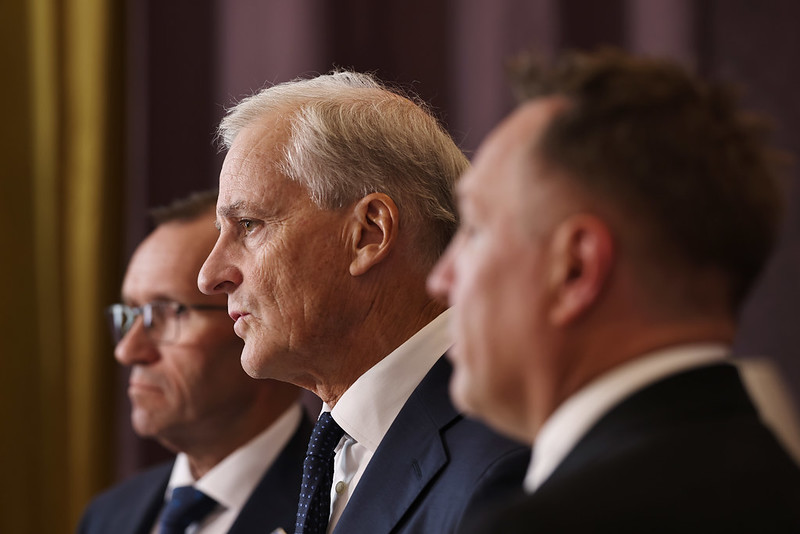 Foreign Minister Espen Barth Eide (left), Prime Minister Jens Stoltenberg (center) and Defense Minister Tore O Sandvik are trying to work closely with the EU and NATO, even though Norway isn’t a member of the EU. PHOTO: Torbjørn Kjosvold/Forsvaret
“It’s been important to bring down the lag here, and we have been working towards that goal,” Eide told state broadcaster NRK while in Brussels on Friday. He and his government have a better chance now of preserving the EEA agreement by adopting EU directives, since they can likely win majority support for them in Parliament. While debate continues over whether Norway should simply join the EU, the trade agreement with the EU has solid support.
Implementing EU directives and other of its legal acts can also help secure how Norwegian companies and citizens share most all of the same rights and privileges as those in EU member countries. Norway learned last month how that can’t always be taken for granted, when it became clear that the EEA agreement did not apply to metal alloys and that they faced a new, if discounted, tariff into the EU. The EU still has the right to protect its inner market, and its leaders think EU members should still have advantages over non-members like Norway.
While the EEA negotiations in Brussels were handled by Norway’s delegation in the European capital, Eide attended the NATO meeting of member countries’ foreign ministers nearby. The meeting lost some of its shine when the US Foreign Minister Marco Rubio failed to attend, but NATO Secretary General Mark Rutte and all the other ministers re-affirmed their support for Ukraine. All in attendance stressed the need for “strength and unity” and increasing their defense spending to 5 percent of GNP by 3035.
Eide could also announce a new contribution of NOK 5 billion (USD 500 million) to fund two new so-called PURL packages that respond to the “Prioritized Ukraine Requirements List.” Norway will be buying ground-to-air missile defense systems, ammunition and other critical equipment from the US that can be be delivered quickly to Ukraine. The US thus benefits as well. The new funding brings Norway’s total financial support to Ukraine to around USD 835 million this year.
From Brussels, Eide traveled to Vienna for another ministerial meeting at the Organization for Security and Cooperation in Europe (OSCE), which further highlighted the need for “political dialogue, shared values and joint action” on a wide variety of issues. That included plans for building the post-Ukraine-war order and securing a lasting peace among European nations. Eide was spending most of the weekend at the Doha Forum in the Middle East before traveling on to London to meet with British Foreign Minister Yvette Cooper.
NewsinEnglish.no/Nina Berglund