
A recent visit to China revealed just how far the UK’s once-thriving chemicals sector lags, held back by rising costs, skills shortages and disjointed support. Could increasing our collective appetite for risk secure survival and unlock new growth? Jonny Williamson reports…
China is moving discoveries from the lab and out to market at a furious pace and scale, underlining its shift from global imitator to leading innovator. Professor Raffaella Ocone is no stranger to China, yet even she was taken aback by the ambition on display during her latest visit.
Invited to speak at the 12th World Congress of Chemical Engineering in Beijing, the President of the Institution of Chemical Engineers (IChemE) admits the experience left her feeling overwhelmed.
“The level of innovation in China is astonishing,” she said. “Its pathway for advancing innovation through technology readiness levels is well developed, understood and agile, bringing discoveries to market faster and more effectively than almost anywhere else.”
That speed and clarity of purpose is what the UK is struggling to match. But without policy alignment, affordable energy and access to talent, the UK will always have one hand tied behind its back.
The engine for economic growth
Innovation drives growth, but chemistry is what keeps the engine running. Almost every aspect of daily life depends on chemical innovation, and it’s chemical engineers who turn these discoveries into safe, scalable and commercial processes. Whether producing strong, lightweight composites, delivering cleaner energy or cutting waste in food production and pharmaceuticals, their work is the glue that holds manufacturing together.
That blend of science and engineering has long been the UK’s strength, tied to its pioneering role in the Industrial Revolution and its establishment of the world’s first chemical engineering course. While the UK continues to perform strongly in research and education, it struggles to commercialise that research, something many others – China included – do far better.
The pages of The Manufacturer frequently discuss the UK’s so-called ‘valley of death’, where new ideas fail to mature. For Raffaella, that gap lies between technology readiness level (TRL) 3 and 6 where a project moves from proof of concept through basic lab validation to real-world demonstration. Bridging it is crucial if the UK is to turn research into competitive advantage on the global stage. Doing so, Raffaella says, rests on three things: industrial clusters, deeper coordination and greater diversity.
Clusters for transition and growth
A clear priority is making sure the UK’s network of industrial clusters – from the Cornwall Space Cluster to the Scottish Decarbonisation Cluster – functions as a genuine driver of innovation and growth. Co-located groups of industries sharing infrastructure, supply chains and skills are central to the UK meeting its large-scale goals, while securing a foothold in emerging markets. Take net zero. Multiple clusters have been established to anchor the shift from petrochemicals to cleaner alternatives. The Acorn carbon capture and storage project, for example, is using legacy oil and gas infrastructure to send captured industrial CO2 emissions to permanent geological storage under the North Sea. The hope is that Acorn can eventually use non-pipeline transportation to move captured CO2, helping to support the decarbonisation of industry across the UK and even internationally. Part of the Scottish Decarbonisation Cluster, Acorn is one among several industrial, power, hydrogen, bioenergy and waste-to-energy businesses with the shared aim of capturing ten million tonnes of CO2 annually by 2030 – and in doing so, creating thousands of long-term, highly skilled jobs and countless supplier opportunities. But Raffaella warns that the opportunity comes with a lesson. The collapse of coal mining showed how quickly entire regions can be left behind when industries vanish overnight. Clusters, if well-designed and supported, can prevent that mistake, providing a bridge from oil and gas to cleaner growth – reskilling workers and attracting new investment in the communities most at risk of decline. Widening the talent base Clusters and industries can only thrive if underpinned by the right skills. Reskilling and upskilling workers from oil and gas, for example, is key to delivering the energy transition. And it is a transition, Raffaella notes, not a substitution. The expertise honed in petrochemicals – from process safety to managing large, complex operations – is exactly what’s needed in carbon capture, hydrogen, offshore wind and battery storage. But Raffaella argues that the future of chemical engineering depends not only on reskilling but also on widening the profession’s intake beyond its traditional boundaries. She points out that engineering remains one of the least gender-diverse professions, with women making up less than 16% of engineers overall, and 22% in chemical engineering. Without change, the sector risks shutting out talent and narrowing the perspectives needed to solve complex, global problems. “Diverse teams create diverse ideas, and that’s what drives innovation,” she stressed. That means tackling barriers head-on through outreach into schools and communities, mentoring networks and targeted training to help attract and retain fresh talent.
Scotland’s first female Professor of Chemical Engineering
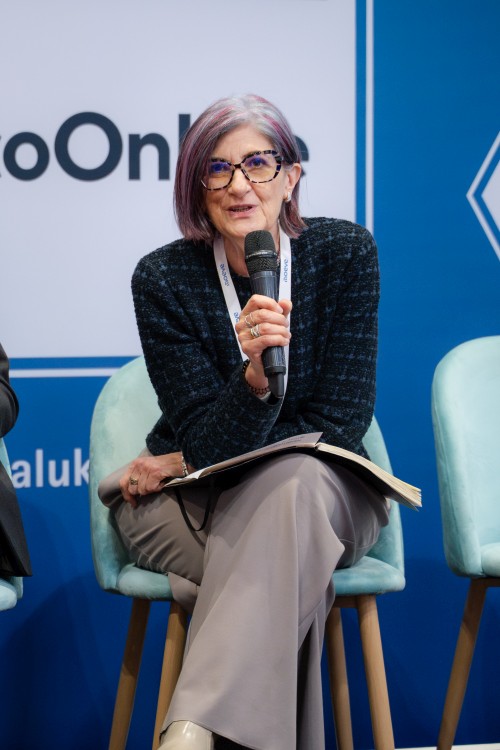 Professor Raffaella Ocone is a Professor of Chemical Engineering at Heriot-Watt University, where she has been since 1999. Her more than 30 year career spans Italy, the US, France, Germany and the UK, giving her a deep understanding of the value of international exchange in fostering inclusive progress.
Her expertise lies in complex reactive systems and their applications across the energy sector. She has been a leading voice in the teaching of engineering ethics and promoting responsible technologies for the energy transition. In recognition of her contributions to engineering, Raffaella was appointed Officer of the British Empire (OBE) in The Queen’s 2019 New Year Honours list. She has also been named as one of the top 100 Most Influential Women in Engineering.
“My own story is a testament to the importance of visibility and opportunity,” Raffaella reflected. “From being a student in my native Italy to becoming the first female professor of chemical engineering in Scotland, you could argue I am living proof of what is possible when barriers are broken down. But my story, sadly, also highlights how rare an example I am.”
As President of the Institution of Chemical Engineers (IChemE), Raffaella champions diversity, inclusion and ethical practice, advocating for wider access to the profession and highlighting the pivotal role chemical engineers play in tackling global challenges.
IChemE’s schools outreach programme, DiscoverChemEng – credited with driving a double-digit increase in the number of students studying chemical engineering – shows the impact of early engagement.
Yet, as Raffaella notes, not everyone can afford to go to university. If the sector is serious about broadening its base, it must create and promote non-traditional routes into chemical engineering, from apprenticeships and vocational pathways to stronger links with colleges and industry training programmes.
“Opening these doors will bring in talent from a wider range of socio-economic backgrounds and ensure the sector is drawing from the full breadth of skills the UK has to offer.”
Coordination as a catalyst
The latest world innovation league table shows the UK has slipped to sixth place, down from fifth last year and fourth the year before. At the same time, China has entered the top ten for the first time. If the UK is to reverse this trend and capitalise on its world-class R&D base, it must coordinate its industrial, academic and policy efforts.
Fragmentation has long been a weakness. Industrialists often undervalue the role of academics, government support is uneven and each part of the innovation chain tends to pull in different directions. That lack of alignment is a likely contributor to the ‘valley of death’ between TRL 3 and 6.
Raffaella is hopeful the recently published Industrial Strategy offers a chance to break this pattern. The tenyear roadmap is ambitious in scope and rightly places skills at the heart of the UK’s future competitiveness. Yet while the direction is set, details on delivery mechanisms are still missing.
“Chemical and process engineering may not be explicitly named, but it is the enabler that underpins all eight sectors the government has designated ‘high potential’,” Raffaella said. “Chemical engineering is also central to the foundational industries, ensuring they and all industries continue to operate while reducing emissions and working towards a more sustainable world.”
Signs of progress are emerging. IChemE is already working with the Chemical Industries Association (CIA), the Royal Society of Chemistry (RSC) and the Society of Chemical Industry (SCI) to press the government to explicitly recognise the vital role of chemistry and chemical engineering in the UK economy, and to secure continued investment in technician, reskilling and graduate programmes.
“We have an incredible opportunity to work in a very synergetic way towards the delivery of this strategy. But we cannot do it in isolation,” Raffaella added. “If we don’t step up, speak up and make our role clear, we risk losing it.”
From risk to reward
What ties Raffaella’s threads together – clusters, coordination, diversity – is appetite for risk. China’s speed isn’t just a matter of scale, she argues, but a systemwide acceptance that some failure is part of progress. In the UK, by contrast, fear of failure too often curtails investments, prolongs pilot projects and leaves promising advances stranded in labs.
Changing that mindset means two things. First, we must take smarter, shared risks so no single party carries the burden alone. Second, we must be far more vocal about the wins that do emerge.
The UK is building world-class expertise in areas like hydrogen, carbon capture, biotech and life sciences. Success stories such as the rapid development and scale-up of the COVID-19 vaccine shows what’s possible when chemical engineers, manufacturers, policymakers and scientists act in concert.
But too often, those stories stay hidden. “We live in an era of communication and information,” Raffaella explained. “We need to share what works and demonstrate how chemical engineering impacts people’s everyday lives. Without it, we would never have had a vaccine, never mind producing enough to vaccinate the whole population. If we want the Industrial Strategy to succeed, we must be braver, louder and more willing to take risks together.”
UK chemicals at a glance:
- Directly contributes nearly £22bn GVA to the economy
- Employs nearly 140,000 people, with wages 32% higher than the average
- Accounts for 12% of total exports
- Accounts for 40% of total manufacturing R&D spend
- 96% of all manufactured goods are dependent on chemistry
For more articles like this, visit our Innovation channel