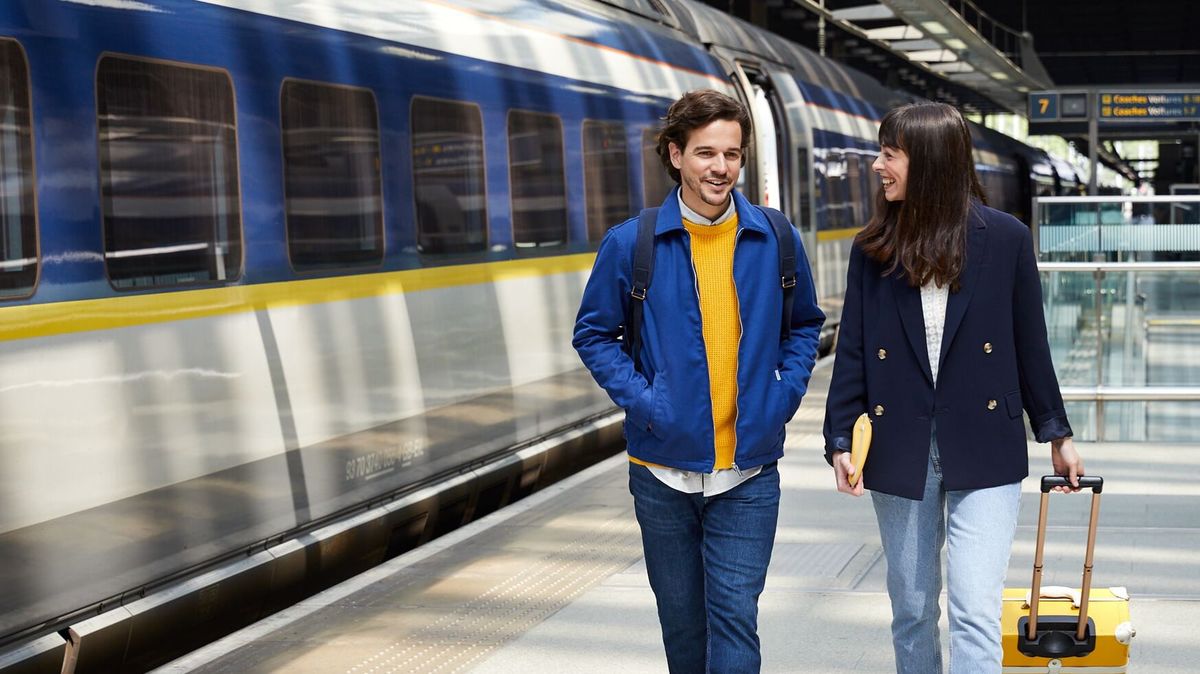
Travellers heading from London to German could soon trade the airport lounge for St Pancras International station, with Eurostar and Deutsche Bahn officially advancing plans for a direct high-speed connection to Germany.
The two rail giants have signed a Memorandum of Understanding (MoU) to launch a seamless service linking the UK capital directly with Cologne (Köln).
Under the new plan, passengers would step onto one of the new double-decker Eurostar Celestia trains in London and step off in the heart of Cologne in under four hours, removing the current requirement to change trains at Brussels-Midi.

The double-deck Eurostar Celestia trains will debut in 2031.
While the announcement has sparked excitement about a “London to Berlin express”, the German capital remains off the cards for a direct daytime service.
With a potential direct travel time hovering around seven to eight hours, any London-Berlin route would struggles t compete with air travel for the time-sensitive business market.
Eurostar London-Frankfurt could follow
Instead, the focus remains firmly on the commercial hubs of the Rhineland.
Cologne is the gateway, but the financial hub of Frankfurt is viewed as the logical extension of the line.
A direct London-Frankfurt service would be a formidable competitor to the shuttle flights currently dominating that corridor, offering uninterrupted working time and a city-centre arrival that avoids the long commute from Frankfurt Airport.

Lufthansa and British Airways dominate the London-Frankfurt skies.
While the agreement is a significant milestone, travellers shouldn’t cancel their flights just yet.
Both Eurostar and Deutsche Bahn have targeted the early 2030s for the launch of the service – placing the maiden voyage at least five years away.
The hurdles are primarily bureaucratic and logistical rather than just technical.
Implementing a direct service requires establishing dedicated terminal facilities at German stations to handle UK border controls and security screening, which has become the complex reality of post-Brexit travel.
Virgin Trains on track for 2030 launch
As previously reported, Eurostar will lose its monopoly on the London-Europe route as Virgin Trains races into the market with the launch of its own high-speed services via the Channel Tunnel from 2030.
British entrepreneur Sir Richard Branson has vowed to “shake up” cross-Channel train services.

“It’s time to end this 30-year monopoly and bring some Virgin magic to the cross-Channel route,” he said, “and give consumers the choice they deserve.”
“I’ve always believed competition drives innovation, and that’s exactly what we will bring to the Channel Tunnel.”
“This is what we do best. Just as we’ve challenged incumbents in the air, on the seas, and just as we’ve led the UK rail market before – we’re ready to do it all over again.”
With the backing of heavyweight infrastructure investors and private equity firms, Virgin Trains has placed a £760 million order with global manufacturer Alstom for 12 Avelia Stream trains capable of an estimated 300km/h.
Virgin will initially duplicate the same routes as Eurostar, starting with London to Paris, with Brussels and Amsterdam following shortly after.

Eurostar claims 75% of business trips between the UK and France.
Virgin says it has “ambitions” to expand “further across France, and into Germany and Switzerland.”
While all Channel Tunnel trains depart from St Pancras International, Virgin is also looking to add intermediate UK stops at Kent’s Ebbsfleet International and Ashford International stations – both of which were served by Eurostar before their closure during the Covid pandemic.
Also on the list is Calais, Disneyland Paris and Charles de Gaulle Airport.

Alstom’s mock-up of the Avelia Stream’s onboard cafe lounge.
The UK government’s Office for Rail and Road chose Virgin Trains over rival bids from Uber-backed startup Gemini Trains, Spanish operator Evolyn and Italian operator Trenitalia.
Virgin Trains provided “the highest confidence level of being operationally viable,” said the ORR, based on its proposal being “more financially and operationally robust than those of other applicants.”
“Its plans are more detailed, and it has provided clear evidence of an exclusive agreement to deliver the necessary rolling stock by 2030.”

Virgin Trains will compete on all Eurostar routes.
UK rail minister Lord Peter Hendy said the debut of Virgin Trains on UK-EU routes “will give passengers greater choice, better value and improve connectivity for millions, as well as drive innovation, lower fares and promote greener connections with Europe.”
Also read: Eurostar to join SkyTeam in 2026