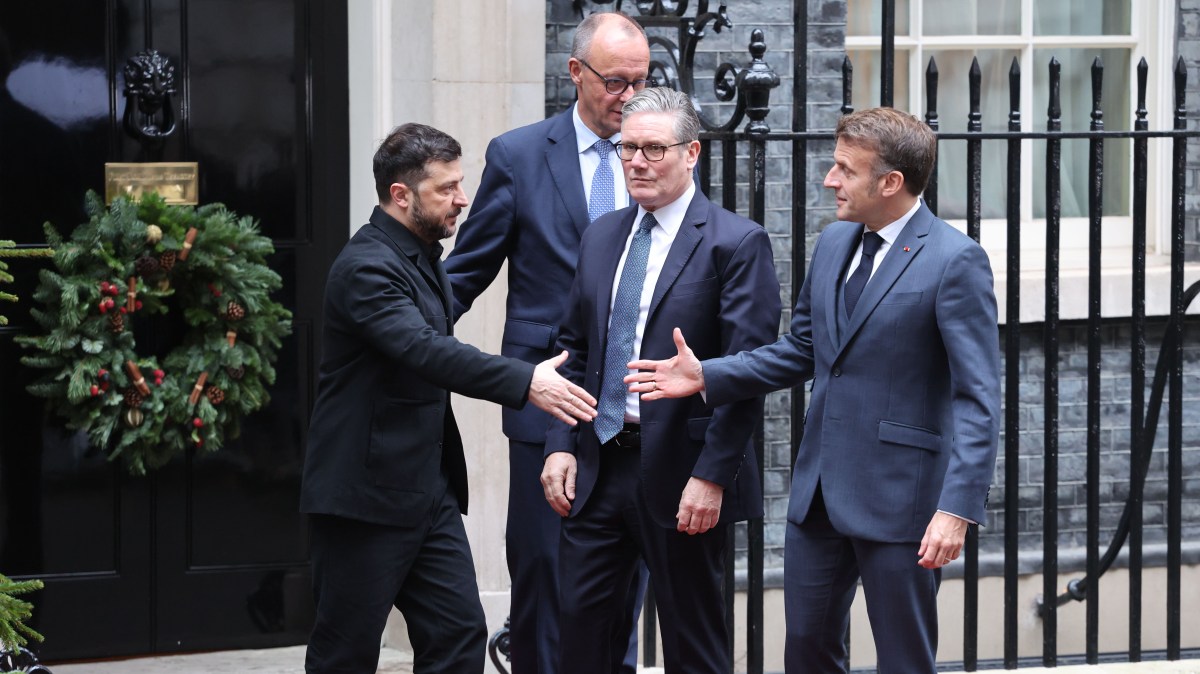

President Zelensky, left, met President Macron, right, and Sir Keir Starmer in London
TIMES PHOTOGRAPHER RICHARD POHLE
President Zelensky of Ukraine arrived in London on Monday at a critical juncture, looking exposed and more dependent than ever on the wobbly support of the Europeans. It is high time for Kyiv’s European allies — Britain’s prime minister, Sir Keir Starmer, President Macron of France and the German chancellor, Friedrich Merz — to shoulder their responsibilities and mount a decisive collective effort to maintain the sovereign independence of Ukraine.
The National Security Strategy document issued by the United States a few days ago suggested that President Trump is seeking to establish “strategic stability” with Moscow, while deploring Europe’s inability to act in its own defence. To Mr Zelensky that sounded as if he were being asked to surrender to Mr Trump and President Putin simultaneously. And to many European leaders, the Kremlin-pleasing US paper called into question the essence of the transatlantic alliance that has sustained the continent’s peace for 80 years.
Mr Trump, who calls the document an expression of his “flexible realism”, attacked the way that Europe’s leaders have embraced the “civilizational erasure” of their continent by opening borders and accepting high numbers of migrants. But if this is indeed a moment of civilizational struggle then the attention should surely be focused on the way that Russia is trying to eradicate Ukrainian culture. Mr Putin’s bombs and artillery shells have in this almost-four-year-old war destroyed or severely damaged some 600 churches, flattened 400 schools, and ruined more than 900 libraries and the Ukrainian books they housed. This can only be interpreted as an effort to wipe out a country’s national identity and, as such, ranks as a war crime under the Hague Convention.
• Deal to release £100bn for Ukraine close, Keir Starmer says
That then is the challenge facing Ukraine’s European friends. They may not be enthusiastic about admitting Ukraine to the European Union or the Nato alliance, but they should find an answer to Mr Trump’s accusation that Europe has essentially become a decadent political entity. A society can be considered decadent when it no longer considers anything worth fighting for. In its long defensive war against Russian invaders, Ukraine has demonstrated that while it may not have EU club membership, it is European in spirit.
It has lost lives not only to defend territory but also to uphold the universal principle that no country has the right to march into a neighbour’s land and seize many thousands of its children. This is a war about land and security, and its resolution demands fair treatment in any future peace settlement. But it is also about the kind of values that make the European idea coherent.
These have to form the backbone of European solidarity with Ukraine under pressure. The key issues were touched on in the Downing Street talks yesterday. First, there is the question of using frozen Russian assets not — as the US president would prefer — as a stepping stone towards a reset of US-Russian relations but as part of a formula to pay at least part of Ukraine’s huge reconstruction costs. This will be difficult but Mr Merz has spent time working out how Ukraine could be helped without penalising Belgium, which is responsible for the safekeeping of the frozen Russian funds. These arguments must be settled quickly if Ukraine is to survive the winter.
• What’s behind the Trump administration’s ideological assault on the EU?
Second, the rearmament of Europe has to advance apace alongside a shake-up of cross- border co-operation. So too does intelligence-sharing with Kyiv. If the US follows through with the tenets set out in its strategic document, then Ukraine will be left in the spring without many of the weapons it needs to hold off further Russian attack and without the targeting information it requires to hit energy plants in the Russian interior. European allies in Nato must urgently find the will and the means to fill the gap left by the US.