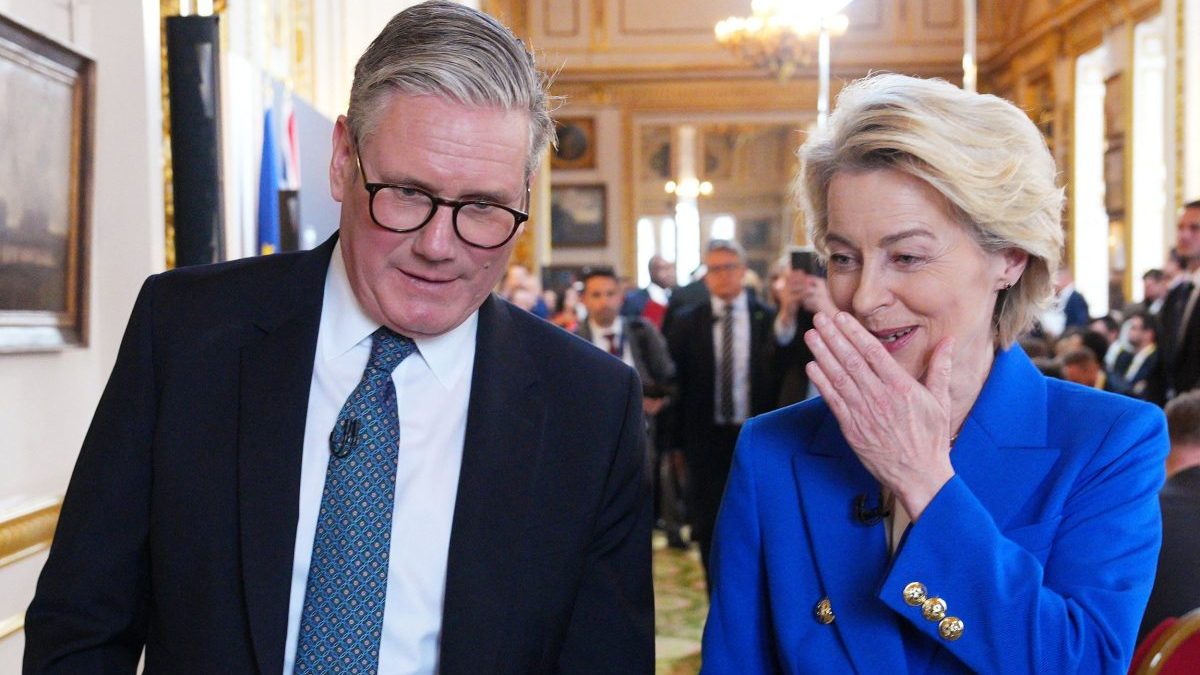
A deal could see tens of thousands of British under-30s travel, work or study in the EU
The UK’s stance on an under-30s visa deal with the EU has been boosted by a major new report which backs capping the number of young Europeans who can come to Britain at 44,000 per year.
The post-Brexit deal should allow the same number of visas for Britons aged under 30 to travel, work or study abroad in the EU annually, according to the cross-party commission’s recommendations.
And British opposition to slashing university fees for EU students – a key Brussels demand – was also backed by the report, which took evidence from senior business leaders, migration experts and the higher education sector, among others.
The Government in London was, however, urged by the UK Trade and Business Commission (UKTBC) to make concessions like waiving most visa fees and the immigration health surcharge, which it has so far been reluctant to do.
The report is likely to give weight to the arguments of Britain’s negotiators in talks over the deal.
New FeatureIn ShortQuick Stories. Same trusted journalism.
The UK and EU are locked in negotiations on a so-called “youth experience” scheme to allow Britons and Europeans under 30 to travel, work and study in each others’ territories for a limited period of time.
Brussels requested the scheme in response to Sir Keir Starmer’s push for deals with the EU to boost trade, the economy and defence in his so-called Brexit “reset“.
The Prime Minister was initially reluctant to agree to such a scheme due to the political pressure he faces on net migration, but the Government has recently shifted to proclaiming the potential benefits of a youth mobility deal.
Cheaper UK university fees for Europeans unlikely
Britain is nevertheless outright refusing EU demands to charge Europeans cheaper UK, rather than international, university fees if they take part in the scheme.
The UK is also fighting to ensure any visa deal is capped, while the formal EU position is to push for it to be unlimited. Although The i Paper understands Brussels is willing to make concessions on the number of places.
And while the youth experience scheme negotiations are not explicitly linked to other parts of the Brexit reset, such as Starmer’s push for a food and drink deal, it is understood that failing to make progress would hamper the wider negotiations and damage the Government’s push for economic growth.
The report, produced as part of efforts to bridge the gaps between the two sides, argued that an initial cap of 44,000 annual visas would command public support in the UK as it would have no overall impact on net migration. This would allow the Government to meet a manifesto pledge and political imperative to cut immigration as it battles against the Reform party’s surge in popularity.
Existing UK youth mobility schemes reduced net migration by more than 44,000 in 2024 due to the number of Britons travelling to places such as Australia, New Zealand, Canada and elsewhere, creating “headroom” for a deal with the EU.
A 44,000 cap would also be a “floor not a ceiling”, with annual reviews and in any case would be more generous than the UK’s existing schemes with other countries.
EU will push for higher visa cap
However, The i Paper understands that the EU, with its population of 450 million, is currently unlikely to accept a youth experience scheme capped at 44,000, since it would only be slightly more than the 42,000 youth mobility visas granted in 2025 to Australia, which has a much lower population of 27 million.
The report also recommended the UK rebuffs the EU demand to charge European under-30s domestic university fees, as it would be impossible for the cash-strapped British university sector to currently absorb, with a consultation on whether or not concessions in this area could be made in future.
“A function of a mature UK-EU relationship is that there will be requests from both sides that cannot be accommodated,” the report said. “This should be regarded as a normal aspect of balanced negotiations.”
Andrew Lewin, a Labour MP and chair of theUKTBC, said: “In recent weeks the Prime Minister has said he intends to keep moving towards a closer relationship with the EU. I’m delighted by this commitment and successfully agreeing on a youth experience deal would be further evidence the relationship is changing for the better.
“Thanks to the expertise of the UKTBC members, we have a proposal for a bespoke and balanced scheme, which would be good for growth, deepen cultural connections with our allies in the EU and renew opportunities for young people that were taken away by the failed Brexit deal.”
Speaking at a UKTBC evidence session in October, Brian Bell, chair of the Government’s Migration Advisory Committee (MAC), said a cap of around 50,000 would be “reasonable” and “balanced” and that it would mean “the overall effect on net migration is essentially zero”.
The commission took evidence from Bell, Universities UK, the Confederation of British Industry, and the Abta travel association, among others.
The UKTBC, convened by the Best for Britain campaign group, is made up of cross-party MPs, as well as senior business people, ex-officials in London and Brussels and ex-EU diplomats.
A UK Government spokesman said: “We are working together with the EU to create a balanced youth experience scheme which will create new opportunities for young people to live, work, study and travel.
“As agreed with the EU in May, any final scheme must be time-limited and capped.
“We will not give a running commentary on ongoing talks.”
The EU said it would not comment on live negotiations.