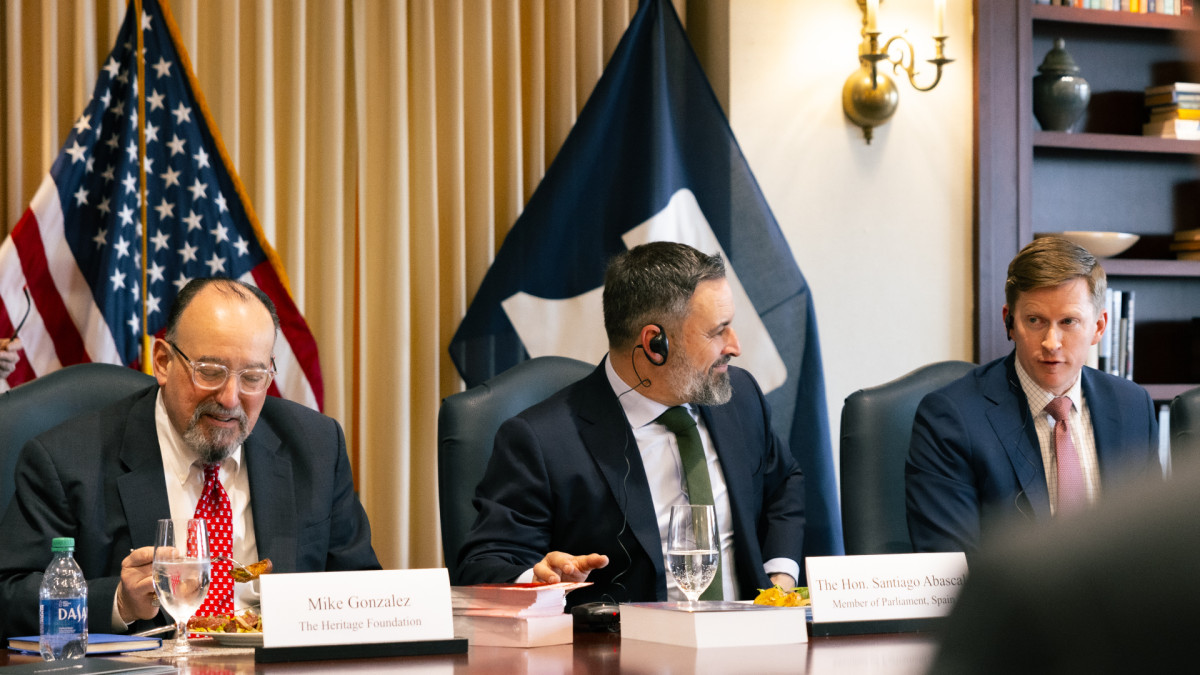
In recent months there has been a great deal of reporting about the meetings that American think tanks have or have not had with the leaders of right-wing political parties throughout Europe. Specifically within Spain, much of the interest in this subject has revolved around reporting about such meetings with the Partido Popular (PP) and Vox.
“In Spain, much of the interest in the relationship with U.S. think tanks has stemmed from their meetings with the PP and Vox”
Looking into the issue of right-of-center outreach by U.S. think tanks, Agenda Pública reached out to The Heritage Foundation (Heritage) and America First Policy Institute (AFPI) for comment on what outreach – if any – they had done to Spanish political and public policy organizations in recent months. AFPI declined to comment for this article. Heritage on the other hand, connected Agenda Pública with their expert, Mike Gonzalez – the Angeles T. Arredondo E Pluribus Unum Senior Fellow, Kathryn and Shelby Cullom Davis Institute for National Security and Foreign Policy – for an interview.
Meetings with Vox and Partido Popular
Gonzalez agreed to “speak mostly in generalities except for what is public,” emphasizing that, “the meetings that I have are private, and the conversations that I have are private.” The conversation between Agenda Pública and Gonzalez took place on November 26th.
In conversation, Gonzalez acknowledged that on his “most recent trip to Madrid, I did meet with the Vox Leadership.” Gonzalez declined to go into specifics about his meeting but said he decided to formally disclose it in this interview “because that is public.” Per Gonzalez, the last time he was in Spain – which was also when he met with Vox leadership – was in November.
Gonzalez went on to share that “as a matter of general practice, every time I am in Spain, I also try to meet with the Partido Popular.” He explained that he did so this spring, when he was there during the April 28, 2025 blackout.
“My association with Spain is long, I spent part of my childhood there,” Gonzalez told Agenda Pública. He went on to share that, “my grandfather was from Asturias and my grandmother was from Galicia [on his mother’s side].” According to Gonzalez, “even on my father’s side, we had very recent Spanish ancestry.”
Gonzalez says that he has friendships in Spain that span decades as a result of longtime travel there. It is clear that Gonzalez has great fondness for Spain, both personally, and for its role in history.
For Gonzalez, “Spain is a bridge country, it’s a key country, one of the most important countries in Western civilization.” According to Gonzalez, “It’s a ‘no-brainer’ that American leaders and public policy organizations would take Spain very seriously and try to forge relations with Spain.”
Gonzalez noted how widely spoken the Spanish language, as a marker of Spain’s historical global reach and influence. “Spain continues to have influence in that part of the world, in Latin America,” which Gonzalez prefers to refer to as “Ibero-America.”
“Regarding Spanish President Pedro Sánchez and U.S. President Donald Trump, Gonzalez stated that «there is no reason for them to get along»”
Regarding Spanish Prime Minister Pedro Sanchez and U.S. President Donald Trump, Gonzalez stated that, “there’s no reason for them to get along.” He went on to remark that Sanchez leads “a Frankenstein coalition that includes socialists, communists, separatists, and terrorist apologists.” Gonzalez went on to highlight Sanchez’s unwillingness to join other NATO countries in committing to spending 5% of GDP on defense in the future saying, “he’s a bad ally“
“There’s no reason why [President] Donald Trump or [Vice President] JD Vance or [Secretary of State] Marco Rubio would entertain having strong ties with his [Sanchez’s] government,” Gonzalez told Agenda Pública. “Now, they [in the Trump administration] can get along with leftists … but transacting with Sanchez has proven to be very difficult,” he added.
According to Gonzalez, “the job of the Heritage Foundation – or any think tank – and therefore my job, is to formulate public policy and public policy has many dimensions: it can be domestic, [and] it can be international.” Gonzalez says that a key part of formulating international foreign policy or national security policy requires “understanding the players, the conditions on the ground,” hence the importance of visiting countries and meeting with key organizations.
Looking Beyond Spain
“There’s been a surge in the dissident right in Europe as represented by Vox i[in Spain], by Fidesz [in Hungary], by Chega in Portugal,” Gonzalez told Agenda Pública. “I was just in Portugal as well, and we had lunch with the leader of the opposition, Andre Ventura [founder of Chega],” Gonzalez recounted.
“As we formulate policy remedies and policy solutions for the U.S. government, we have to know what is happening in Europe in terms of immigration, in terms of work, in terms of the threat to free expression emanating from Brussels, from Ursula von der Leyen [President of the European Commission],” Gonzalez told Agenda Pública.
“I just don’t understand how a think tank – or any foundation – can attempt to formulate policy remedies in the realm of national security and foreign policy without understanding the situation on the ground and who the players are,” Gonzalez reiterated.
Europe and the Trump Administration National Security Strategy
The conversation between Agenda Pública and Mr. Gonzalez took place prior to the publication of the Trump administration’s National Security Strategy document. It is striking how much of the views he shared seem represented in the document.
“Think tanks have long been involved in international activities and outreach. So have political parties. This is not new”
That said, for those in Europe fretting about U.S. think tanks’ international outreach or the Trump administration’s National Security Strategy, doing so strikes this writer as unnecessary. Think tanks have long engaged in international outreach. For that matter, so have political parties. This isn’t new.
It is worth noting that American think tanks have a long history of engaging with European political and policy entities across the political spectrum. Furthermore, some prominent U.S. think tanks have offices in Europe. For example, The German Marshall Fund of the United States (GMF) and the Center for European Policy Analysis (CEPA) are both non-partisan think tanks headquartered in Washington, D.C., with a presence in Europe.
During the 1992 U.S. presidential elections, the U.K. Conservative Party sent staffers to the United States to meet with the reelection campaign of George H.W. Bush to talk strategy. Then-Governor Bill Clinton of Arkansas went on to win that election. Then, in the 2015 U.K. General Election, Obama campaign strategists Jim Messina and David Axelrod found themselves on opposing campaigns as they advised the Conservatives and Labour, respectively.
In short, Transatlantic policy and political outreach may be a bit more new for Spain, but it is not new for the United States. Spanish voters alone will decide who they do or do not want to elect.