Europe faces a challenging period ahead as it works toward decarbonization while reducing supply-chain risks from China.
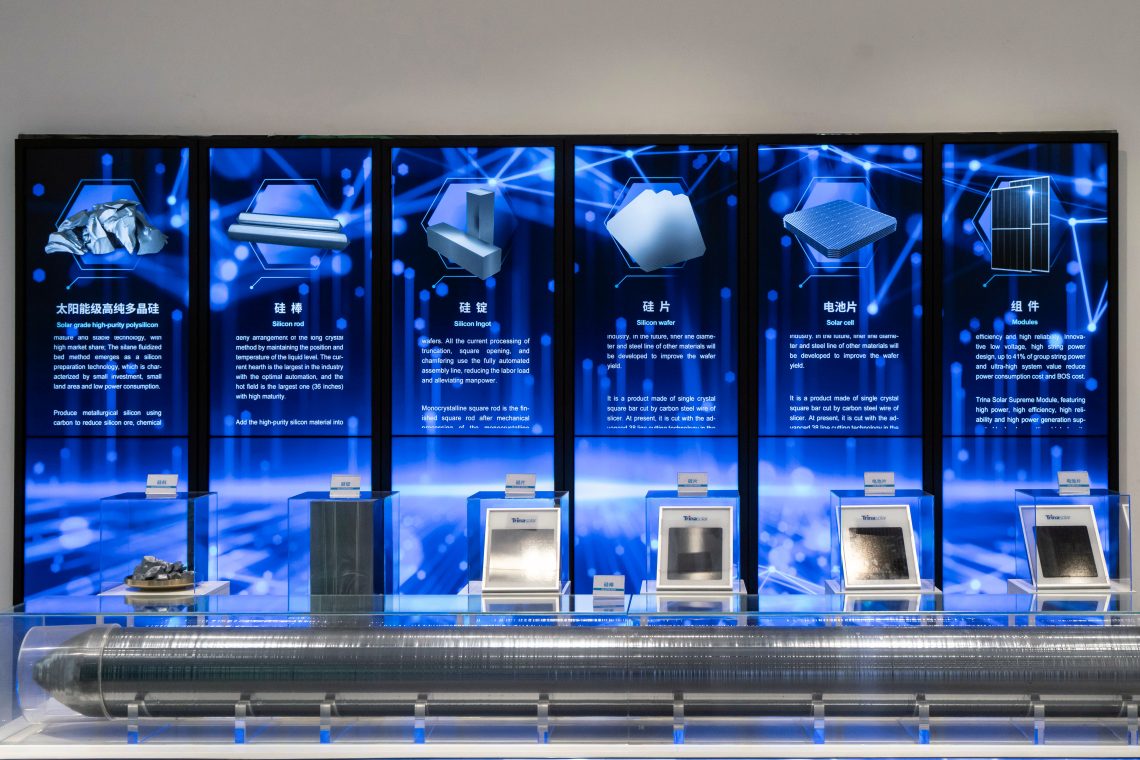
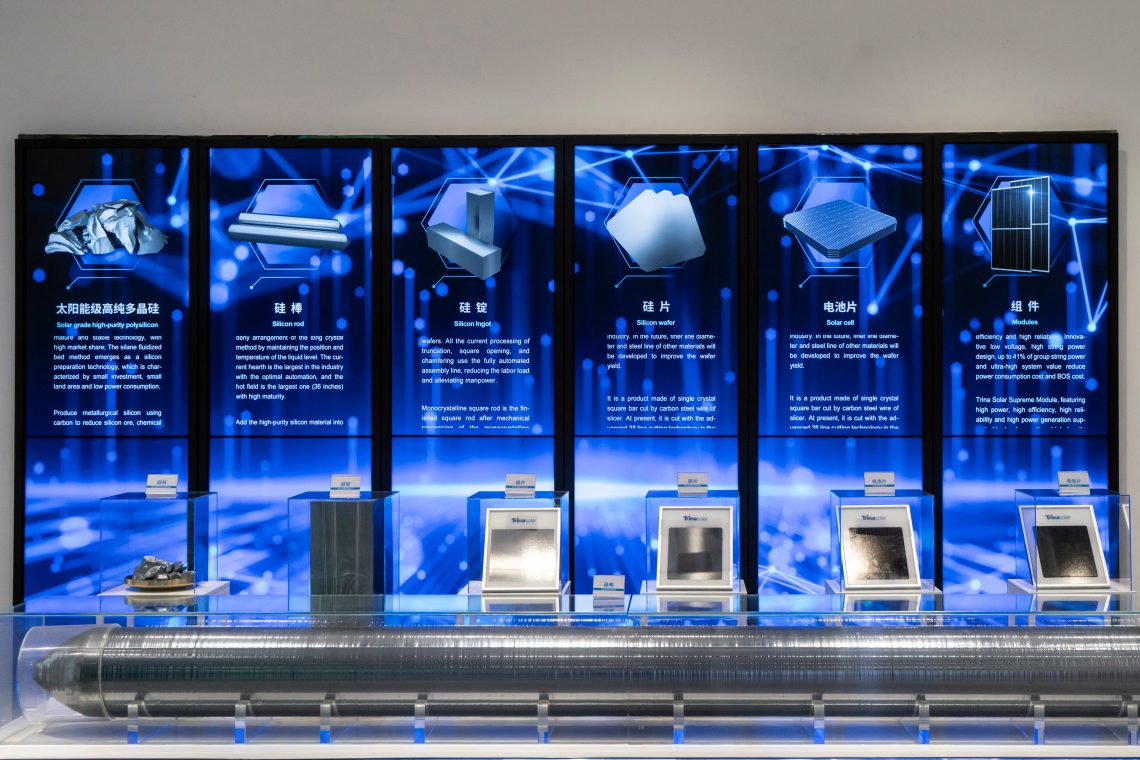 Sep. 26: Various stages of a photovoltaic panel production displayed at the Trina Solar Co. offices in Changzhou, China. © Getty Images
×In a nutshell
- China’s control of key materials threatens Europe’s energy transition
- Export controls and trade disputes jeopardize Europe’s clean-tech supplies
- Europe must diversify supply chains and bolster processing to reduce risks
Over the past two years, European policymakers have embraced the term “de-risking” to describe the continent’s recalibrated relationship with China. While the European Union considered China a “systemic rival” in 2019, the bloc no longer seeks full “decoupling,” but aims to reduce exposure in sectors deemed strategic for security and competitiveness. The underlying concern is that while Europe has cut its dependence on Russian gas, it has at the same time become equally reliant on Chinese goods that are essential for the continent’s lofty environmental and technological goals.
The 2022 energy crisis revealed how overuse of specific supply chains can turn external shocks into domestic economic pain. A similar pattern has emerged across clean-tech industries. China dominates the global production and processing of solar photovoltaic (PV) components, rare earth elements (REEs), permanent magnets and advanced battery materials such as graphite and lithium compounds. In several stages of these value chains, Chinese producers control 80 percent or more of global capacity.
This concentration creates a new type of strategic vulnerability – not directly in energy supply, but in the supply of critical technologies. A disruption in Chinese exports of magnets, PV wafers or battery chemicals could delay renewable-energy deployment, electric vehicle (EV) production and power-grid upgrades, much as past cutoffs of Russian gas have disrupted heating and industry. Even short interruptions reverberate through prices, investment timelines and industrial output.
Europe’s exposure to China is deepest where its ambitions are highest.
Trade tensions have added a political dimension. The EU’s anti-subsidy probe into Chinese EVs has already triggered retaliatory investigations into European agricultural exports. Meanwhile, Beijing has tightened export-licensing requirements for certain grades of graphite and REE magnets, signaling that it is willing to weaponize its market share. Brussels is responding through the Critical Raw Materials Act (CRMA), which seeks to build mining, refining and recycling capacity within the EU; but such projects take years to mature.
Europe faces a strategic dilemma: to accelerate decarbonization while reducing reliance on the Chinese supply chains that enable it. Achieving both goals will require difficult trade-offs, credible diversification plans and cooperation with partners such as the United States, Japan and Australia. Failure to do so could leave the continent facing another energy crisis – this time rooted not in pipelines, but in processing plants and export licenses.
Where the dependency actually bites
Europe’s vulnerability to China is concentrated in a few high-impact sectors that underpin the EU’s clean-energy transition. There are four sectors that illustrate the problem clearly: rare earth elements and magnets, solar photovoltaics, magnesium and batteries.
Rare earth elements and permanent magnets
Rare earth elements are indispensable for EV motors, wind-turbine generators and defense technologies. While mining occurs in many countries, China dominates the refining and magnet-making stages of the supply chain. The EU is highly import-dependent on China for permanent magnets, while Japan and a few other producers currently account for limited residual trade flows.
For heavy rare earth elements, the EU’s reliance on China is close to 100 percent. When Beijing tightened export-licensing scrutiny for high-performance magnets in 2025, European manufacturers considered it a warning shot. The CRMA sets diversification targets for 2030, yet meaningful refining and magnet capacity in Europe remains more distant.
Solar photovoltaics
Chinese firms now control over 80 percent of global PV manufacturing capacity, from polysilicon to finished modules. More than 90 percent of the solar panels installed in Europe originate from China, following the collapse of the EU’s own solar industry in the early 2010s. This creates a paradox: Europe’s flagship climate technology depends on a single foreign supplier. Any trade restriction or logistics shock could delay installations and inflate project costs, undermining the bloc’s climate targets.
Magnesium
Magnesium, the lightest of all commonly used structural materials and one that is crucial for lightweight aluminum alloys, represents a small market with enormous concentration: 95-96 percent of EU magnesium imports come from China. Efforts to restart smelting in Romania, France and Norway face high energy costs and lengthy permitting processes.
In 2021, China briefly cut its magnesium output so that it could reduce its domestic energy consumption, causing immediate price spikes and supply shortages globally. This threatened Europe’s automotive and packaging industries and raised fears of widespread production halts and job losses. The incident illustrated how even minor materials can create systemic risk when concentrated in one country.
Batteries and critical minerals
Europe’s rapidly expanding battery industry remains heavily dependent on Chinese mid-stream processing. China refines around 60-70 percent of global lithium and cobalt and about 90 percent of natural graphite, including almost all of the spherical graphite used in battery anodes.
Even when cell assembly takes place in Europe, these refined inputs still originate largely from Chinese plants, creating a single potential point of failure in the supply chain. Partnerships with Australia, Canada and other allied suppliers are growing, yet alternative refining and processing capacity is unlikely to satisfy Europe’s projected demand before the end of this decade.
Beyond energy technology
Other sectors, notably pharmaceuticals, show similar dependence on Asian supply chains. Nevertheless, the immediate strategic exposure and risk lie in clean-energy and industrial materials. These inputs are directly linked to Europe’s power systems, transport and manufacturing competitiveness – the same areas that proved most vulnerable during the Russian gas crises.
In sum, Europe’s exposure to China is deepest where its ambitions are highest. Solar modules, magnets, magnesium and battery materials together form a new axis of dependency – a European energy transition built on foreign foundations.
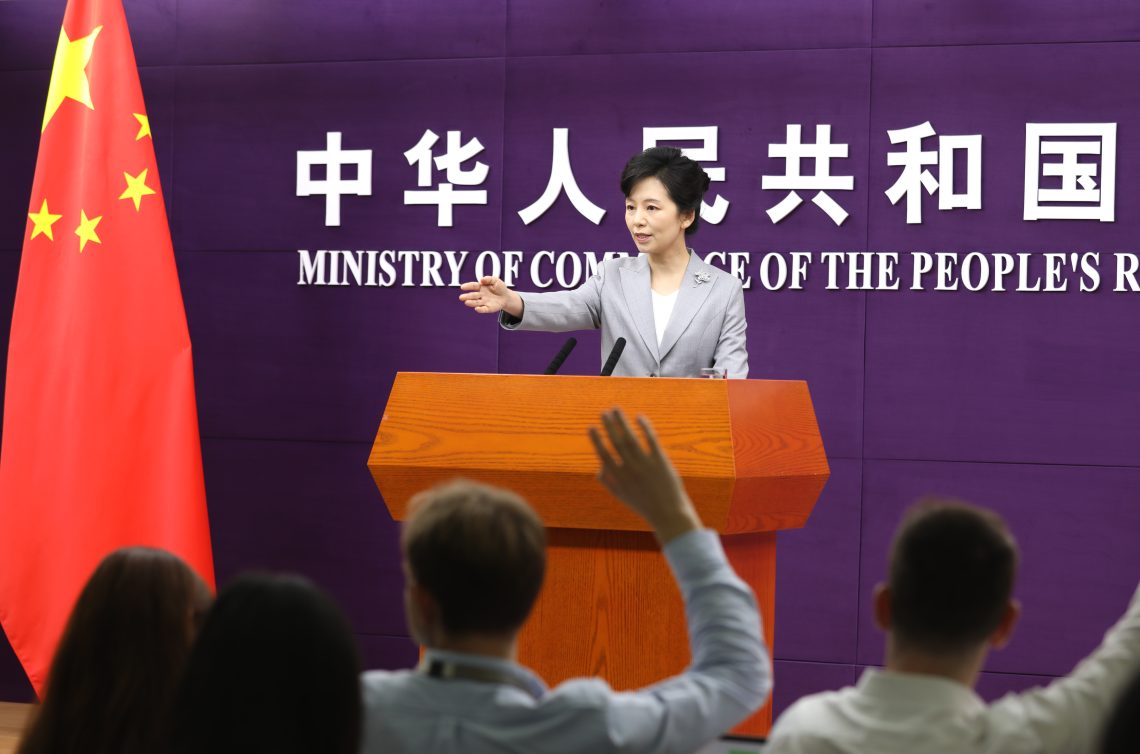 July 3: A spokesperson for China’s Ministry of Commerce discusses trade and export policy at press conference in Beijing, China. © Getty Images
How a new energy crisis could unfold
Europe’s dependence on Chinese inputs would not translate into crisis overnight. But several well-defined transmission channels could rapidly turn a disruption in critical materials into broader economic stress. Unlike the gas shock of 2022 following Russia’s invasion of Ukraine, this crisis would propagate through manufacturing bottlenecks, investment delays and price volatility rather than household energy bills.
Export controls and licensing delays
China has already used administrative tools to signal leverage. The 2023 introduction of export-licensing requirements for certain grades of graphite and the 2025 tightening of controls on high-performance magnets demonstrated how easily paperwork can become policy acting as a barrier to trade. Even minor slowdowns could idle European production lines for EV motors or wind-turbine generators. Because Europe lacks stockpiles and domestic refining capacity, any Chinese export pause – intentional or accidental – would transmit instantly through supply chains.
Tariffs, retaliation and trade friction
The EU’s anti-subsidy investigation into Chinese EVs and Beijing’s counter-probes into European agricultural exports marked a new phase of politicized trade. Escalation could easily spill into clean-tech components. If China were to impose duties or quotas on PV modules, magnets or battery materials, project costs would surge and installation timetables would slip, forcing governments to revise their climate-energy trajectories. Conversely, European tariffs on Chinese goods would raise input prices for the bloc’s own green industries, amplifying inflationary pressures.
Logistics and currency transmission
Even without formal restrictions, disruptions in shipping, insurance or foreign exchange markets could put supply chains under pressure. A geopolitical flare-up in the South China Sea or around Taiwan would reroute maritime trade and lift freight rates. Because most of Europe’s energy-transition hardware travels by sea, a few weeks of port congestion or renminbi appreciation could add billions to project budgets.
Financial and industrial contagion
Downstream sectors – utilities, carmakers and construction firms – operate on tight investment cycles. A sudden shortage of PV modules or battery cells would defer revenues, unsettle balance sheets and dampen investor confidence. For publicly traded utilities and automakers, even modest delivery delays can translate into market-value losses, feeding through to credit conditions and public budgets.
Read more from economics expert Karl-Friedrich Israel
Taken together, these factors reveal a clear pattern: Europe’s vulnerability has shifted from energy consumption to energy technology. Supply shocks in Chinese clean-tech exports would not freeze households, but they could freeze the energy transition itself.
×
Scenarios
The extent to which Europe can achieve future autonomy depends on how the EU manages its asymmetric relationship with China. Two distinct paths capture the strategic choices and risks facing the green energy industry generally, while a third would see Europe continue toward clean energy generation but sacrificing other technological goals.
Likely: Managed dependency while pursuing all EU goals
Europe continues its current course: cautious diversification under the banner of “de-risking” while maintaining pragmatic trade with China. The CRMA and a handful of joint ventures with allies improve resilience at the margins, but Chinese producers remain dominant in solar PVs, battery materials and magnets.
Supply tensions persist but remain manageable through inventories and flexible contracting. Political pressure for “sovereignty” fades as economic growth takes precedence. The energy transition proceeds, but the underlying exposure remains: a stable dependence rather than genuine autonomy. The likelihood of this scenario is 60 percent.
Somewhat likely: Trade fractures result in complications for EU goals
Escalating disputes over EV tariffs or technology transfers trigger a cycle of retaliation. Beijing slows export approvals for graphite and rare-earth magnets; Brussels raises barriers on Chinese clean-tech imports. Project costs rise, renewable-energy build-outs stall and Europe again confronts supply-driven inflation reminiscent of 2022.
Governments then scramble to subsidize domestic production, fragmenting Europe’s single market. Utilities and automakers delay investment, and the EU’s climate goals slip further out of reach. The crisis is as political as it is economic: Europe proves unable to reconcile its environmental ambition with its geopolitical vulnerability. The likelihood of this scenario is 15 percent.
Possible: Nuclear for industry and homes; EVs, PV and wind targets abandoned
Repeated supply shocks, geopolitical headwinds and rising costs push Europe toward a strategic rethink enabling a continued drive toward clean energy via nuclear power while ambitious goals for solar and wind power, as well as the switch from combustion engines to EVs, are abandoned.
Building on today’s renewed focus on nuclear power generation (the British and the Czechs moving from design to implementation of small modular reactors [SMRs], Slovakia choosing Westinghouse for nuclear fuel supplies, Prague selecting South Korea’s nuclear power firm for new large reactors at legacy power plants), several European states join the nuclear power revival as a route to energy autonomy and industrial stability. France accelerates its development of SMRs with Croatia and Italy pursuing similar options, Sweden reverses course and allows nuclear power, while Poland and Finland partner with U.S. and South Korean suppliers. Even Germany sets new conditions under which it will gradually restart its nuclear plants.
The shift ensures long-term, low-carbon baseline energy generation and reduces reliance on Chinese clean-tech inputs, thereby challenging assumptions that China is essential to Europe reducing its carbon footprint and that renewables alone can ensure energy security. Although it slows the expansion of solar and wind capacity and sidelines the drive for EVs in the short term, this scenario offers greater long-term stability, cost predictability and geopolitical control. This approach could ultimately strengthen both Europe’s industrial base and its strategic autonomy. The likelihood of this scenario is 25 percent.
Contact us today for tailored geopolitical insights and industry-specific advisory services.

Sign up for our newsletter
Receive insights from our experts every week in your inbox.