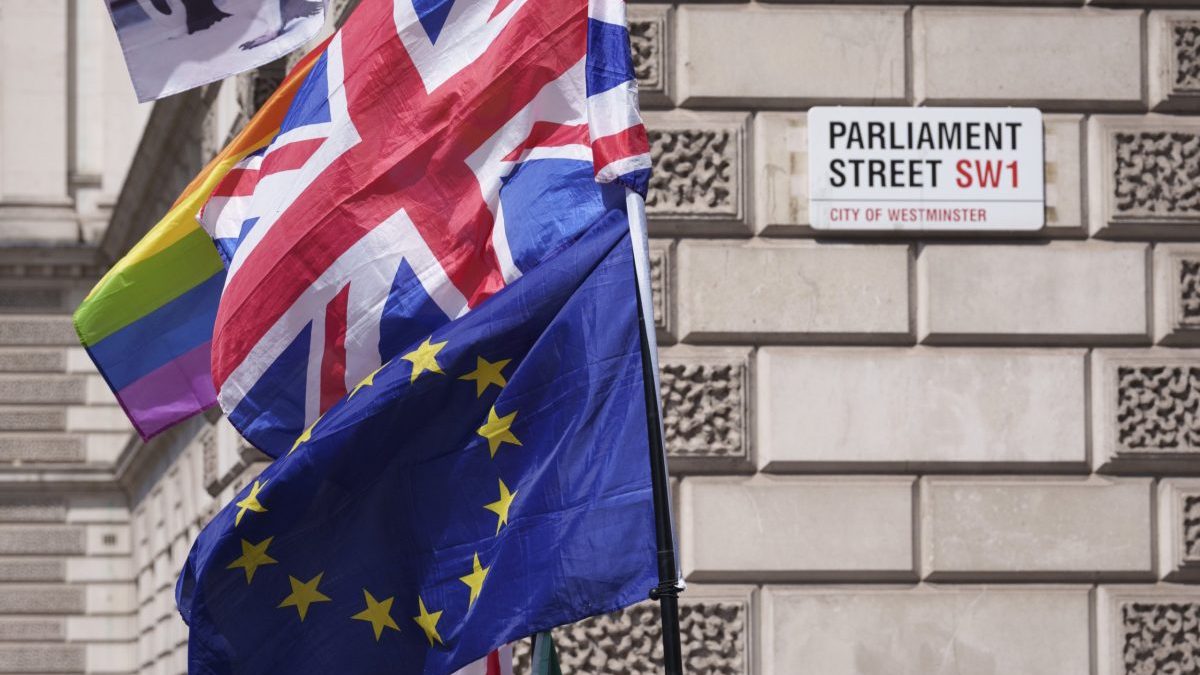
Some Labour MPs may appear warm to reopening the debate – but there’s no real prospect of a closer relationship with Europe any time soon
Don’t be fooled by talk of reversing Brexit, after a Labour “rebellion” shunted the idea of a bespoke customs union with the EU to the top of the political agenda.
A vote on Tuesday in the Commons saw a Liberal Democrat motion, which proposed ministers negotiate a customs union (An agreement that means countries don’t pay tariffs to move goods or services between them), pass by a single vote.
Despite the non-binding nature of the vote and the abstention of most Labour MPs, 13 of them contradicted the party’s established position. Included in the list was Meg Hillier, chair of the influential Treasury Select Committee, seen as a significant get by the Lib Dems.
Lib Dem leader Ed Davey rashly dubbed the win a “historic victory,” although there is zero chance of a Ten Minute Rule Bill (the procedure used for voting on the measure) getting any further down the parliamentary track. Whips generally advise their MPs not to get involved in the posturing of other parties, even if they agree with the principle being discussed.
“I just wanted to push the envelope a bit because I have always voted against Brexit,” one Labour MP told The i Paper on Wednesday after they lent their support to the Lib Dems the previous evening.
“I did hover over whether to back it, because you shouldn’t really vote on Ten Minute Rule Bills because it sets a precedent that you might in future. Mind you, it has shown me that our grouping is so much smaller than it was in the last parliament. It’s mostly London MPs, voting along Remain lines like 2016. It doesn’t really mean anything, I don’t see any meaningful changes in my lifetime.”
Polling shows public opinion shifting in a pro-European direction. But that doesn’t mean the public, or Labour backbenchers, have the appetite for another debate if the Government decides to seek much closer trading links with the European Union.
A Labour frontbencher, who represents a Brexit-supporting constituency described Tuesday’s vote as “like waving an EU flag in the Royal Albert Hall” at Last Night of the Proms, where blue and yellow EU flags jostle with Union red, white and blue to show the bearers’ different interpretation of Britishness.
“Voting last night with the Liberals might make you feel better about yourself, but is it going to change anything? No,” the Labour source added. “Do I think Brexit was a disaster? Yes. Do I want a conversation to rejoin? No. Customs union would mean closer political union and hardly anyone wants to have that discussion.”
Just as Brexit tore the Tories apart during the last parliament, Labour also carries battle scars. “Before the 2019 election, it was so defining. And then obviously we had such a terrible defeat, and then we voted for the deal even though we knew it was a bad deal,” one minister told The i Paper. “I do not want to go back there.”
Until recently, by sticking with his “red lines” – ruling out a return to the customs union or the single market – Keir Starmer has managed to neutralise Brexit after a deeply divisive period for both party and country. The Lib Dems, always resolutely pro-Europe, have swerved the divisions and are trying to make the most of an unexpected – albeit small – political win.
The customs union is one of the four donkeys of the Liberal Democrats’ apocalypse. Day in, day out, the party has a quartet of go-to replies to every new political development. If in doubt, they spin their Rolodex of responses. 1: Recall Parliament for a debate. 2: Call for the Government’s emergency Cobra committee to meet. 3: Criticise Donald Trump and 4: Call for Britain to rejoin the customs union. At Prime Minister’s Questions on Wednesday, Davey managed to crowbar numbers three and four into the same question.
“If we stand up to President Trump, we do need to strengthen our ties with Europe, not just on defence, but on the economy too,” Davey said, clearly flushed from Tuesday night’s success. “Does the Prime Minister fear that if he keeps opposing a customs union in 12 months’ time he will not be standing there?”
Starmer contented himself by replying that trying to broker a fresh customs union with the EU would pose a risk to the pharmaceuticals industry and to carmakers like Jaguar Land Rover that benefited from separate deals with the US and India.
“It is not sensible or fair to the JLR workforce or to the pharma sector to say having achieved those things now we should unravel them by discussion about a customs union. I just don’t think it’s a sensible way to take our country forward,” the Prime Minister told Davey.
Nonetheless, Starmer’s comments are in the context of a shifting mood where MPs are more prepared, at least privately, to examine the repercussions of Britain’s prolonged withdrawal from the EU, which the Office for Budget Responsibility estimates has led to a lasting four per cent reduction in economic output.
In recent weeks, the Government, which previously used a bargepole approach to avoid detailed discussion of Brexit, has shifted that approach, expressing concerns about the considerable economic consequences while seeking strategies to stimulate growth.
Before the budget, Minouche Shafik, the Prime Minister’s economic adviser, suggested that returning to the customs union could be one of the most effective ways of generating the longed-for growth. A desire for closer ties is growing within the Cabinet, with pro-European ministers such as David Lammy, Peter Kyle, Liz Kendall, Bridget Phillipson and Wes Streeting understood to be advocating for more decisive action. But all the agitating now is for a post-Starmer environment.
If anything, the baker’s dozen who supported the Lib Dems on Tuesday show how little Labour support there is for the idea of closer ties.
Asked if Starmer might make a 2029 general election a clearer choice between a Labour Party in favour of the customs union versus Reform UK, keen to cut all ties, a minister laughed and held up their hand.
“Let me stop you there,” the minister told The i Paper. “Keir won’t be leading us into the next election.”
Even so, Labour might keep going, fastening upon the increasingly unpopular effects of Brexit, and the wider perception that it was a mistake, to attract some disaffected voters in Liberal Democrat or Green-facing marginal seats. Recent analysis suggests that, if the 2016 referendum were rerun today, a substantial majority would vote to Remain.
But that doesn’t take account of how Europe feels about the UK. Only recently did France effectively block UK defence firms from the new €150bn EU defence fund by insisting on a strict “Europe-only” rule.
Tuesday’s vote “isn’t significant at all because Europe isn’t interested,” a pro-Europe Labour MP said on Wednesday. “Labour has the muscle memory that is pro-EU but makes the same mistake as others in thinking we can just say what we want, and Europe will be so glad to have us.”