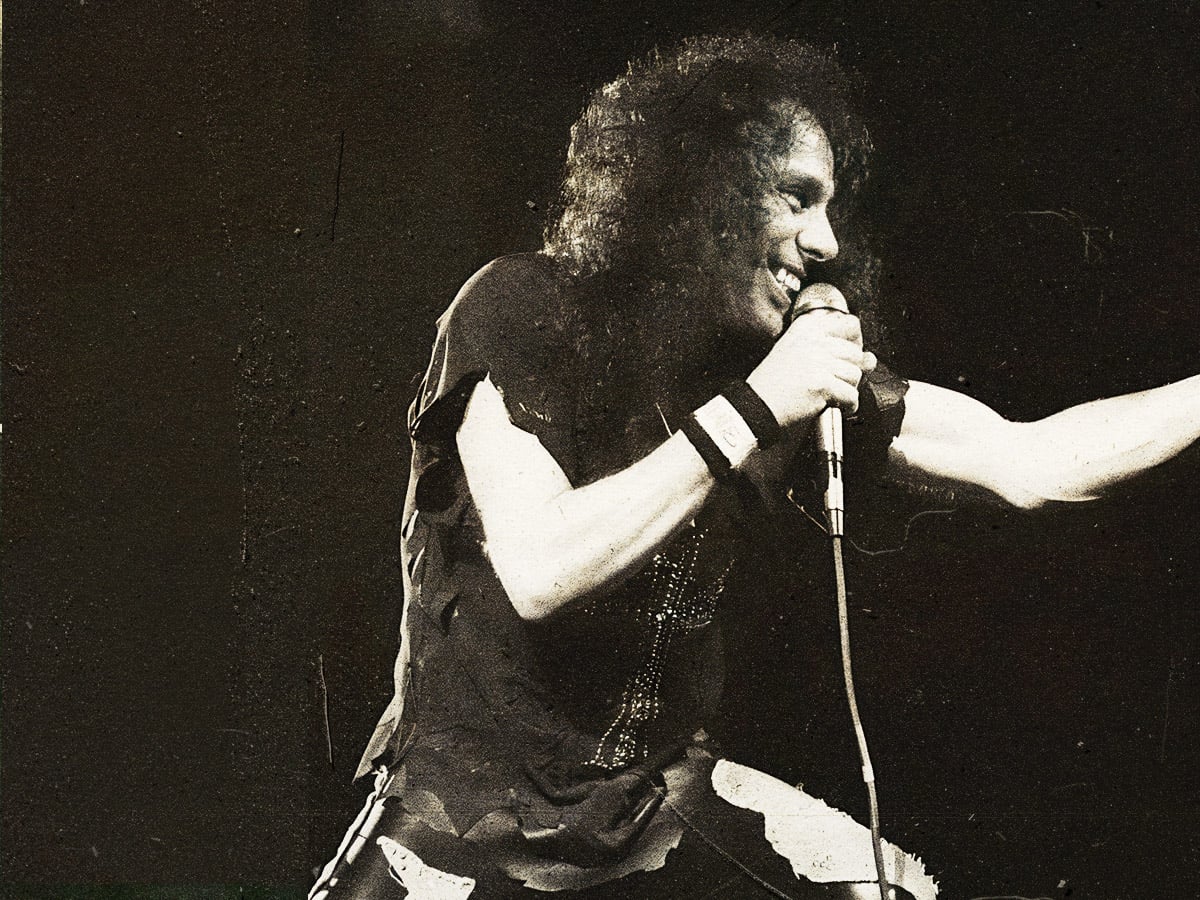
(Credits: Far Out / Alamy)
Wed 10 December 2025 20:00, UK
There’s a reason why Ronnie James Dio became one of the biggest names in the rock world.
And it’s not necessarily because he looked the part…because he certainly didn’t. At least, not really. Mainly, it was Dio’s talent that spoke for itself, especially his voice, which embodied the kind of sharp, definitive power that most look for in classic rock heroes. Dio’s ethos is also one that very few rock figures have nowadays, focusing on the constant drive forward as a main principle of progression.
In fact, Dio has previously explained how most of the people he enjoys working with are people who hold this belief. In the studio, or any aspect of the creative process, for that matter, if collaborators aren’t willing to share his values about chasing progress, then there’s usually no use in working with them at all. This is also what made him best suited to head up Black Sabbath, with few others actually equipped to do the job.
Most people, including those in the Sabbath circle, were pretty sceptical about any newcomer stepping into shoes as big as Ozzy Osbourne’s. However, Dio was a strong contender from the beginning, a force designed to mould and shapeshift to meet any challenge that came in his way. As Tony Iommi recalled, Dio was the perfect switch-up that the band needed, coming in with a completely different approach and a new vision, and not just an Osbourne wannabe.
At the time, this was the decision that would make or break Sabbath. Everybody knew back then what a carbon copy of their notorious frontman would do to the band, but people were also reserved when it came to the right person to enter the spotlight, knowing that someone without the same amount of energy or ability to take risks would likely fall flat on their face. But Dio worked hard, channelling all the lessons and values he already came with at that moment in time.
A lot of Dio’s mindset came from his own influences, but it also came from knowing when good music came from people nurturing the right dynamics behind the scenes. For instance, you can tell that one of the reasons why he loves The Black Album is because of its sheer simplicity, not in the arrangements or melodies, but in being pure good music, effortlessly so, in precisely the ways that Dio enjoys.
While many of these lessons are ones he continues to carry, many are ones achieved through more difficult means – like when he worked with Ritchie Blackmore, who taught him a lot about how not to be, embodying the kinds of negative traits that made Dio actively look in the opposite direction. While Dio acknowledged that Blackmore gave him a lot of opportunities and helped his career in ways he’ll always feel indebted to, there were parts of his demeanour that he didn’t like, or even understand.
Recalling working with him, Dio later said, “I got to know Ritchie. He’s a very private person, and I understood that, so I stayed away. If you jump on top of someone like Ritchie, he doesn’t want to know about you. One day, [he] came into the dressing room and said to me, ‘You’re a great singer,’ and I said, ‘Thank you very much,’ and then we became friends.”
Later, however, Dio realised that while they might have been musically aligned, their attitudes were very different. “I felt he was a very cruel person,” he said. “Cruel to the fans, very cruel, and to people in general. [He was a] really bad person, but he’s a great musician, and I learned what works and what doesn’t work.”
Elsewhere, while recalling why he left Rainbow, Dio described Blackmore as “difficult”, saying, “I can only say that it was a wonderful time in my life. I learned so much. I saw the world for the very first time, all of the world in Rainbow. It just got more difficult, more, more difficult, because Ritchie is a very difficult person. He doesn’t care about people and I do. So it made difficult for me to be me,” per Rock and Roll Garage.
This is part of the reason why Dio excelled in his own space – because he knew what it meant to be a fan of something and appreciate those who allow your art to thrive. Without his audience, Dio wouldn’t have gotten anywhere, much less accrued a legacy of his own. And appreciating that meant that he was always fated to stand apart, even among those with equal amounts of talent and opposing views.
Related Topics