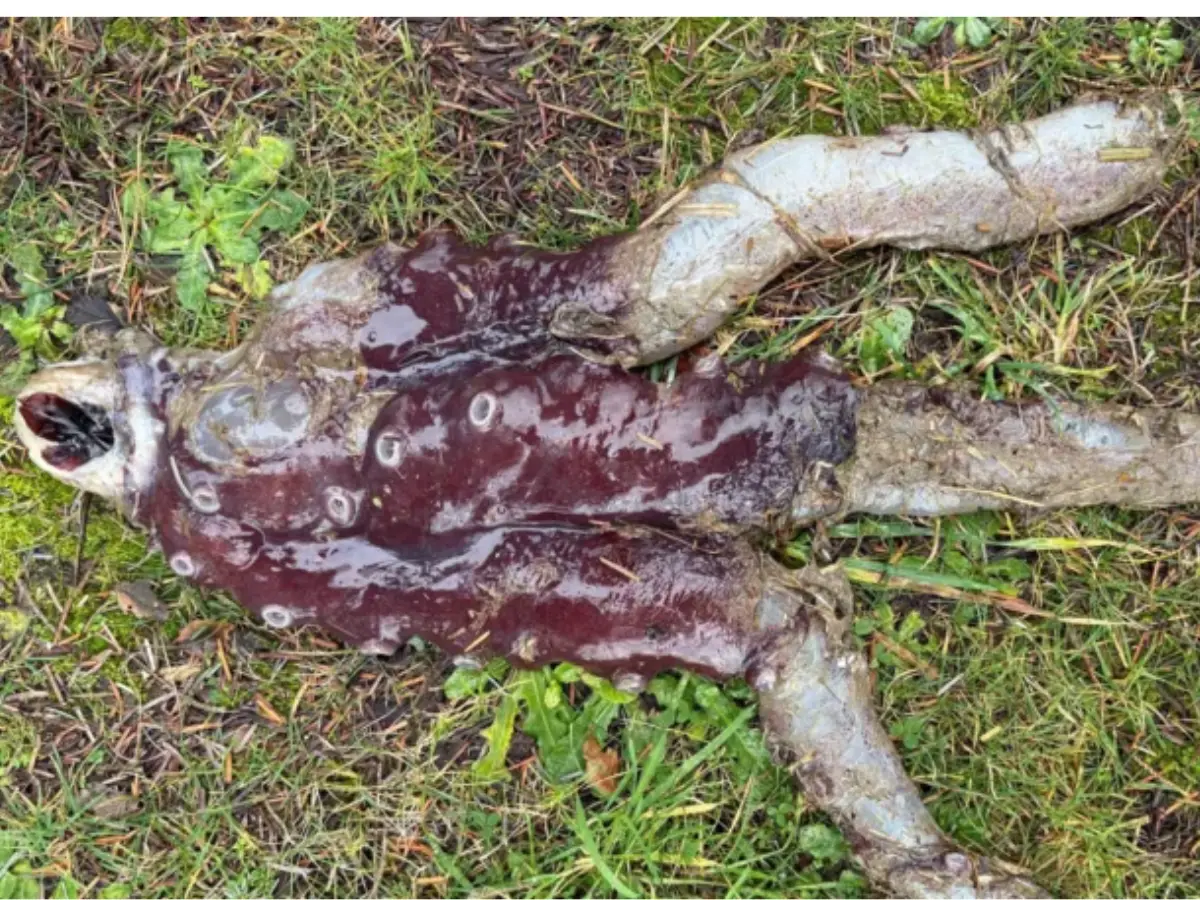
Beachgoers in Scotland were left shocked when they came across a rare seven-legged’ octopus on a local beach. The strange-looking creature is known as a septopus and was found broken up along the Ythan estuary in Aberdeenshire. The creature was washed ashore, revealing itself from the deep sea. It is huge, with its arms measuring around 20 inches. Researchers studied the animal and believe that it was a female. Dr Lauren Smith, a marine biologist at research organisation Saltwater Life, said it is unclear as to how this octopus reached the beach. However, it is still “an extraordinary find”. Beachgoers stumbled upon it on November 30, and its pictures started doing the rounds on social media. One of her friends sent her photos, which is how she learnt about the septopus.
She told The Daily Mail that it is likely that the octopus was attacked by whales, which left it in fragments, ultimately leading it to end up on the beach. It is also possible that it was caught by a trawl and thrown back. There is also a chance that the creature lost its way and was attacked later. Smith added that it is very rare to come across this species, and so now researchers at the labs are very excited.
Add WION as a Preferred Source
Octopus with seven legs found in Scotland
An early analysis revealed that the septopus does not belong to Scotland’s native coastal octopus species. Initially, researchers thought it was a giant squid. But the absence of “toothed” suckers suggested otherwise. The octopus, or septopus, is scientifically known as Haliphron atlanticus. It is commonly known as the giant gelatinous octopus or seven-arm octopus. This species is found at a depth of 1,600 feet or more. Its beak was found at a different place, and so were its three arms that washed ashore on December 4. This species is typically found in the Azores west of Portugal, Puget Sound in Washington State and Chatham Rise, New Zealand.