(Credits: Far Out / Paramount Pictures / Alamy)
Thu 11 December 2025 1:00, UK
Emerging during the instantaneous domination of punk rock in England, Elvis Costello was a secret walking encyclopedia of music, keeping his immense knowledge of music history close to his chest.
A young Costello was blessed with a wide-ranging musical education from a young age. His father, Ross, a professional trumpet player and singer, followed in his own father, Patrick’s, footsteps. Born with an ear for music, Costello’s parents raised him in a home with a constant soundtrack and, even after they divorced, their son’s music education never faltered. His father’s encouragement was to give his young son five or six of the day’s current pop hit records a week, amassing an enviable collection while he was still in primary school.
Before he was even known as “Elvis Costello”, he performed under his birth name, Declan MacManus, playing with fellow folk-rockers in the Liverpool music scene. His ambitions became too big for his home, and he relocated to London, adopting his father’s own alias, Costello, when approaching club bookers, because it was easier to spell and understand compared to MacManus. Soon, as his career took various turns, he found himself signed to a label and preparing for stardom – with one small catch.
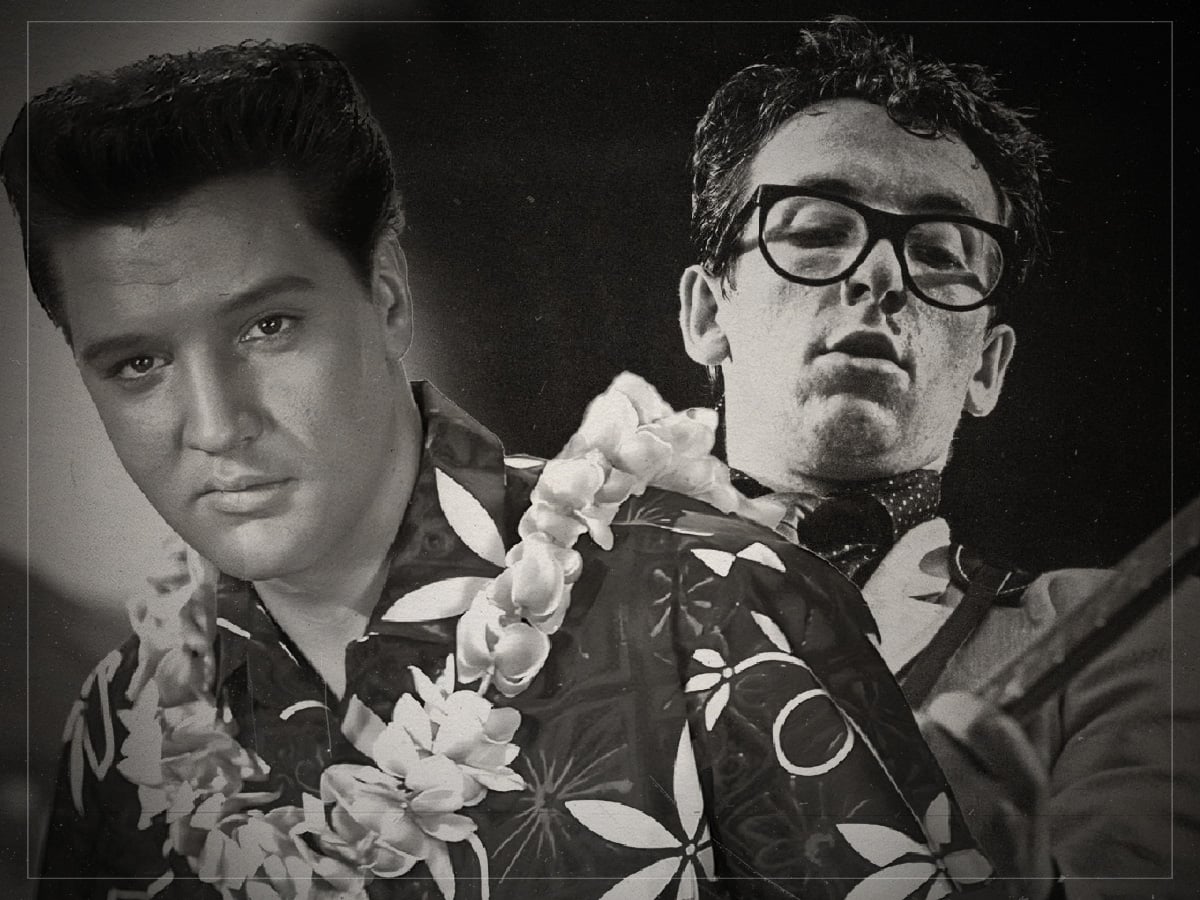
It would be safe to assume that Costello adopted Elvis Presley’s name out of sheer admiration, a devotion to the King and a way of channelling his musicality. But the reality was, it wasn’t Costello’s choice. When he signed to Stiff Records in 1976, its founders, Jake Riviera and Dave Robinson, became his managers and concocted a new image for him. They traded his rimless eyeglasses, intended to correct Costello’s astigmatism, for a pair of large black frames, placing him intentionally outside of the “pop star” mould.
His stage name would now be Elvis, chosen solely for its attention-grabbing value. Presley was still alive at the time, and Costello’s association with his name would surely gain him some traction. Costello claimed to be impartial to Presley’s music and did not think twice about his sudden name change; he’d seen his father, Ross, adopt a variety of monikers in his youth, and assumed it to be par for the course. At least he would be able to keep Costello.
Despite Costello’s indifference to his namesake, his admiration of Presley was inevitable and, on a list of his 500 favourite albums, Presley’s inclusion was a no-brainer. Costello’s picks, as he calls them, “can only improve your life,” and he allocates two for The King, beginning with his 1976 album, The Sun Sessions, particularly the track ‘Blue Moon of Kentucky’.
Presley’s rendition of the bluegrass tune was one of his earliest recordings for Sun Records, done at just 19 years old. It appears as a B-side to his debut single, ‘That’s All Right’, in 1954. Presley’s version of the song was more upbeat, a rockabilly twist that gave it a new life, one that became the most well-known iteration. Sun Records’ Sam Phillips later said to Rolling Stone, “I thought maybe there was a good possibility of getting run out of town, ‘cause hey, man, you didn’t mess with bluegrass. Bluegrass is kind of sacred, you know.”
Costello’s second Presley pick is RCA’s 1987 release, The Memphis Record, a compilation of songs recorded in 1969, as a follow-up to his legendary Comeback Special. Having recorded only in Nashville or Hollywood since his signing with RCA, these recordings were his return to Memphis for the first time since 1955. Costello names ‘Power of My Love’ as the key song from the collection, a highlight of the excitement that Presley felt at being back in the studio, after all those years.
Costello’s choices reflect the spectrum of Presley’s career, from his wide-eyed beginnings in Memphis to his trip back home, honouring his roots.
Related Topics