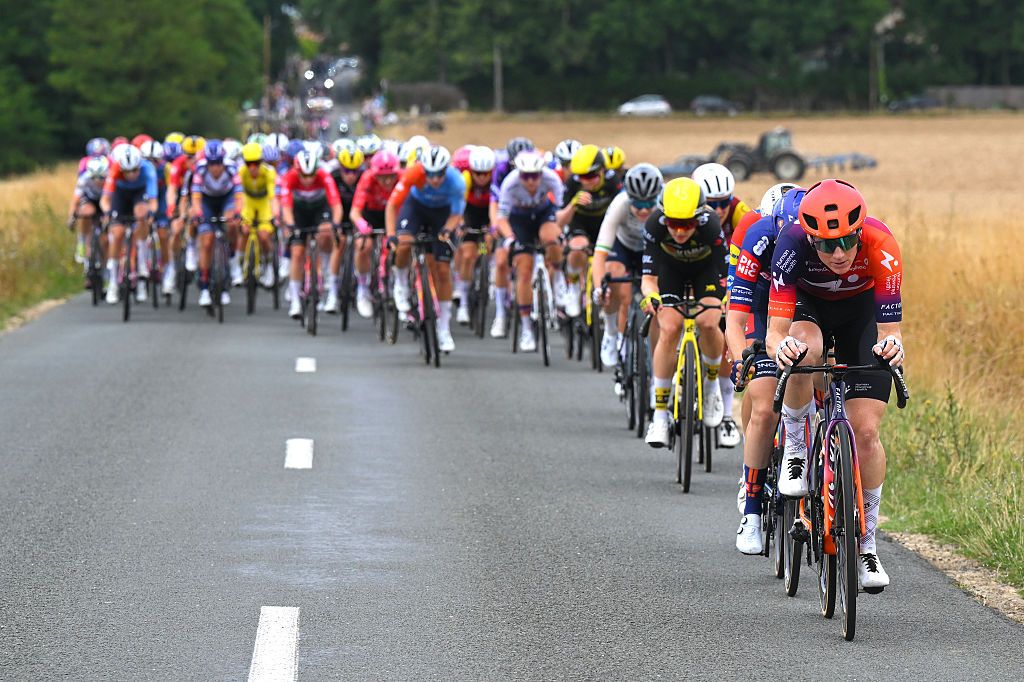
2025 marked the 10th year of the Women’s WorldTour, first introduced in 2016 as a cohesive, elite-level calendar division, with WorldTour team status introduced in 2020.
When the WorldTour team system was launched – bringing in things like a minimum wage, proper insurance, and maternity rights – the UCI announced their intention to expand the licences to 15 teams in the first three years, to ensure a good portion of the peloton were operating at a professional level, and raise the standard of the sport.
You may like
That was until this autumn, with the revelation that – even with the introduction of ProTeams and a healthy promotion and relegation system – the Women’s WorldTour is going to shrink back down to 14 squads, because not enough teams made the cut.
This is the same number of teams we had in 2022, before the first Tour de France Femmes had taken place, a time when – we’re led to believe – women’s cycling was much different, whereas the last three years have ostensibly accelerated the sport to new heights.
But if that’s true, why is the WorldTour taking a backwards step in 2026? Is one fewer team in the WorldTour something to worry about, or just a minor thing? Well, while it might only be one team, and it’s certainly not catastrophic – especially as ProTeams mean we actually have more teams at a professional level – it is something significant and symbolic of some of the concerns rippling under the surface of women’s sport.
The issue facing the Women’s WorldTour
In case you weren’t aware, 2025 marked the end of the current promotion and relegation system for both the men’s and women’s peloton, meaning the licences were going to be renewed and only teams ranked in the top 15 (on the women’s side) would be eligible for a WorldTour license, alongside all the other financial and ethical criteria they have to meet.
On the women’s side, this meant that the bottom ranked WWT team, Roland Le Dévoluy, was going to be relegated, and EF Education-Oatly were going to be promoted. Which is exactly what happened, and that equals 15.
However, the closure of Ceratizit (who actually ended up outside the top 15 anyway too) meant that there were going to be two licences up for grabs. Sixteen teams applied for the 15 licences, so at first look, you’d think all the spots would be filled. But no.
You may like
Reason being that the top 15 rule meant that only one team was actually eligible for the final licence, and that was Laboral Kutxa-Fundación Euskadi, but they didn’t. Cofidis Women and Roland applied instead, but, ranked 19th and 18th respectively, didn’t get in, with Cofidis confirmed as a ProTeam, whilst Roland have mysteriously disappeared.
Having that top 15 rule is no bad thing, and helps keep the integrity and quality of the WorldTour as high as it should be, but the concern emerges when you have to ask yourself, whilst wouldn’t a top-15 ranked team want to be in the WorldTour?

Rankings-wise, Laboral Kutxa-Fundación Euskadi did enough to join the WorldTour, but chose not to apply (Image credit: Getty Images)
In the case of Laboral Kutxa-Fundacion Euskadi, it was particularly surprising to see that they did not pursue a WorldTour license, as they have been saying for several seasons that that was their goal, as they tried to secure a budget of €2 million, which they have done.
The reason for not applying, then? €2 million just isn’t enough to run a WorldTour team anymore, the team told Cyclingnews. Considering top teams use to run on a budget of €400,000 when the WorldTour calendar was introduced, this increase in costs is rapid, and whilst some things are keeping up – the calendar is very healthy, for example – perhaps the financial backing for teams is not.
The 16th-ranked team, VolkerWessels, didn’t want to apply either, despite outperforming WWT teams like Ceratizit and Roland with much smaller budgets, because they manage to do that whilst not having the funding to afford to be WorldTour.
The financial criteria mean that you can no longer just buy your way into a WorldTour license, which is good, but also means the best teams aren’t part of the best tier, which is maybe not so good.
What it means for the health of the women’s sport
In 2026, the financial burden on Women’s WorldTour teams is only going to get bigger, with teams now only allowed to miss one WorldTour event all season, and minimum wages going up again. This is good, of course, for the professionalism of the sport, but if the best-performing teams can’t afford to be registered at the top-level, is there a disconnect between the ideal scenario and reality? The WorldTour should be aspirational, but it should also be achievable for 15 teams, and clearly, right now, it is not.
Women’s cycling is better than ever right now, with so many top-level races, so many truly elite athletes, and better pay for many riders at the top of the pyramid. But maybe the shop window part of the sport is speeding away from the realities of the bulk of the peloton.
On the men’s side, this just isn’t a problem. The top ProTeams are operating with WorldTour-level budgets anyway, with three applying to step up this year, and two making the cut, with zero questions or concerns about money.
So it may only be one team, but this issue raises questions about some of the concerns that have been brewing under the surface in women’s cycling this year. Are salaries and costs rising faster than sponsor funding? Is the whole sport actually as professional and healthy as races like the Tour de France Femmes would suggest it is? Is promotion and relegation even appropriate for a WorldTour that has only been in existence for five years?
There is an argument to be made that perhaps the UCI could have admitted Cofidis to the WorldTour, given they have the financial backing and set-up, just not the ranking. The top 15 rules is very limiting on the women’s side, where there are really only around 15 elite-level squads, not 24 or so fighting for 18 spots like on the men’s side.
My view
Matilda Price
Assistant Features Editor
My feeling is that this all shows that promotion/relegation was a bit too much, too soon and too inflexible for the Women’s WorldTour, which is still really in its nascency compared to the men’s side. I’d rather see 15 well-funded, motivated, professionally set-up teams than a step backward, and if that means giving a license to a team like Cofidis who scored a few less UCI points, is that such a bad thing?
All that said, however, this isn’t something the UCI are just ignoring, and they are trying to rectify it. The governing body announced on Thursday that they are setting up a process so that a 15th team can apply for a two-year licence at the end of 2026, to join the WorldTour for the remainder of the WorldTour cycle.
They haven’t laid out what the sporting criteria for this will be – would only a top-15 ranked team be eligible, or might they open the door to Cofidis? So it may not solve the problem if the eligible teams still don’t have the financial means, but it is something, and hopefully means the WorldTour will only be reduced for one year.
Whatever happens with the remaining license, this happening should be a reminder to all of us that women’s cycling is exactly where it needs to be just yet. The Women’s WorldTour and the introduction of ProTeams has been truly transformative for the sport, that much is clear, but growth is not entirely linear, and it can be fragile, too.